Financial services company Ameriprise Financial (NYSE: AMP) reported revenue ahead of Wall Street’s expectations in Q3 2026, with revenue rising 9.7% year on year to $5.19 billion. Its non-GAAP profit of $11.26 per share was 4.3% below analysts’ consensus estimates.
For more on Ameriprise Financial, read our free full research report.
Ameriprise Financial (AMP) Q3 2026 highlights:
- Revenue $5.19 billion vs S&P analysts’ consensus estimates of $5.06 billion (9.7% year-on-year growth, 2.7% beat)
- Pre-tax profit $1.43 billion (27.5% margin)
- Adjusted EPS $11.26 vs S&P analysts’ consensus estimates of $11.77 (4.3% miss)
- Market capitalization $43.27 billion
Revenue growth
A company’s long-term revenue performance can indicate its overall quality. Any business can post a good quarter or two, but many enduring ones grow for years. Over the last five years, Ameriprise Financial grew its revenue at a decent 8.3% compounded annual growth rate. Its growth was slightly above the average financials company and shows its offerings resonate with customers.
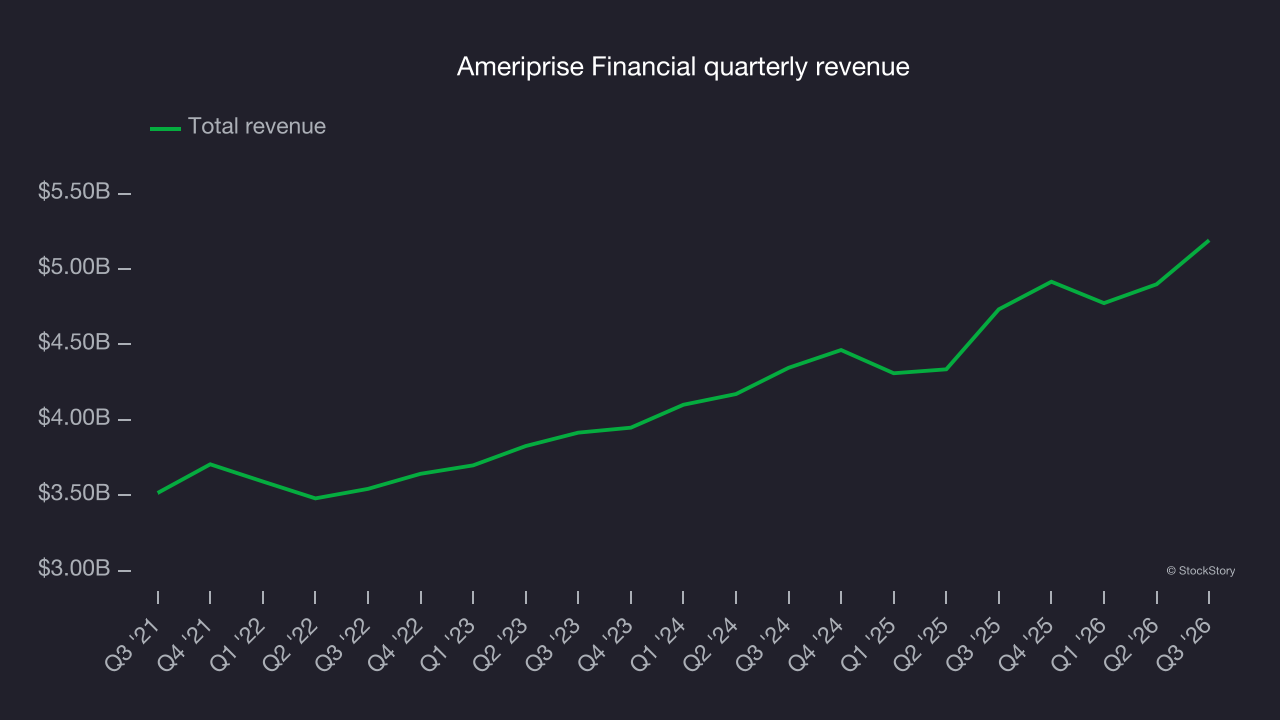
Long-term growth matters most, but within financials, a half-decade historical view may miss recent interest rate changes, market returns and industry trends. Ameriprise Financial’s annualized revenue growth of 9.3% over the last two years is above its five-year trend, suggesting some bright spots. 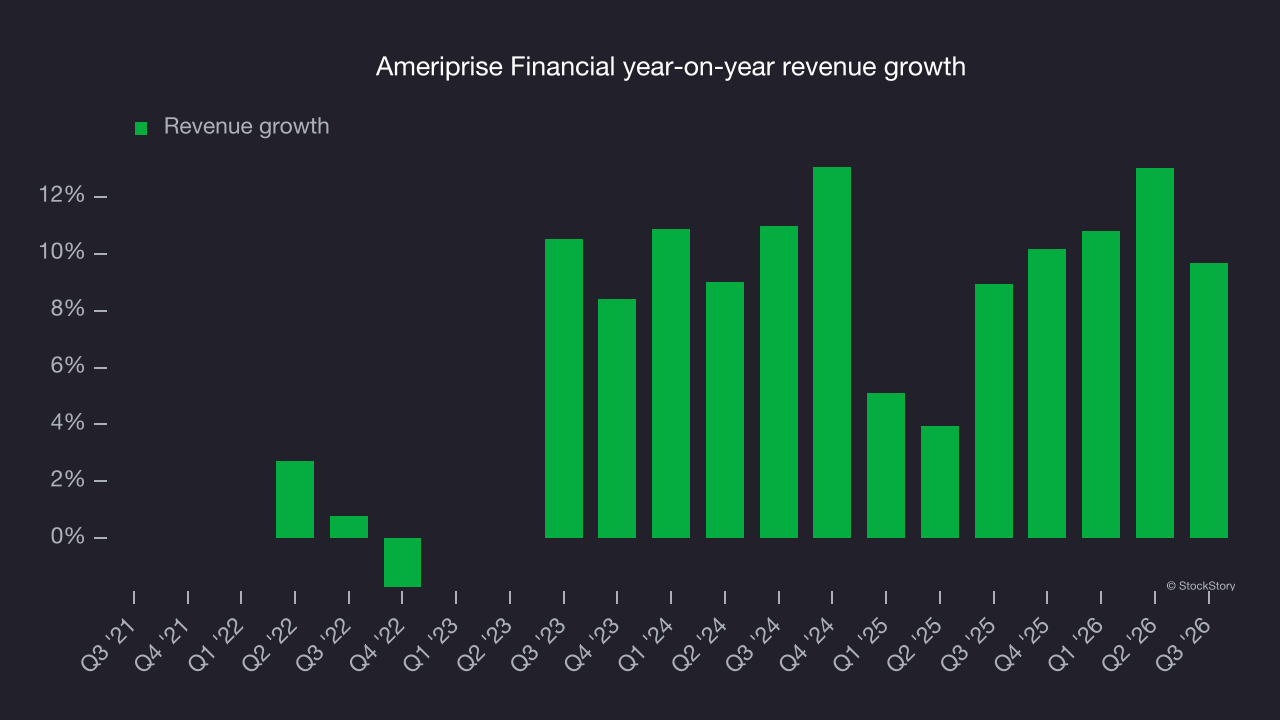 Note: Quarters not shown were determined to be outliers because they were impacted by outsized investment gains/losses that are not indicative of the recurring fundamentals of the business.
This quarter, Ameriprise Financial reported year-on-year revenue growth of 9.7%, and its $5.19 billion of revenue exceeded Wall Street’s consensus estimates by 2.7%.
Key takeaways from Ameriprise Financial’s Q3 results
Ameriprise Financial’s Q3 results were mixed: Revenue beat analysts’ consensus estimates, but EPS fell short. Shares remained flat at $489.15 immediately after the release.
For more on Ameriprise Financial at its current price, read the report below. The latest quarter matters when deciding whether to buy the stock, but not nearly as much as longer-term fundamentals and valuation. Read our full research report here (it’s free).