Building envelope solutions provider Carlisle Companies (NYSE: CSL) reported Q3 2026 results exceeding the market’s revenue expectations, with revenue up 8.6% year on year to $1.46 billion. Its non-GAAP profit of $5.92 per share was in line with analysts’ consensus estimates.
For more on Carlisle, read our full research report, available free.
Carlisle (CSL) Q3 2026 highlights:
- Revenue $1.46 billion vs S&P analysts’ consensus estimates of $1.43 billion (8.6% year-on-year growth, 2.7% beat)
- Adjusted EPS $5.92 vs S&P analysts’ consensus estimates of $5.90 (in line)
- Adjusted EBITDA $348.1 million vs analysts’ consensus estimates of $351.8 million (23.8% margin, 1.1% miss)
- Operating margin 20%, down from 21.8% in the same quarter last year
- Free cash flow margin 18.9%, down from 29.2% in the same quarter last year
- Organic revenue rose 8.8% year on year (beat)
- Market capitalization $13.81 billion
"For the fourth quarter, we expect high-single-digit revenue growth with flat adjusted EBITDA margin, as the benefits of our pricing actions continue to build. Our outlook does not assume a near-term recovery in new construction markets. With the strength of our imperative business model, resilient re-roofing demand, and our leadership position in North America, we remain committed to advancing Vision 2030 through organic growth, synergistic acquisitions, margin expansion, and increased free cash flow, and we remain confident in our path to $40 of adjusted EPS and 25%-plus ROIC."
Revenue growth
Examining a company’s long-term performance can provide clues about its quality. Any business can have short-term success, but a top-tier one grows for years. Over the last five years, Carlisle’s revenue grew at a sluggish 2.6% compounded annual growth rate, falling short of our standards.
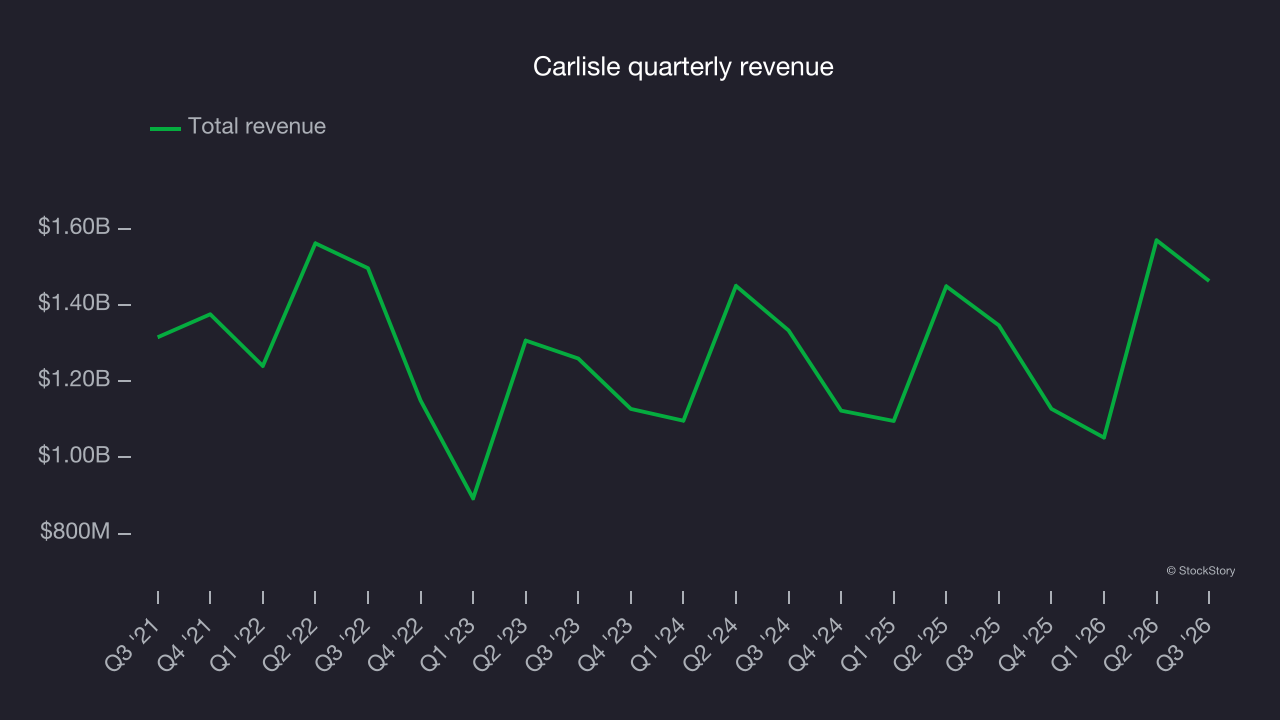
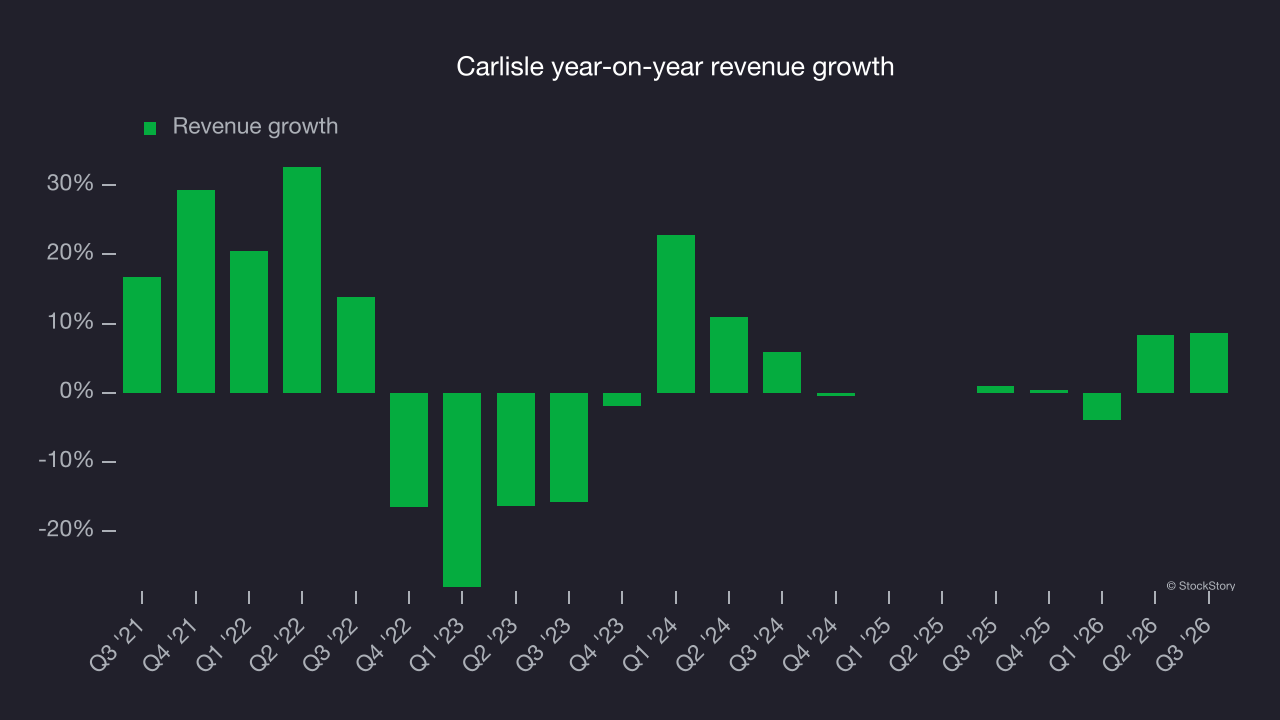
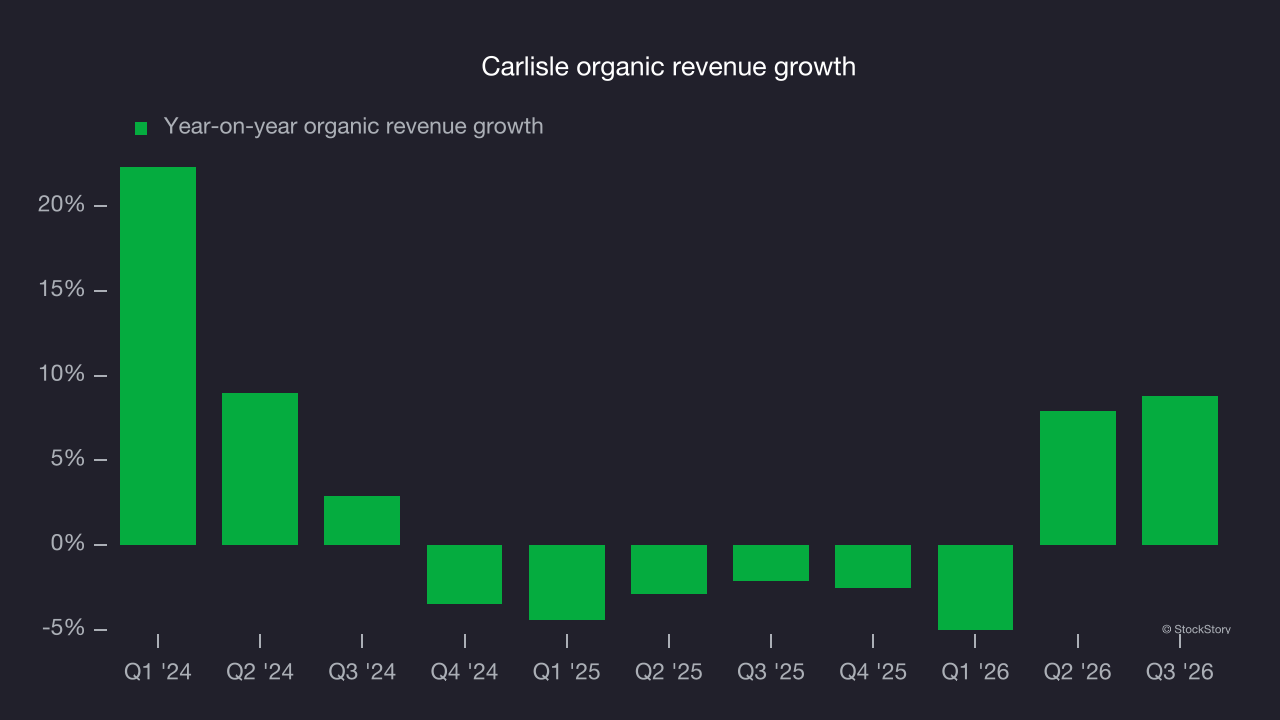
This quarter, Carlisle reported year-on-year revenue growth of 8.6%, and its $1.46 billion of revenue exceeded Wall Street’s consensus estimates by 2.7%.
Looking ahead, sell-side analysts expect revenue to grow 4.7% over the next 12 months, according to S&P. While this projection implies its newer products and services will spur better top-line performance, it is still below average for the sector.
Operating margin
Carlisle has performed well over the last five years. It demonstrated strong profitability for an industrials business, with an average operating margin of 21%. That outcome is unsurprising given its favorable gross margin baseline.
Looking at the trend in its profitability, Carlisle’s operating margin decreased by 1.4 percentage points over the last five years. This raises questions about the company’s expense base because its revenue growth should have given it leverage on its fixed costs, resulting in better economies of scale and profitability.
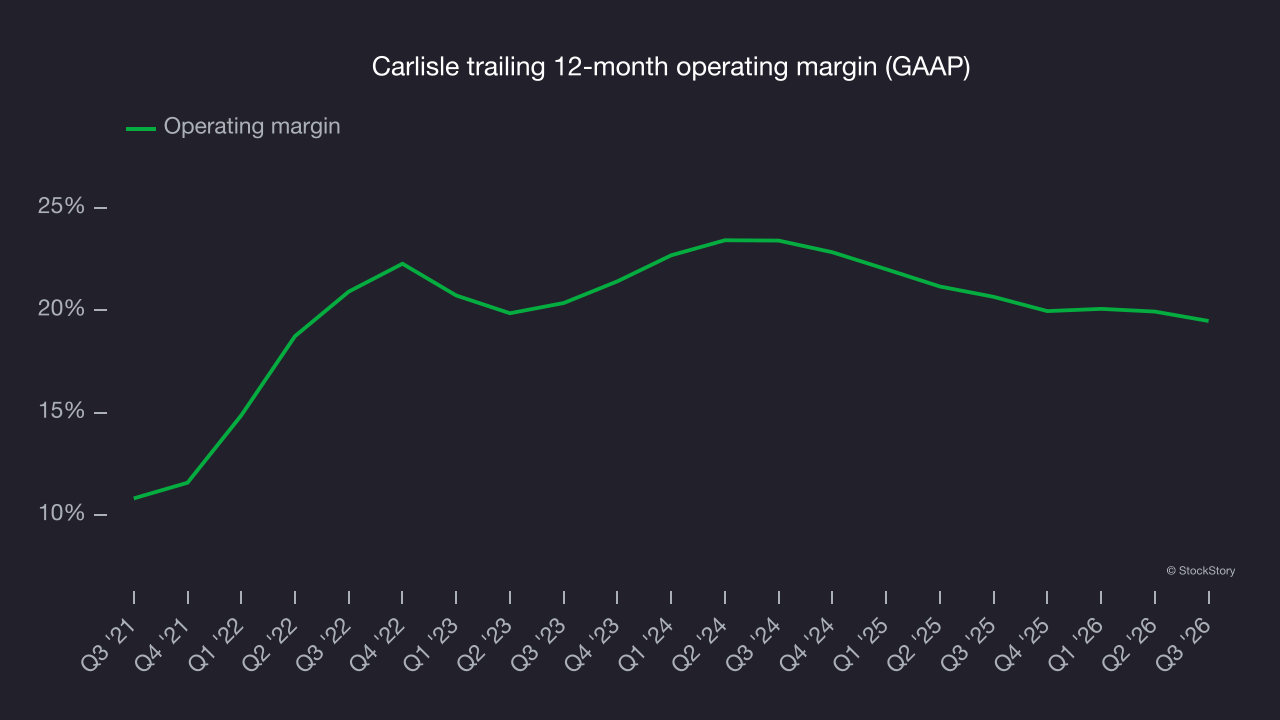
This quarter, Carlisle generated an operating margin of 20%, down 1.8 percentage points year on year. Its gross margin decreased more than its operating margin, suggesting its recent inefficiencies were driven more by weaker leverage on its cost of sales than by increased marketing, R&D and administrative overhead expenses.
Earnings per share
We track the long-term change in earnings per share (EPS) for the same reason as long-term revenue growth. Compared to revenue, however, EPS highlights whether a company’s growth is profitable.
Carlisle’s EPS grew at a 22.4% compounded annual growth rate over the last five years, higher than its 2.6% annualized revenue growth. This indicates the company became more profitable on a per-share basis as it expanded.
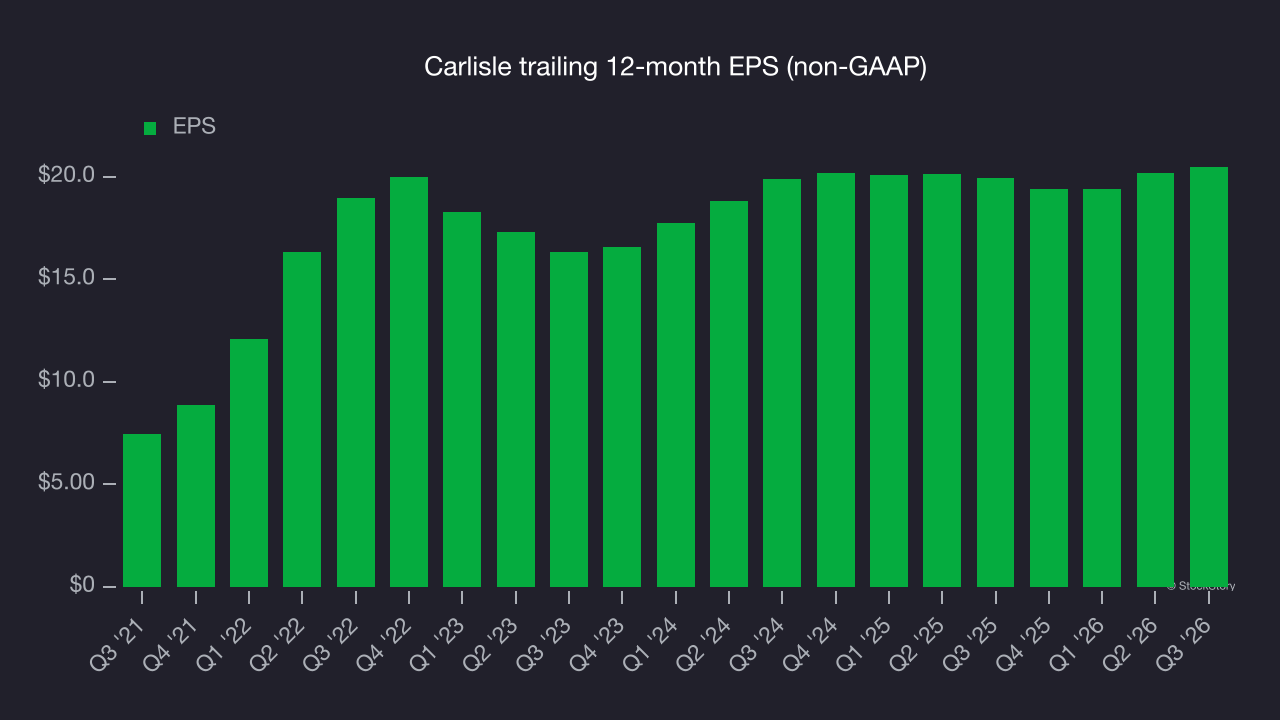
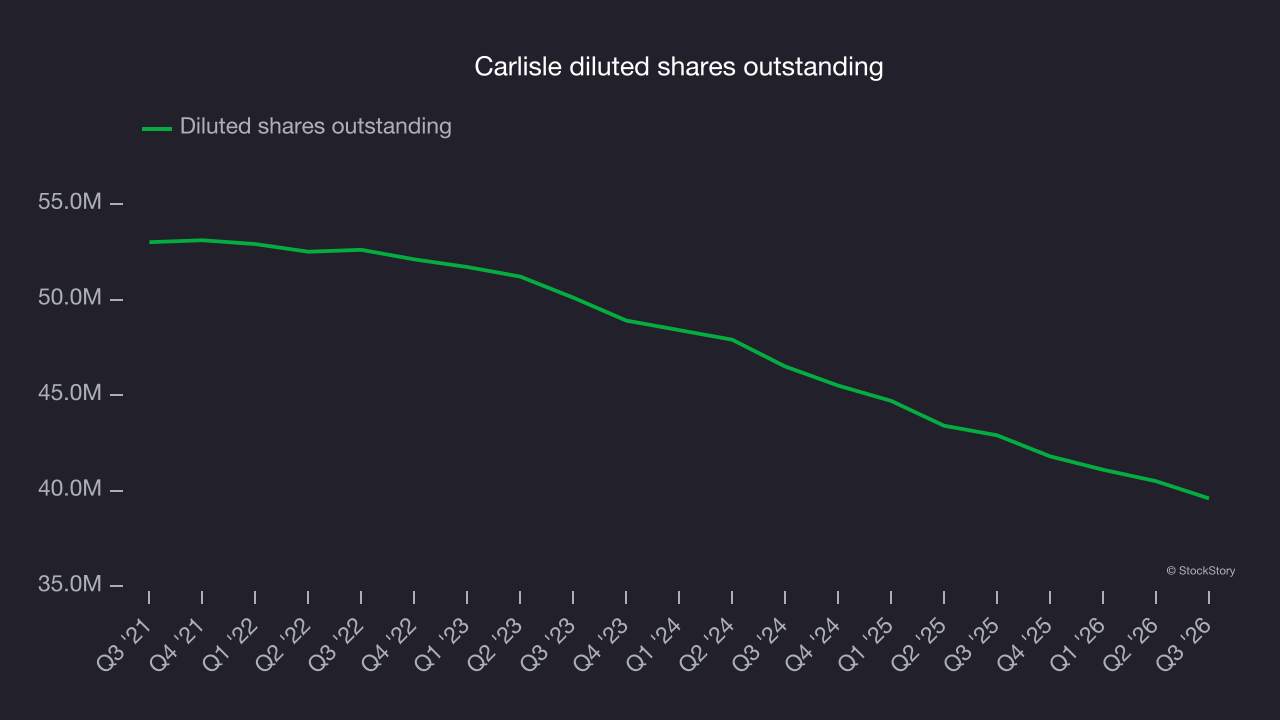
As with revenue, we analyze EPS over a more recent period because it can provide insight into an emerging theme or development for the business.
For Carlisle, its two-year annual EPS growth of 1.4% was lower than its five-year trend.
In Q3, Carlisle reported adjusted EPS of $5.92, up from $5.61 in the same quarter last year. This result was close to analysts’ consensus estimates. Over the next 12 months, Wall Street expects Carlisle’s full-year EPS to grow 14.8% from $20.48 to $23.50, according to S&P.
Key takeaways from Carlisle’s Q3 results
Revenue was a bright spot for Carlisle, with both total and organic revenue topping analysts’ consensus estimates. A slight EBITDA miss tempered the results, making for a mixed quarter. Investors were likely hoping for more, as shares fell 3.6% to $332.91 immediately after the results.
How does Carlisle look at the current price? When evaluating the stock, consider valuation, business quality and the latest earnings. For more on Carlisle, read the full research report here (it’s free).