Regional banking company National Bank Holdings (NYSE: NBHC) fell short of the market’s revenue expectations in Q3 2026, but revenue rose 19.8% year on year to $126.4 million. Its non-GAAP profit of $0.06 per share was 78.6% below analysts’ consensus estimates.
For more on National Bank Holdings, read our free full research report.
National Bank Holdings (NBHC) Q3 2026 highlights:
- Net interest income $112.9 million vs analysts’ consensus estimates of $116.2 million (28% year-on-year growth, 2.8% miss)
- Net interest margin 4% vs analysts’ consensus estimates of 4% (4.3 basis point beat)
- Revenue $126.4 million vs S&P analysts’ consensus estimates of $131.3 million (19.8% year-on-year growth, 3.7% miss)
- Efficiency ratio 76% vs analysts’ consensus estimates of 62.5% (1,344.7 basis point miss)
- Adjusted EPS $0.06 vs S&P analysts’ consensus estimates of $0.28 (78.6% miss)
- Tangible book value per share $25.37 vs analysts’ consensus estimates of $26.25 (6.3% year-on-year decline, 3.4% miss)
- Market capitalization $1.74 billion
In announcing these results, Chief Executive Officer Tim Laney shared, “This was a deeply disappointing quarter. We reported a net loss of $8.8 million, driven primarily by $40.6 million of provision expense tied to a handful of specifically identified commercial credits, mainly in the franchise and healthcare industries. We take these credit events seriously and have made a series of both personnel and process improvements in these specific coverage areas of our business. To that end, none of these actions were driven by our regulators, and we will be relentless in our focus to meet the highest standards of credit risk management.”
Revenue growth
Two primary revenue streams drive bank earnings. While net interest income, which is earned by charging higher rates on loans than paid on deposits, forms the foundation, fee-based services across banking, credit, wealth management and trading operations provide additional income. Over the last five years, National Bank Holdings grew its revenue at a mediocre 9.8% compounded annual growth rate, falling short of the banking sector standard.
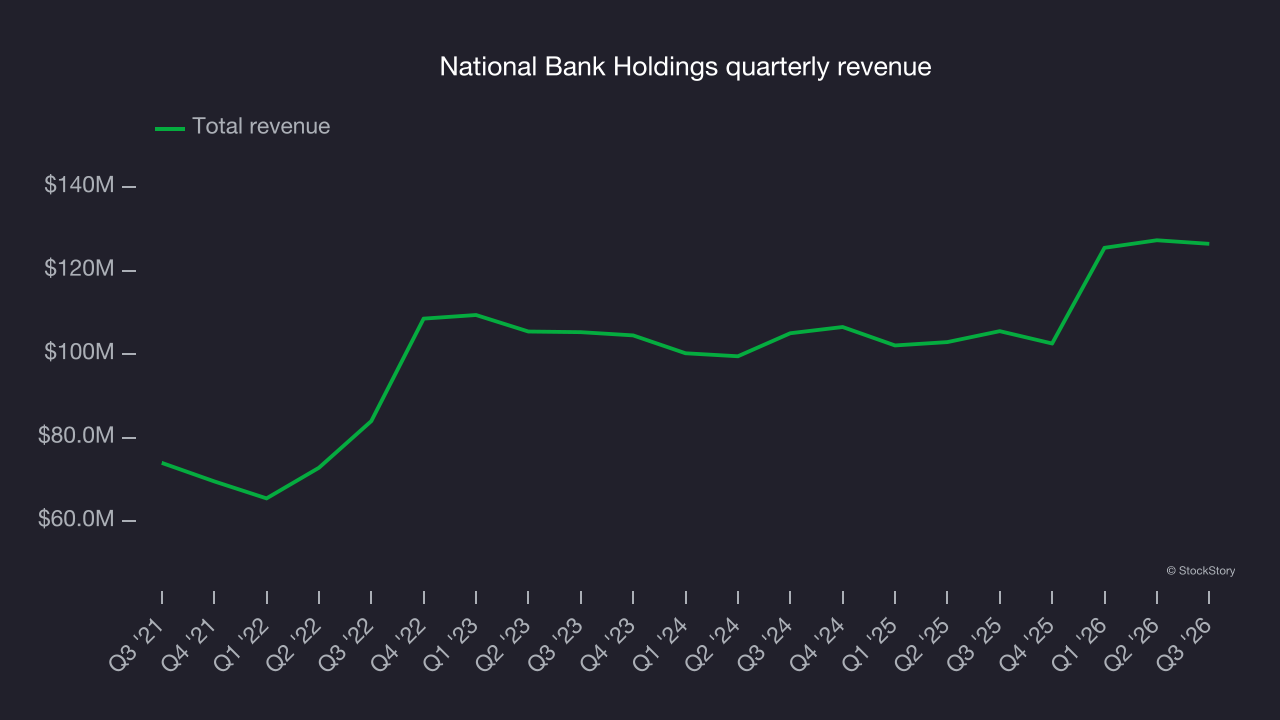
Long-term growth matters most, but within financials, a half-decade historical view may miss recent interest rate changes, market returns and industry trends. National Bank Holdings’s recent performance shows its demand has slowed as its annualized revenue growth of 8.5% over the last two years was below its five-year trend. Decelerating revenue growth in the sector warrants caution, as it could signal changing consumer tastes aided by low switching costs. 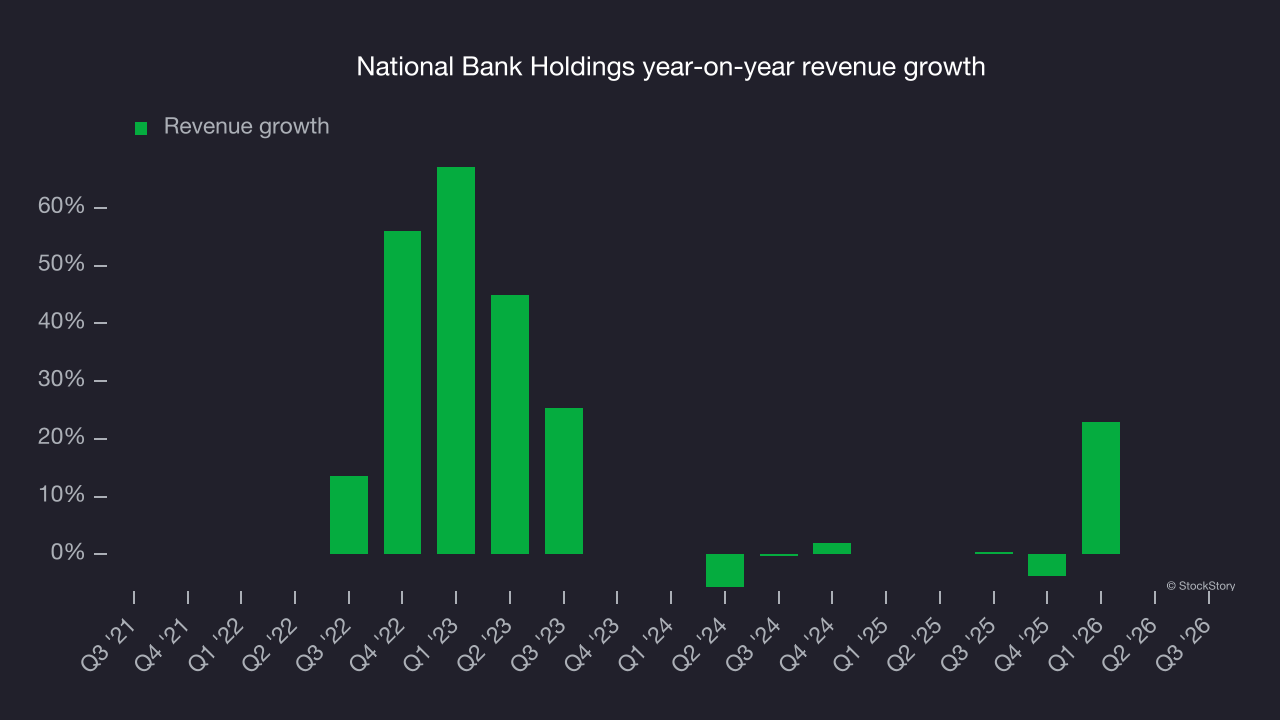 Note: Quarters not shown were determined to be outliers because they were impacted by outsized investment gains/losses that are not indicative of the recurring fundamentals of the business.
This quarter, National Bank Holdings’s revenue grew by 19.8% year on year to $126.4 million but fell short of Wall Street’s consensus estimates.
Net interest income made up 83.3% of the company’s total revenue during the last five years, meaning National Bank Holdings barely relies on non-interest income to drive its overall growth.
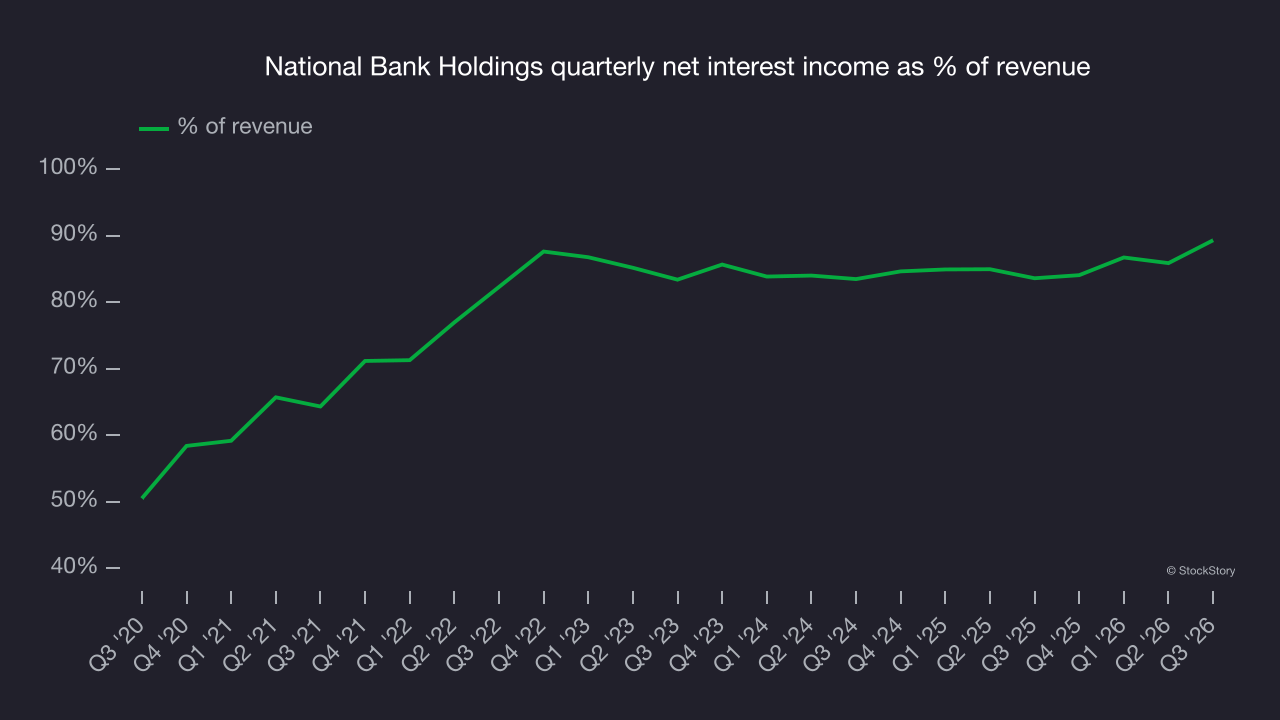
Markets consistently prioritize net interest income growth over fee-based revenue, recognizing its superior quality and recurring nature compared to the more unpredictable non-interest income streams.
Tangible book value per share (TBVPS)
Banks are balance sheet-driven businesses because they generate earnings primarily through borrowing and lending. They’re also valued based on their balance sheet strength and ability to compound book value (another name for shareholders’ equity) over time.
This makes tangible book value per share (TBVPS) the most important metric to track for banks. TBVPS represents the real, liquid net worth per share of a bank, excluding intangible assets that have debatable value upon liquidation. EPS can become murky due to acquisition impacts or accounting flexibility around loan provisions, and TBVPS resists manipulation through financial engineering.
National Bank Holdings’s TBVPS grew at a sluggish 1.1% annual rate over the last five years. The last two years show a similar trajectory as TBVPS grew by 1.6% annually from $24.57 to $25.37 per share.
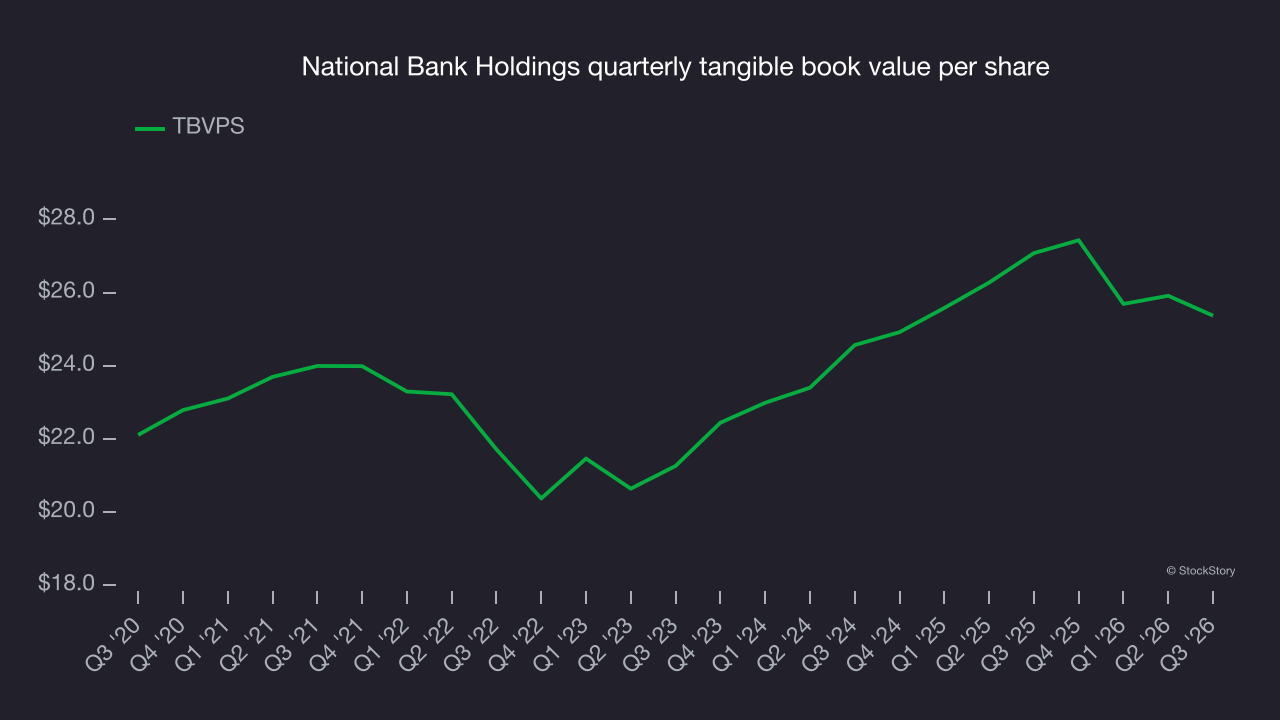
Over the next 12 months, consensus estimates call for National Bank Holdings’s TBVPS to grow by 16.2% to $29.47, a solid growth rate.
Key takeaways from National Bank Holdings’s Q3 results
National Bank Holdings delivered a disappointing quarter with few positives: Revenue and net interest income both fell short of Wall Street’s consensus estimates. Shares fell 2.5% to $38.02 immediately after the results.
National Bank Holdings had an underwhelming quarter, but assessing the stock at its current price requires a broader view. What happened in the latest quarter matters, but not as much as longer-term business quality and valuation, when deciding whether to invest in this stock. For more on National Bank Holdings, read our full research report here (it’s free).