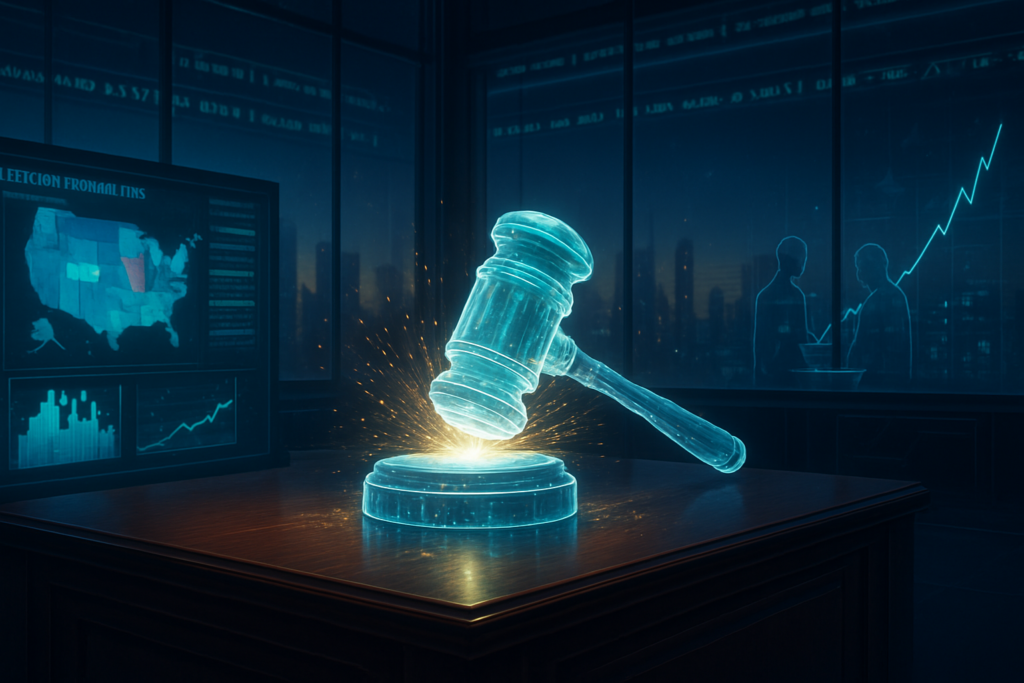
The era of "underground" political wagering officially ended not with a whimper, but with a gavel. As we move into the first quarter of 2026, the ripple effects of Kalshi’s landmark legal victory over the Commodity Futures Trading Commission (CFTC) have transformed the U.S. financial landscape. What began as a niche legal challenge in late 2024 has blossomed into a multi-billion-dollar industry, where trading on the 2026 Midterm elections has already eclipsed the total volume of several mid-cap equity sectors.
Currently, markets on Kalshi are pricing a 58% probability that the Republican Party retains control of the House in the upcoming November elections, a figure that has seen massive volatility following recent fiscal policy shifts. This high-velocity trading environment was unthinkable just eighteen months ago. Before October 2024, American prediction markets were largely stifled by regulatory red tape, forcing retail traders toward offshore platforms like Polymarket. Today, the "unfreezing" of the U.S. market has integrated political forecasting directly into the brokerage accounts of millions, fundamentally changing how the public consumes and hedges against political risk.
The Market: What's Being Predicted
The central market currently captivating traders is the "Congressional Control" suite of contracts. Unlike the speculative fervor of 2024, today’s markets on Kalshi and Interactive Brokers (NASDAQ: IBKR) are characterized by deep liquidity and institutional participation. On Kalshi alone, notional volume for 2025 exceeded $23 billion, a staggering jump from the platform's early days. The resolution criteria are razor-sharp: contracts payout based on the official certification of election results, providing a binary outcome that serves as a definitive "price" for political power.
The path to this liquidity was paved in October 2024 when Judge Jia Cobb of the U.S. District Court for the District of Columbia ruled that the CFTC had overstepped its authority by banning Kalshi’s election contracts. Judge Cobb famously clarified that speculating on elections did not constitute "gaming" under the Commodity Exchange Act. This ruling effectively categorized political forecasting as a legitimate form of economic hedging rather than illicit gambling. By May 2025, the CFTC, under new leadership, dropped its appeal, cementing the legality of these markets at the federal level.
This regulatory clarity has allowed for an explosion of secondary markets. Traders are no longer just betting on who wins; they are trading on the margin of victory, the timing of Supreme Court vacancies, and even the probability of specific legislative packages passing before the 2026 recess. The timeline for these markets has also stretched; while the 2024 election was a "sprint" following the court's October stay denial, the 2026 cycle is a "marathon," with markets opening nearly two years in advance.
Why Traders Are Betting
The primary driver of current market activity is the realization that prediction markets are often "faster" than traditional polling. During the 2024 election cycle, prediction markets famously signaled shifts in key battleground states hours—and sometimes days—before major networks or polling aggregates like 538 could catch up. This "price discovery" mechanism has turned traders into amateur analysts, utilizing high-frequency data to hedge their traditional portfolios.
Furthermore, the integration of event contracts into mainstream platforms like Robinhood (NASDAQ: HOOD) has democratized the asset class. Retail investors now use prediction markets to hedge against "policy shocks." For instance, a trader heavily invested in renewable energy stocks might buy "Democratic Senate Control" contracts as a hedge; if the party loses and subsidies are threatened, the payout from the prediction market offsets the loss in their equity portfolio. This "hedging utility" has moved the conversation away from moral objections toward financial pragmatism.
Recent whale activity has also underscored the institutionalization of the space. In late 2025, several prominent hedge funds were identified as taking massive positions in "Federal Reserve Rate Cut" and "Debt Ceiling Resolution" markets. These players aren't "gambling" in the traditional sense; they are using Kalshi as a transparent venue to offset macro risks that were previously difficult to price. The consensus among traders is that the market's collective intelligence, backed by real capital, provides a more accurate "truth" than the punditry seen on cable news.
Broader Context and Implications
Despite the federal green light, a new front has opened in the battle for prediction markets: the "Social Harm" doctrine. Leading the charge is New York with its Oversight and Regulation of Activity for Contracts Linked to Events (ORACLE) Act. Introduced in late 2025, the ORACLE Act represents a significant counter-offensive by state-level regulators who view certain markets—specifically those tied to "social harm"—as unethical.
The ORACLE Act seeks to ban New York residents from trading on outcomes involving mass shootings, natural disasters, or wars. Proponents of the bill argue that profiting from tragedy creates "perverse incentives" and degrades the moral fabric of the financial system. This has sparked a fierce debate over the limits of information markets. Should a trader be allowed to profit from a predicted famine in a conflict zone? While platforms argue that these markets provide vital data for NGOs and insurance companies to allocate resources, critics see them as a "death pool" for the digital age.
This tension highlights a growing divide between federal preemption and state sovereignty. While the 2024 Kalshi ruling protected election markets from the CFTC, it did not necessarily shield them from state-level consumer protection or gambling laws. As of January 2026, the industry is watching a critical case in Nevada, where Kalshi is fighting to prevent the state from classifying its contracts as "unlicensed gambling." The outcome of these state battles will determine whether the U.S. becomes a unified market or a fragmented "checkerboard" of varying restrictions.
What to Watch Next
The immediate focus for the industry is the Public Integrity in Financial Prediction Markets Act of 2026, introduced in Congress earlier this month. This bipartisan bill seeks to codify the legality of election markets at the federal level while simultaneously banning government officials and their immediate families from trading on them. If passed, it would provide the "gold standard" of legitimacy the industry craves, potentially overriding state-level bans like New York’s ORACLE Act through federal preemption.
On the judicial front, the Ninth Circuit Court of Appeals is expected to issue a ruling in February 2026 regarding Nevada's attempt to ban election betting. A victory for Kalshi there would likely stifle other states from pursuing similar bans, while a loss could embolden New York and California to move forward with their own restrictive legislation. Traders should also keep a close eye on the "Social Harm" markets; if a major platform launches a high-profile market on a controversial global conflict, it could provide the political ammunition necessary for the ORACLE Act to pass the New York Senate.
Finally, the 2026 Midterm cycle will be the first "full-cycle" test of these markets. We will see if the liquidity remains stable during the summer doldrums or if it requires the "high-stakes" atmosphere of a presidential year to thrive. Watch for Robinhood (NASDAQ: HOOD) to expand its offerings, potentially including "Local Election" contracts, which would further test the limits of state-level oversight.
Bottom Line
The October 2024 Kalshi victory was the "Big Bang" for American prediction markets, proving that the demand for real-time, capital-backed forecasting is insatiable. We have moved past the question of whether these markets should exist and into the much more complex territory of how they should be governed. The transition from a "gaming" prohibited by the CFTC to a "derivative" traded on major exchanges is nearly complete.
However, the "Social Harm" debate suggests that the industry’s greatest challenge is no longer legal, but reputational. While election markets have gained a measure of respectability as "civic sensors," markets tied to tragedy remain a lightning rod for controversy. The success of the ORACLE Act in New York will serve as a bellwether for whether the public is ready to accept the cold, hard logic of prediction markets when the subject matter turns grim.
As we look toward the 2026 Midterms, one thing is certain: the "wisdom of the crowd" has been weaponized. For the first time in history, the most accurate pulse of the American electorate isn't found in a pollster’s spreadsheet, but on a trading floor. Whether this makes for a more informed democracy or a more volatile one remains the most important prediction of all.
This article is for informational purposes only and does not constitute financial or betting advice. Prediction market participation may be subject to legal restrictions in your jurisdiction.
PredictStreet focuses on covering the latest developments in prediction markets. Visit the PredictStreet website at https://www.predictstreet.ai/.