Date: December 26, 2025
Introduction
As the final week of 2025 unfolds, Walmart Inc. (Nasdaq: WMT) stands at a historic crossroads. Long considered the quintessential defensive play in the retail sector, the Bentonville, Arkansas-based giant has spent the last year shattering old perceptions. With its recent high-profile transition from the New York Stock Exchange to the Nasdaq on December 9, 2025, Walmart has signaled to the world that it no longer views itself as a mere brick-and-mortar chain, but as a "tech-powered omnichannel ecosystem." In a year defined by high interest rates and shifting consumer habits, Walmart has not only survived but thrived, capturing market share across all income brackets and successfully diversifying its profit streams into high-margin advertising and automated logistics.
Historical Background
Walmart’s journey began in 1962 when Sam Walton opened the first "Wal-Mart Discount City" in Rogers, Arkansas. Walton’s revolutionary strategy was simple yet disruptive: operate in small rural towns that competitors ignored, maintain a lean cost structure, and pass every cent of savings to the consumer—a philosophy known as "Everyday Low Price" (EDLP).
By the 1970s, the company went public, and by the 1990s, it had become the largest retailer in the world. Key milestones include the 1983 launch of Sam’s Club and the 1991 international expansion into Mexico. Over the last decade, however, the narrative shifted from physical expansion to digital survival. Under the leadership of Doug McMillon, the company underwent a massive transformation, acquiring Jet.com in 2016 and India’s Flipkart in 2018, effectively pivoting the organization toward a future where "the store" is just one component of a larger digital and physical infrastructure.
Business Model
Walmart operates a massive, three-pronged business model designed to leverage scale and data.
- Walmart US: The crown jewel, contributing nearly 70% of total sales. It dominates the U.S. grocery market, which serves as the primary driver of foot traffic and digital orders.
- Walmart International: This segment focuses on high-growth emerging markets. While the company has divested from some slower markets (like the UK and Japan), it has doubled down on India (Flipkart/PhonePe) and Mexico (Walmex), targeting the growing middle class in these regions.
- Sam’s Club: A membership-only warehouse model that contributes roughly 13% of revenue. It serves as an incubator for technology, such as "Scan & Go" and AI-driven inventory management.
The genius of the modern Walmart model is the "flywheel." Low-cost groceries attract customers; those customers join Walmart+ (membership); the resulting data fuels Walmart Connect (advertising); and the massive volume allows Walmart to build an automated supply chain that competitors cannot replicate.
Stock Performance Overview
The performance of WMT shares over the past two years has been nothing short of exceptional. Following a historic 3-for-1 stock split in February 2024, the stock became a favorite among retail investors.
- 1-Year Performance: In 2025, WMT shares surged 23%, fueled by consistent earnings beats and the successful integration of its media and tech acquisitions.
- 5-Year Performance: The stock has more than doubled in value, significantly outperforming the broader S&P 500. This period represents the market's re-rating of Walmart from a value stock to a growth/tech hybrid.
- 10-Year Performance: Investors have enjoyed a compounding effect of roughly 12-14% annually (including dividends), a testament to the company’s ability to reinvent itself while maintaining its dividend aristocrat status.
Financial Performance
In the fiscal year ending 2025, Walmart reported staggering total revenue of approximately $681 billion, a 5.1% year-over-year increase. More importantly, operating income grew at 8.6%, significantly faster than sales—a clear indicator that the shift toward high-margin services is working.
- Margins: Gross margins have stabilized at 24.8%, despite inflationary pressures.
- Debt & Cash Flow: The company maintains a healthy debt-to-equity ratio of 0.67 and continues to generate robust free cash flow, allowing for the completion of the $2.3 billion Vizio acquisition without straining the balance sheet.
- Valuation: Currently trading at a trailing P/E of approximately 39x, Walmart is no longer "cheap" by traditional retail standards, but many analysts argue the premium is justified by its dominant tech stack and advertising growth.
Leadership and Management
CEO Doug McMillon, a Walmart veteran who started in a distribution center, has been the architect of the company’s modern era. His "People-Led, Tech-Powered" strategy has been widely praised for balancing the needs of 2.1 million global employees with the demands of a digital-first economy.
The management team has been restructured to emphasize technology, with Chief Technology Officers and Chief Data Officers playing central roles in capital allocation decisions. The board’s recent decision to move to the Nasdaq reflects a governance-level commitment to aligning with the world's leading technology companies.
Products, Services, and Innovations
Innovation is no longer a buzzword at Walmart; it is a core operational reality.
- Automated Fulfillment: By late 2025, 60% of Walmart’s distribution centers have been automated, drastically reducing the cost of last-mile delivery and improving inventory accuracy.
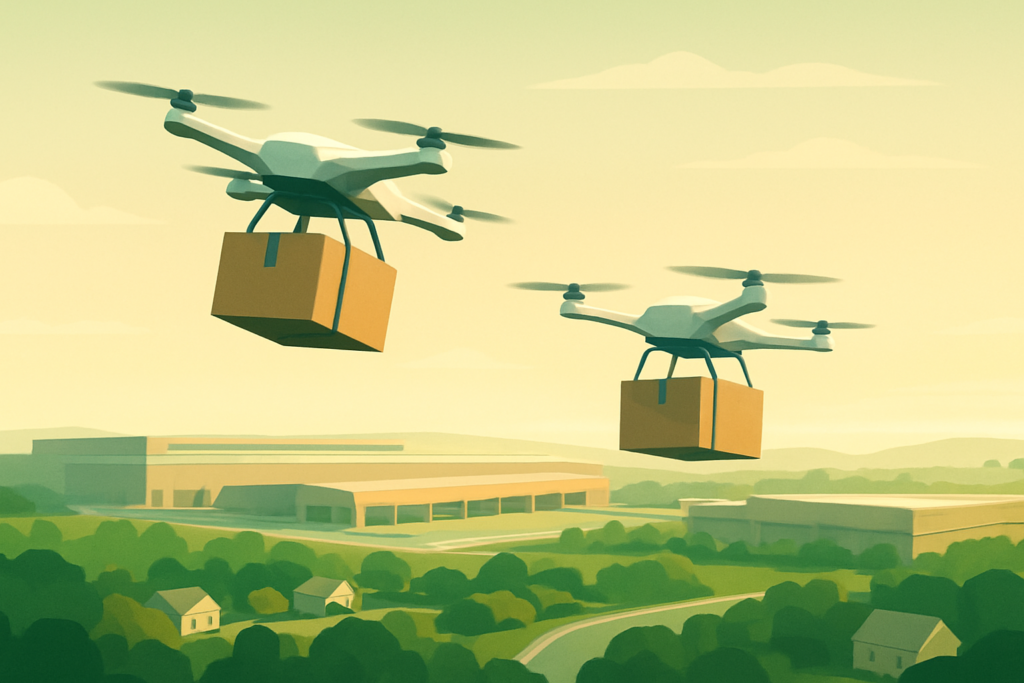
- Drone Delivery: Walmart now operates the largest drone delivery network in the U.S., covering several major metropolitan areas and delivering items in under 30 minutes.
- Generative AI: The "Search by Intent" feature in the Walmart app uses GenAI to help customers shop for life events (e.g., "organize a gluten-free backyard BBQ") rather than just searching for individual items.
- Walmart Connect: This advertising arm has seen 50% YoY growth, leveraging customer data to provide brands with highly targeted ad placements both online and on-store screens.
Competitive Landscape
Walmart remains in a fierce battle with Amazon.com, Inc. (Nasdaq: AMZN). While Amazon leads in general e-commerce, Walmart maintains a significant lead in online groceries (roughly 37% market share). Its "store-as-a-hub" model, which places 90% of the U.S. population within 10 miles of a Walmart, gives it a logistics advantage that Amazon’s warehouse-centric model struggles to match in the fresh food category.
Against Target Corporation (NYSE: TGT) and Costco Wholesale Corporation (Nasdaq: COST), Walmart has gained significant ground in 2025. Its price leadership has attracted affluent households—75% of Walmart’s recent market share gains came from households earning over $100,000 annually—who are "trading down" to manage their budgets.
Industry and Market Trends
The retail industry in late 2025 is dominated by the "China Plus One" strategy. To mitigate geopolitical risks and potential tariffs, Walmart has diversified its supply chain, tripling its exports from India and increasing sourcing from Vietnam. Furthermore, the rise of "retail media" (advertising within retail ecosystems) has become the primary driver of margin expansion across the sector, a trend Walmart is currently leading.
Risks and Challenges
Despite its dominance, Walmart faces several headwinds:
- Regulatory Scrutiny: The FTC remains watchful of Walmart’s dominance in the retail media space, particularly following the Vizio acquisition.
- Labor Costs: Persistent pressure to raise wages remains. In 2025, starting salaries for specialized roles like truck drivers have climbed to $115,000 to combat labor shortages.
- Geopolitical Tariffs: As a massive importer, Walmart is highly sensitive to trade tensions between the U.S. and China, which can squeeze margins or force price hikes.
Opportunities and Catalysts
- Vizio Integration: The full integration of Vizio’s SmartCast OS in 2025 allows Walmart to turn "the living room into a storefront," offering shoppable ads directly through television sets.
- India IPOs: Potential public listings for Flipkart and PhonePe in the near future could unlock significant shareholder value.
- Nasdaq-100 Inclusion: Following its move to the Nasdaq, the stock is expected to see massive passive inflows as it is added to major tech-heavy indices.
Investor Sentiment and Analyst Coverage
Wall Street is overwhelmingly bullish on WMT. Currently, over 80% of covering analysts maintain a "Buy" or "Strong Buy" rating. The consensus view is that Walmart has successfully transitioned from a cyclical retailer to a secular growth story. Institutional ownership remains high, and the stock is increasingly viewed as a "safe haven" during periods of market volatility due to its essential goods dominance.
Regulatory, Policy, and Geopolitical Factors
Walmart's scale makes it a de facto arm of U.S. economic policy. It is a key player in discussions regarding the national minimum wage and trade policy. The company’s move toward sustainability—aiming for zero emissions by 2040—has also made it a favorite for ESG-focused institutional investors, though it continues to face criticism from labor groups regarding worker benefits and unionization.
Conclusion
Walmart Inc. has entered 2025 not just as a survivor of the retail apocalypse, but as its victor. By merging the physical reach of its 10,000+ global stores with a cutting-edge digital and advertising infrastructure, the company has created a moat that is wider than ever. For investors, WMT represents a unique blend of stability and high-tech growth. While the valuation is higher than in decades past, the company’s pivot to high-margin revenue streams suggests that the "new" Walmart is just getting started. As we look toward 2026, the key for investors will be monitoring the execution of its automated supply chain and the continued growth of Walmart Connect.
This content is intended for informational purposes only and is not financial advice.