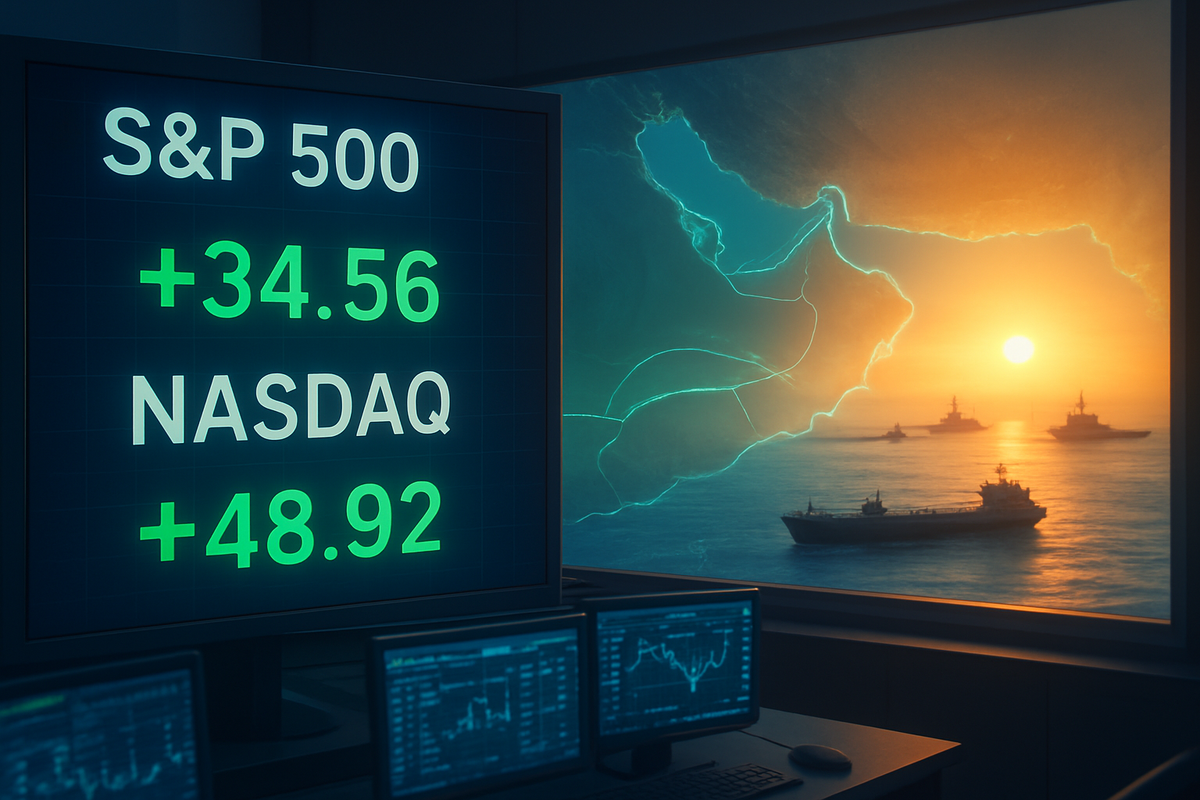
In a dramatic shift that has sent shockwaves through global financial centers, the United States and Iran have entered a fragile two-week ceasefire, effective immediately. The truce, brokered through intense back-channel diplomacy by Pakistan, aims to de-escalate a 40-day conflict that had brought the world’s energy markets to the brink of collapse. The immediate implication for Wall Street was a stunning "red-to-green" reversal during Thursday’s trading session, as investors pivoted from fears of a protracted war to a cautious optimism regarding the reopening of global trade routes.
The announcement, delivered late by President Donald Trump, centered on the strategic reopening of the Strait of Hormuz— a move that has already begun to deflate the "war premium" on crude oil. While the S&P 500 and Nasdaq Composite began the April 9, 2026, session in negative territory due to skepticism over the deal's longevity, a midday wave of buying pressure saw major indices reclaim lost ground. This surge signals a significant "re-risking" phase as the threat of "Operation Epic Fury" is temporarily shelved in favor of formal negotiations in Islamabad.
The Path to Peace: A Forty-Day Conflict Pauses in Islamabad
The ceasefire comes after nearly six weeks of escalating hostilities that saw energy prices skyrocket and maritime insurance rates reach prohibitive levels. The breakthrough was finalized following marathon sessions between Pakistani Prime Minister Shehbaz Sharif and U.S. officials. According to details released by the White House, the "double-sided ceasefire" hinges on the "COMPLETE, IMMEDIATE, and SAFE OPENING" of the Strait of Hormuz. President Trump, who had previously set an 8:00 PM EST deadline on April 7, characterized the deal as a necessary step to prevent a total civilizational collapse in the region.
The timeline leading to this moment was fraught with peril. Following the initiation of "Operation Epic Fury," a massive U.S. aerial bombardment campaign, Iran had effectively shuttered the Strait of Hormuz, mining the waters and threatening any vessel attempting passage. The Pakistani mediation, spearheaded by Sharif and Field Marshal Asim Munir, provided a face-saving exit for both sides. The formal talks scheduled to begin in Islamabad on Friday, April 10, are expected to address the long-term status of regional nuclear facilities and the lifting of various maritime blockades.
Market volatility reached a fever pitch early on April 9. Skepticism reigned in the morning hours as reports surfaced of continued skirmishes between Israeli forces and Hezbollah targets in Lebanon. Initial reports also suggested that mines had not yet been cleared from the Strait, causing oil prices to "gush" back toward the $100 per barrel mark. However, the narrative flipped at approximately 11:45 AM ET when the Israeli government signaled it would participate in direct negotiations, providing the necessary assurance for the rally to take hold. By midday, the S&P 500 (INDEXSP:.INX) erased its morning dip to trade up 0.5%, while the Nasdaq Composite (INDEXNASDAQ: .IXIC) rebounded to gain 0.7%.
Winners and Losers: A Massive Capital Rotation
The ceasefire has triggered a violent rotation of capital across the industrial and energy sectors. The most immediate "losers" in this shift are the major oil producers and defense contractors who had benefitted from the conflict’s escalation. ExxonMobil (NYSE: XOM) saw its shares retreat as the prospect of restored supply from the Persian Gulf sent crude prices lower. Similarly, Chevron (NYSE: CVX) and ConocoPhillips (NYSE: COP) faced selling pressure, with the latter losing nearly 6% as the perceived risk to its Qatari LNG joint ventures diminished, cooling the speculative frenzy that had driven prices to record highs.
In the defense sector, the "pause button" on active combat led to a downward re-rating of several heavyweights. Lockheed Martin (NYSE: LMT), Northrop Grumman (NYSE: NOC), and General Dynamics (NYSE: GD) all saw their stock prices slip or stall after a 30% year-to-date rally. RTX Corporation (NYSE: RTX) also saw its missile-defense-driven momentum halt as investors weighed the likelihood of reduced munitions expenditure under the 14-day truce. These companies, which had been the darlings of the "war-hedge" portfolio, are now facing questions about their near-term revenue projections if the Islamabad talks prove successful.
Conversely, the "relief rally" has breathed new life into the transportation and consumer-facing sectors. Airlines, which have been battered by soaring jet fuel costs, emerged as the day's biggest winners. Delta Air Lines (NYSE: DAL) and United Airlines (NYSE: UAL) saw significant midday gains as the drop in WTI crude prices translated directly to lower projected operating costs. Shipping giant Frontline PLC (NYSE: FRO) experienced extreme volatility; while the reopening of the Strait is fundamentally positive for tanker volume, the operational risks and insurance premiums remain high, leaving investors to balance the prospect of renewed traffic against the reality of a still-mined waterway.
Wider Significance: Global Trade and Geopolitical Precedents
This event marks a potential turning point in the broader trend of geopolitical fragmentation that has defined the mid-2020s. The involvement of Pakistan as a lead mediator highlights a shift in the global diplomatic architecture, where traditional Western-led "shuttle diplomacy" is increasingly supplemented or replaced by regional powers with cross-border ties. For the markets, the significance lies in the restoration of the "just-in-time" supply chain logic that had been severely compromised by the closure of the Strait of Hormuz.
The ripple effects extend far beyond the immediate region. Competitors in the European energy market, who had been bracing for a winter of record-high prices, may now see a stabilization of natural gas and oil futures. This could potentially curb the inflationary pressures that have forced central banks to maintain restrictive interest rate policies. Historically, this situation draws parallels to the de-escalation of the 1980s "Tanker War," where temporary cessations of hostilities often led to massive, albeit volatile, market rallies as trade resumed under the watchful eye of international naval escorts.
From a policy standpoint, the Trump administration’s willingness to use "Truth Social" as a primary tool for high-stakes geopolitical signaling continues to disrupt traditional market forecasting. Traders are increasingly forced to monitor social media feeds for real-time policy shifts, adding a layer of idiosyncratic risk to the macro environment. If the Islamabad talks result in a permanent lifting of sanctions or a new nuclear framework, it could lead to a secular decline in energy volatility, fundamentally altering the valuation models for the entire S&P 500 energy sector.
What Comes Next: The Islamabad High-Wire Act
In the short term, the primary focus will remain on the logistics of the Strait. The 14-day window is a narrow one, and the successful clearing of mines is the first hurdle. If naval observers confirm safe passage for commercial vessels by the end of the weekend, the market rally could extend into next week. However, any "strategic miscalculation" or a return to hostilities by proxy forces could just as easily send the Nasdaq and S&P 500 back into a tailspin. Strategic pivots will be required for fund managers who have spent the last quarter heavily overweight in defense and energy.
Long-term, the Islamabad talks represent a binary outcome for the markets. A permanent settlement would likely catalyze a "peace dividend" rally, potentially pushing the S&P 500 to new all-time highs as energy costs normalize and consumer confidence returns. Conversely, a failure to move beyond the two-week truce would likely result in an even more aggressive military stance from the U.S., creating a "bull trap" for those who bought into the April 9 rally. Investors should watch for announcements regarding "Freedom of Navigation" operations by the U.S. Navy and the specific language used by Iranian leadership regarding their "right to defend" the waterway.
Market opportunities may emerge in the international shipping and global logistics sectors if certainty returns to the Persian Gulf. Companies that had rerouted around the Cape of Good Hope may see a sudden improvement in margins if they can safely return to the Suez Canal route. However, the challenge remains the durability of a peace brokered under extreme duress. The "re-risking" seen today is as much about a sigh of relief as it is about a calculated bet on a stable future.
Final Wrap-Up: Navigating the New Normal
The April 9 "red-to-green" reversal is a testament to the market's desperation for geopolitical stability. The Pakistan-brokered ceasefire has provided a vital two-week reprieve for global trade and a significant boost to investor sentiment. Key takeaways include the extreme sensitivity of the airline and consumer sectors to energy price fluctuations and the rapid cooling of the defense sector's war-induced premium. While the S&P 500 and Nasdaq ended the midday session with renewed vigor, the path forward remains clouded by the complexities of the Islamabad negotiations.
Moving forward, the market's trajectory will be entirely dependent on the "Islamabad Accord" or lack thereof. Investors should remain vigilant, watching for any signs of friction in the mine-clearing operations or the reopening of the Strait. The lasting impact of this event may well be a recalibration of how the market prices in geopolitical risk in an era of rapid, social-media-driven diplomacy. For now, the "destruction button" has been paused, but for Wall Street, the countdown to the end of the two-week truce has already begun.
This content is intended for informational purposes only and is not financial advice