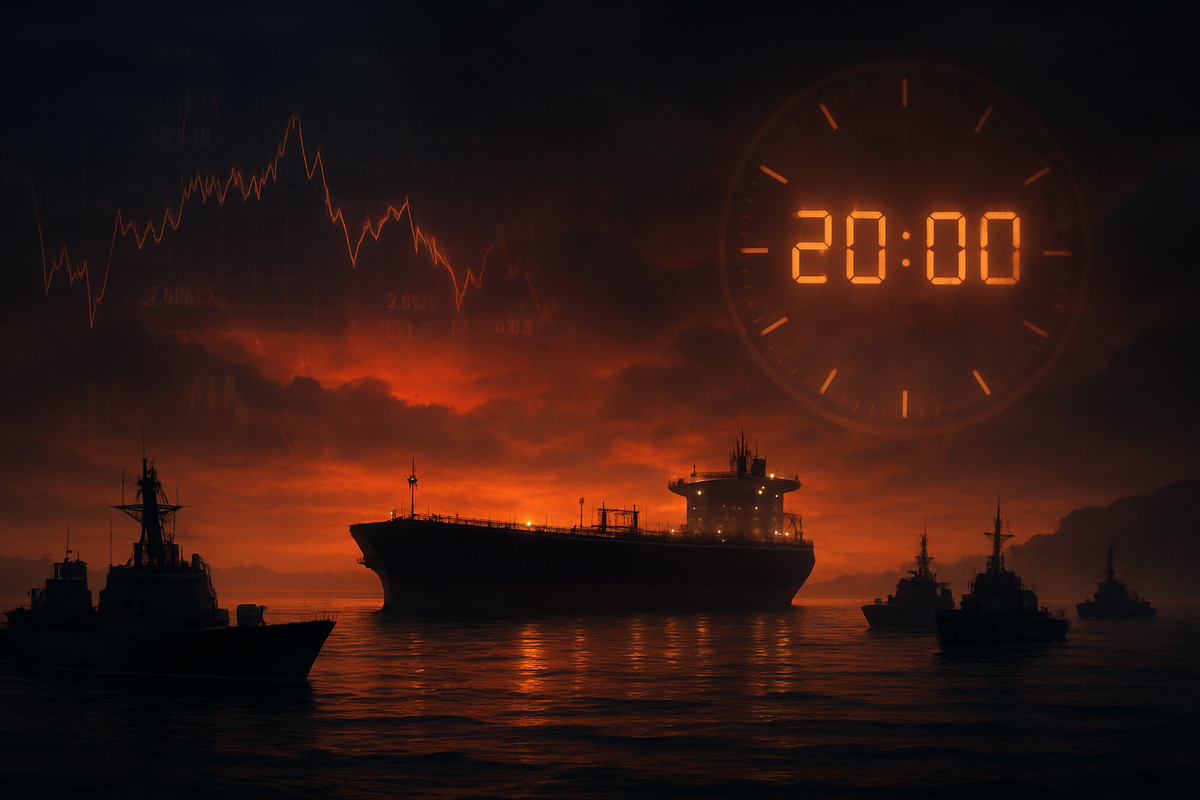
Global financial markets are on a knife-edge this Tuesday, April 7, 2026, as the world counts down to an 8:00 PM ET deadline set by President Donald Trump for Iran to end its blockade of the Strait of Hormuz. In a series of increasingly bellicose statements, the White House has warned that failure to comply will result in the "complete demolition" of Iran’s civilian infrastructure, specifically targeting power plants and bridges. The ultimatum, which the President has colorfully dubbed the precursor to "Power Plant Day" and "Bridge Day," has sent crude oil prices soaring and triggered a flight to safety across Wall Street.
The immediate implications of this standoff are staggering. With the Strait of Hormuz—a transit point for a fifth of the world’s oil—effectively shuttered for the past five weeks, the global energy supply chain is nearing a breaking point. Market participants are bracing for a potential military escalation that could not only disrupt oil flows indefinitely but also drag the global economy into a period of deep stagflation. As the 8 PM deadline approaches, the S&P 500 has seen intraday swings of up to 2%, reflecting the profound uncertainty of what many fear could be the start of a much larger regional conflict.
The Road to "Operation Epic Fury"
The current crisis is the culmination of a five-week military confrontation known as "Operation Epic Fury." The standoff began on February 28, 2026, when the Iranian Islamic Revolutionary Guard Corps (IRGC) initiated a "de facto" blockade, demanding new transit fees for international shipping and seeking to rewrite the legal regime of the waterway. In response, a coalition of U.S. and Israeli forces launched targeted strikes against Iranian military assets, including the Kharg Island oil hub. Despite these efforts, Iran has refused to relent, instead calling on its citizens to form "human chains" around critical infrastructure to deter further American aggression.
President Trump’s 8 PM ET ultimatum represents a dramatic escalation from previous diplomatic efforts. Originally slated for Monday, the President extended the deadline by 24 hours, stating it was "inappropriate" to launch massive strikes immediately following Easter Sunday. However, his rhetoric on social media has remained uncompromising. In a post earlier today, he warned that "a whole civilization will die tonight" if the Strait is not reopened, emphasizing that the U.S. military is prepared to strike every major bridge and power station in the country. This threat to destroy non-military infrastructure marks a significant shift in U.S. engagement strategy, raising alarms among international human rights groups and traditional allies.
The timeline leading to this moment has been characterized by a breakdown in traditional back-channel communications. While intermediaries such as Pakistan have attempted to broker a ceasefire, those talks have reportedly stalled over Iran's insistence on a full U.S. withdrawal from the Persian Gulf. As the clock ticks down, the U.S. Fifth Fleet has been positioned in the Gulf of Oman, and several carrier strike groups are reportedly on high alert. The IRGC has countered by moving mobile missile launchers to the coastline, signaling that any strike on their power grid will be met with immediate retaliation against U.S. energy interests in the region.
Market reaction has been swift and severe. West Texas Intermediate (WTI) crude has surged to over $114 per barrel, a 21% increase in just one month, while the national average for gasoline in the U.S. has hit a painful $4.13 per gallon. Investors have largely abandoned "risk-on" assets, leading to a visible slide in the broader indices. Trading volume has spiked in the final hours of the New York session as fund managers reposition portfolios for the possibility of a full-scale kinetic conflict by sunrise in Tehran.
Sector Impact: Winners and Losers in a War Economy
The energy sector has emerged as the primary beneficiary of the rising tensions, with the Energy Select Sector SPDR Fund (XLE) up more than 37% for the first quarter of 2026. Industry giants like Exxon Mobil Corp (NYSE: XOM) and Chevron Corp (NYSE: CVX) have seen their stock prices climb by nearly 40% year-to-date. These "supermajors" stand to gain from the skyrocketing price of crude, though executives remain wary of the potential for physical damage to their own assets in the Middle East. If Iran follows through on threats to strike regional energy facilities, the short-term gains from high prices could be offset by catastrophic operational losses.
On the other side of the ledger, the defense industry is seeing a historic influx of capital. Raytheon Technologies—now known as RTX Corp (NYSE: RTX)—and Lockheed Martin Corp (NYSE: LMT) are reporting record-high backlogs of $268 billion and $194 billion, respectively. The U.S. military’s need to replenish "expendables" like Tomahawk cruise missiles and PAC-3 interceptors has made these companies essential to the war effort. Similarly, Northrop Grumman Corp (NYSE: NOC) has seen increased demand for its surveillance and drone technologies. While these stocks have seen occasional "sell-on-news" pullbacks, the prospect of a sustained infrastructure-level bombing campaign suggests a long-term revenue tailwind for the "Big Five" defense contractors.
Conversely, the losers in this scenario are numerous and varied. The airline industry is perhaps the hardest hit, as surging jet fuel costs threaten to wipe out thin profit margins. Shares of United Airlines Holdings Inc (NASDAQ: UAL) and Delta Air Lines Inc (NYSE: DAL) have been under heavy selling pressure as analysts' factor in the likelihood of $120+ oil. Additionally, consumer discretionary sectors are reeling; as the price at the pump rises, discretionary spending at retailers like Target Corp (NYSE: TGT) is expected to plummet. Furthermore, shipping companies like Maersk are being forced to reroute vessels around the Cape of Good Hope, adding 10 to 20 days to transit times and significantly increasing freight costs for U.S. importers.
The broader technology sector is also feeling the pinch. While tech giants are less sensitive to oil prices than industrial firms, the general market "risk-off" sentiment has led to a sell-off in high-valuation growth stocks. Investors are moving capital out of companies like Nvidia Corp (NASDAQ: NVDA) and into safer havens such as gold and Treasury bonds. If the 8 PM deadline passes without a resolution, the resulting market volatility could trigger a wider correction that spares no sector, as the cost of insurance and capital both trend sharply higher.
Wider Significance: A Redefinition of Global Chokepoints
The significance of this event extends far beyond a temporary spike in oil prices; it represents a fundamental challenge to the global order and the security of maritime commons. The Strait of Hormuz has long been considered the world's most important oil chokepoint, and Iran's attempt to exert sovereign control over international shipping lanes is a precedent that the U.S. and its allies are unwilling to accept. Historically, this echoes the "Tanker War" of the 1980s, but with a modern twist: the 2026 conflict involves far more sophisticated missile technology and a global economy that is more interconnected, yet more fragile, than it was forty years ago.
From a regulatory and policy perspective, this crisis is likely to accelerate the push for Western energy independence. While the U.S. has significantly increased its domestic production over the last decade, the global nature of oil pricing means that American consumers are still vulnerable to Middle Eastern shocks. We may see a renewed legislative push for even more aggressive domestic drilling and perhaps a strategic pivot back toward nuclear energy to reduce the reliance on a global power grid that is currently under threat. The Biden-era emphasis on green transitions has, in the eyes of many in the current Trump administration, left the U.S. and Europe exposed to energy blackmail.
The ripple effects on global competitors, particularly China, cannot be understated. China is the largest importer of Iranian oil, and a total blockade or the destruction of Iranian infrastructure would be a massive blow to Beijing's industrial engine. This creates a complex geopolitical triangle where the U.S. action against Iran serves as an indirect form of economic pressure on China. However, this also risks pushing Tehran and Beijing into a tighter "alliance of necessity," potentially leading to more formal military cooperation and further destabilizing the Indo-Pacific region.
Finally, the threat to destroy civilian infrastructure like power plants and bridges represents a controversial evolution in modern warfare. While the U.S. has historically targeted "dual-use" infrastructure, the explicit naming of civilian power grids as primary targets for "total demolition" suggests a move toward a "maximum pressure" doctrine that ignores traditional distinctions between military and civilian assets. The legal and ethical fallout from such an operation would likely dominate international discourse for years, potentially leading to new sanctions, UN resolutions, and a radical realignment of international law regarding the protection of civilian life during interstate conflicts.
Looking Ahead: Diplomatic Exit or Full-Scale Strike?
As the 8 PM ET deadline looms, the world is looking at two primary scenarios. The first, and most optimistic, is a last-minute diplomatic "climb down." It is possible that the threat of total infrastructure collapse will force the Iranian leadership to reopen the Strait, perhaps under the guise of a temporary "humanitarian opening" brokered by Pakistan or Oman. In this scenario, we would likely see a massive "relief rally" in the S&P 500, with oil prices potentially dropping $10 to $15 per barrel overnight. However, the underlying tensions would remain, and the risk of a "snap-back" blockade would keep markets on edge for months.
The second, more dire scenario is the commencement of "Power Plant Day." If the 8 PM deadline passes without a concession from Tehran, U.S. strikes will likely begin within the hour. This would lead to an immediate spike in oil toward the $150 mark and a potential 5% to 10% drop in global equity markets as the reality of a protracted war sets in. Strategic pivots would be required for almost every major multinational corporation, as supply chains would need to be permanently rerouted and energy hedging strategies would become a matter of survival.
In the long term, this event may force a total re-evaluation of how global trade is protected. We could see the emergence of a more permanent, multi-national maritime task force designed to keep the world's chokepoints open, effectively ending the era where any one nation can hold the global economy hostage. Alternatively, it could lead to the further balkanization of the global economy, with the West and the East creating entirely separate energy and trade ecosystems. For investors, the "new normal" will likely involve higher baseline volatility and a permanent "geopolitical premium" baked into the price of every barrel of oil.
Wrap-Up: High Stakes in the Final Hours
The situation tonight represents one of the most significant geopolitical tests of the 21st century. The 8 PM ET ultimatum is not just a military deadline; it is a referendum on the stability of the global energy market and the reach of American power in 2026. The key takeaways for investors are clear: the era of cheap energy and predictable shipping lanes has been interrupted, and the focus must now shift toward capital preservation and sectors that benefit from increased defense spending and domestic energy production.
Moving forward, the market will be hypersensitive to any news regarding the commencement of strikes or a diplomatic breakthrough. Investors should keep a close watch on the "VIX" volatility index and the performance of safe-haven assets like the 10-year Treasury and gold. Furthermore, the resilience of the U.S. consumer in the face of $4+ gasoline will be a critical indicator of whether the broader economy can avoid a recession in the coming quarters.
In the coming months, the lasting impact of this confrontation will be measured by whether the Strait of Hormuz remains a reliable artery for global trade. If the U.S. succeeds in forcing it open through sheer kinetic force, it may restore a sense of maritime order, but at the cost of long-term stability in the Middle East. If the conflict widens, the global market may be entering a "lost year" of growth, defined by energy shortages and heightened military readiness. For now, all eyes are on the clock as 8 PM ET approaches—the moment when the "rules of engagement" for the modern world may change forever.
This content is intended for informational purposes only and is not financial advice.