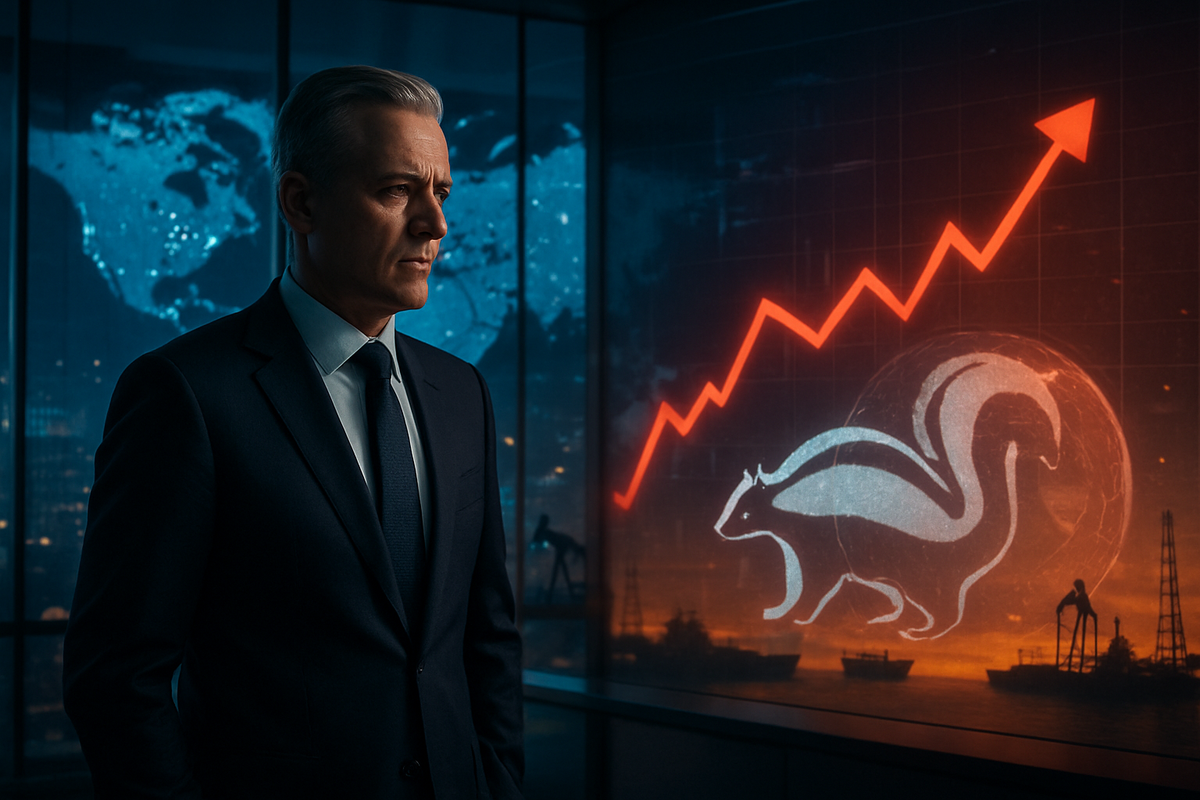
In a starkly worded annual letter released on April 6, 2026, JPMorgan Chase & Co. (NYSE: JPM) Chairman and CEO Jamie Dimon delivered a sobering "state of the world" address that has sent ripples through global financial markets. Addressing shareholders during one of the most volatile periods in recent memory, Dimon introduced a vivid new metaphor for the current economic landscape: the "geopolitical skunk." He warned that while the U.S. economy has displayed remarkable resilience, the "stink" of persistent, sticky inflation and escalating global conflict threatens to derail the long-hoped-for "soft landing."
The implications of Dimon’s letter are immediate and profound, arriving just as the market grapples with the fallout from the "March Oil Shock." With crude prices hovering near two-year highs and the Federal Reserve suddenly pausing its rate-cutting cycle, Dimon’s warning suggests that the era of low interest rates is not just over, but may be replaced by a "higher-for-much-longer" reality. For investors, the letter serves as a definitive pivot away from the optimism of 2025, signaling a shift toward a "war-footing" economy defined by supply chain remilitarization and energy insecurity.
The Warning from One Vanderbilt: A Timeline of Turbulence
Jamie Dimon’s 2026 letter did not emerge in a vacuum; it is the culmination of several months of escalating tension and disappointing economic data. The timeline leading to this moment began in late February 2026, when a major military escalation in the Middle East—specifically the conflict involving Iran and the closure of the Strait of Hormuz—sent shockwaves through energy markets. By March, West Texas Intermediate (WTI) crude had surged past $110 per barrel, ending a period of relative price stability and reigniting inflationary fears that many thought had been extinguished in 2025.
In his letter, Dimon specifically addressed the "tectonic shifts" occurring beneath the surface of the global economy. He identified the "remilitarization of the world" and the massive government deficit spending required to fund it as permanent inflationary forces. "The skunk at the party—and it could happen in 2026—would be inflation slowly going up, as opposed to slowly going down," Dimon wrote. He argued that the current 3.5% inflation rate is not a temporary spike but a reflection of a fundamental realignment of global trade and production. The reaction from the banking industry and the Fed was swift; shortly after the letter’s release, market-implied probabilities for a rate hike in the third quarter of 2026 jumped from 10% to 45%.
Winners and Losers in the New "Security Supercycle"
The geopolitical and inflationary landscape described by Dimon creates a sharp divide between market participants. The primary beneficiaries of this "Security Supercycle" are the companies providing the physical and energy security that a volatile world demands. ExxonMobil (NYSE: XOM) and Chevron (NYSE: CVX) have emerged as clear winners, with both stocks hitting record highs as they leverage their low-cost production in the Permian Basin to satisfy a world starved for non-Middle Eastern energy. Similarly, defense contractors like Lockheed Martin (NYSE: LMT) and RTX Corporation (NYSE: RTX) are seeing their order backlogs swell to historic levels, as the U.S. defense budget approaches the $1 trillion mark for the first time.
On the other side of the ledger, the "sticky" nature of inflation is putting immense pressure on consumer-facing giants. Companies like Walmart (NYSE: WMT) and Target (NYSE: TGT) are facing a double-edged sword: rising logistics costs due to $4-a-gallon gasoline and a consumer base that is increasingly choosing "needs over wants." Meanwhile, the commercial real estate and technology sectors remain the primary "losers" in this environment. As interest rates remain stubbornly high, the cost of servicing debt is crushing growth-oriented firms and regional banks that lack the "fortress balance sheet" of JPMorgan Chase.
A Historical Pivot: The Return of 1970s-Style Volatility?
Dimon’s analysis places the current moment into a broader historical context, drawing uncomfortable parallels to the stagflationary era of the 1970s. For decades, the global economy benefited from "the peace dividend"—a period of low defense spending and hyper-efficient, just-in-time global supply chains. Dimon suggests that this era is officially dead. The "remilitarization" he describes represents a shift toward "just-in-case" supply chains, which are inherently more expensive and inflationary. This mirrors the geopolitical shocks of 1973 and 1979, where energy became a weapon of war rather than just a commodity.
The regulatory implications of this shift are equally significant. As Dimon noted, the U.S. government’s continued deficit spending—projected to remain above 6% of GDP throughout 2026—leaves the Federal Reserve in a difficult position. Unlike previous cycles where the Fed could lower rates to stimulate a slowing economy, the current inflationary "skunk" limits their maneuverability. This event suggests that future policy may lean more toward "industrial policy"—where the government picks winners in energy and defense—rather than the pure market-driven approaches of the early 2000s.
The Roadmap for 2026: Strategic Pivots Required
Looking ahead, the short-term outlook is dominated by the Federal Reserve’s next move. If the "nowcasts" for April inflation hold steady at 3.5% or higher, the market must prepare for the possibility that the 3.50%–3.75% Fed Funds rate is actually a floor, not a peak. For corporations, the strategic pivot required is clear: efficiency through technology. JPMorgan itself is leading this charge, announcing a $20 billion investment in AI for 2026 to offset rising labor and energy costs. Other financial institutions like Bank of America (NYSE: BAC) and Goldman Sachs (NYSE: GS) are following suit, deploying "agentic AI" to lower cost-to-serve ratios in their wealth management divisions.
In the long term, the primary challenge for investors will be navigating the "energy transition" while simultaneously managing "energy security." Dimon’s letter suggests that the world cannot simply abandon fossil fuels while geopolitical risks are at a fever pitch. This creates a market opportunity for "bridge technologies"—such as carbon capture and modular nuclear reactors—that can provide stable power without the volatility associated with global oil markets. Scenarios range from a prolonged "muddle-through" where growth remains sluggish, to a more severe "energy-driven recession" if the conflict in the Middle East continues to escalate.
Summary: Preparing for a Higher-for-Longer Reality
The key takeaway from Jamie Dimon’s 2026 letter is a call for vigilance. The "Geopolitical Skunk" has arrived, and it is likely to linger. The combination of structural inflation, a war-footing economy, and high energy prices has fundamentally altered the investment landscape. While the U.S. consumer remains resilient for now, the "gravity" of high interest rates on asset prices is beginning to take hold. For investors, the "goldilocks" era of low inflation and steady growth has been replaced by a period where physical assets, defense infrastructure, and large-scale financial institutions hold the upper hand.
Moving forward, the market will be hyper-focused on two specific indicators: the monthly CPI reports and the status of global shipping lanes. If energy prices remain above $100 per barrel into the summer of 2026, the risk of a "hard landing" increases significantly. As Dimon warned, the outcome of current geopolitical events may be the "defining factor" for the next decade of global economics. Investors should maintain high levels of liquidity and look toward companies with the pricing power to withstand a "sticky" inflationary environment.
This content is intended for informational purposes only and is not financial advice.