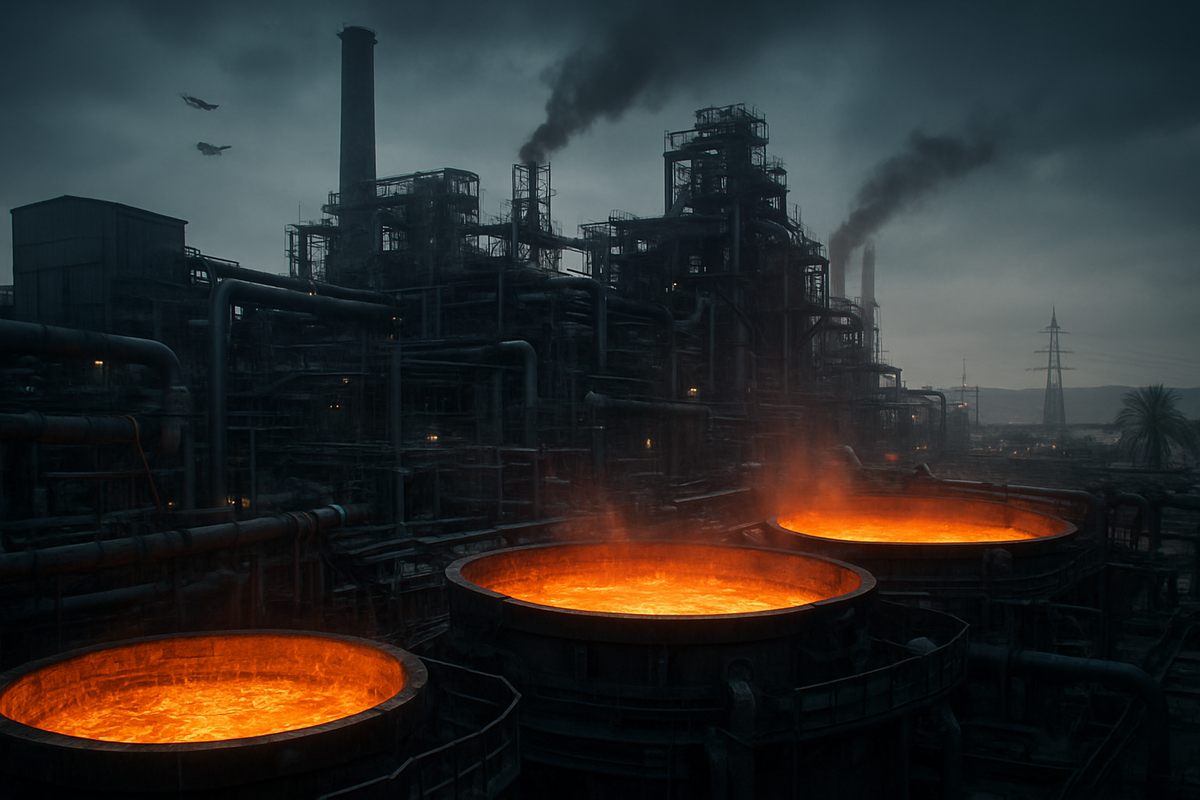
LONDON — On this day, April 2, 2026, the global commodities market is grappling with a supply shock of historic proportions. In the wake of precision Iranian airstrikes targeting critical industrial infrastructure across the Middle East, the global aluminum market has been thrown into chaos. Prices for the "green metal" have surged to a four-year high, briefly touching $3,500 per metric ton on the London Metal Exchange (LME). The sudden removal of nearly a tenth of the world's production capacity has analysts warning of an industrial paralysis that could ripple through the automotive, aerospace, and renewable energy sectors for years to come.
The immediate catalyst for the market panic is the closure of the Strait of Hormuz, a maritime chokepoint through which 9% of global aluminum production flows. With the waterway effectively sealed by regional hostilities, the "swing supply" that global manufacturers rely on has vanished overnight. Estimates from industry trackers suggest a staggering 1.3 million ton global deficit is now inevitable, as major smelting hubs in the United Arab Emirates and Bahrain report catastrophic damage and a complete halt in exports.
The Strike on the Smelters: A Timeline of Disruption
The crisis reached a boiling point in late March 2026 when a series of drone and missile strikes targeted the Al-Taweelah plant in Abu Dhabi, operated by Emirates Global Aluminium (EGA). The facility, one of the world’s largest and most technologically advanced smelters with a capacity of 1.6 million metric tons, sustained "significant damage" to its dedicated 3,500 MW power infrastructure. Without the continuous electricity required to keep the reduction cells—known as "pots"—molten, the aluminum within them began to solidify, a process often referred to as "freezing" the line. Industry experts warn that restarting a frozen smelter can take months, if not years, as each pot must be painstakingly cleaned and relined.
Concurrently, Aluminium Bahrain (BSE: ALBA), which operates the world’s largest single-site smelter, reported that its Line 6 expansion was partially hit, while its primary export routes through the Persian Gulf were severed. The closure of the Strait of Hormuz has not only stopped the outward flow of finished metal but has also strangled the inward flow of alumina and bauxite. Middle Eastern producers are "long on energy but short on ore," and without the roughly 60% of alumina imports that typically pass through the Strait from Australia and Brazil, the remaining operational pots in the region are running on rapidly dwindling stockpiles.
The market reaction was instantaneous. From a stable trading range of $2,400 to $2,600 in early 2025, the LME three-month aluminum price skyrocketed 40% in a matter of weeks. The "Midwest Premium"—the extra fee North American buyers pay for physical delivery—has also hit record levels as manufacturers scramble to secure whatever metal is already on-shore.
Winners and Losers: A Reshuffled Corporate Landscape
The geopolitical vacuum has created a stark divide between the "haves" and "have-nots" of the aluminum world. Among the primary beneficiaries are Western producers with assets safely located far from the conflict zone. Alcoa (NYSE: AA) has seen its stock price climb as it prepares to accelerate the restart of its San Ciprián smelter in Spain. With its vertically integrated supply chain, Alcoa is less vulnerable to the alumina shortages currently plaguing its Middle Eastern rivals. Similarly, Century Aluminum (NASDAQ: CENX), which focuses primarily on the U.S. domestic market, stands to gain from the skyrocketing premiums in the United States.
In Australia and Canada, Rio Tinto (NYSE: RIO) is leveraging its vast hydroelectric-powered smelting capacity to fill the void. Rio Tinto’s status as a partner in the ELYSIS carbon-free smelting technology makes its metal even more valuable in a market where "green aluminum" was already in high demand. South32 (ASX: S32) has also seen increased interest in its South African and Australian operations as buyers look for non-Gulf alternatives. However, the gains for these producers are tempered by the broader economic uncertainty and the risk of demand destruction if prices remain at these elevated levels.
On the losing end, Norsk Hydro (OTC: NHYDY) faces a complex dilemma. While its Norwegian operations are thriving, its Qatalum joint venture in Qatar is currently operating at barely 60% capacity due to logistical blockages, dragging down the company's overall performance. The biggest losers, however, are the downstream industrial giants. Companies like Boeing (NYSE: BA) and Ford Motor Company (NYSE: F), which have shifted heavily toward aluminum to lightweight their fleets and vehicles, are now facing a margin-crushing spike in raw material costs and potential production delays.
The Wider Significance: A Crisis for the Energy Transition
The disruption of the Middle Eastern aluminum supply is not just a commercial headache; it is a strategic threat to the global energy transition. Aluminum is a "critical mineral" for the production of electric vehicle (EV) frames, solar panel racks, and high-voltage transmission lines. Before this crisis, the market was already tight due to China’s 45.5 million ton capacity cap, intended to curb emissions. With the Middle East—a region that accounts for nearly 23% of the world’s tradable supply outside of China—now effectively offline, the timeline for decarbonization is under threat.
This event mirrors the 1973 oil crisis in its potential to permanently alter supply chain philosophies. For decades, the "just-in-time" model favored sourcing from the lowest-cost producers, which often meant heavily subsidized or energy-advantaged smelters in the Gulf. The 2026 strikes have highlighted the "geopolitical risk premium" that was largely ignored during years of low volatility. We are likely to see a massive shift toward "friend-shoring" and a renewed focus on domestic production capabilities in the U.S. and Europe, regardless of the higher energy costs involved.
Historically, the aluminum market has rarely seen such a massive amount of nameplate capacity knocked offline simultaneously. Even the 2018 sanctions on Rusal did not result in a physical disruption of this scale. The current 1.3 million ton deficit is roughly four times larger than any shortfall seen in the last decade, and it occurs at a time when global LME warehouse stocks are at their lowest levels since the early 2000s.
What Comes Next: Scenarios for a Scarce Market
In the short term, the market's eyes are on the Al-Taweelah power plant. If EGA can secure emergency repairs and bypass the Hormuz blockade via overland routes through Saudi Arabia or the port of Fujairah, some pressure may ease. However, the volume of aluminum produced in the region—millions of tons—is far too large for current trucking and rail infrastructure to handle effectively. A protracted closure of the Strait will likely force the LME to reconsider its "Russian metal" bans or release strategic reserves to prevent a total industrial standstill in Europe.
Longer-term, this crisis will accelerate the adoption of secondary, or recycled, aluminum. Since recycling aluminum requires only 5% of the energy needed to produce primary metal, companies with strong recycling footprints will hold a strategic advantage. We may also see a flurry of investment in new smelting capacity in "safe" jurisdictions like Quebec or Iceland, though these projects take years to come online.
Summary: A New Reality for Global Industry
The events of April 2026 mark the end of an era for the global aluminum market. The era of cheap, readily available metal from the Middle East has been shattered by the reality of modern geopolitical warfare. Investors and manufacturers must now navigate a landscape defined by a 1.3 million ton deficit and a $3,500/t floor price.
Key Takeaways for Investors:
- Watch the Premiums: The base LME price is only half the story; physical delivery premiums will tell you where the real metal is flowing.
- Geopolitics Over Fundamentals: Traditional supply/demand models are secondary to news regarding the Strait of Hormuz and Middle Eastern de-escalation.
- The Green Pivot: Producers with renewable energy sources and "low-risk" geographic profiles (e.g., Rio Tinto, Alcoa) will likely command a permanent premium.
The coming months will be a test of resilience for the global manufacturing sector. As long as the Al-Taweelah plant remains offline and the Strait remains closed, the aluminum crisis is only just beginning.
This content is intended for informational purposes only and is not financial advice.