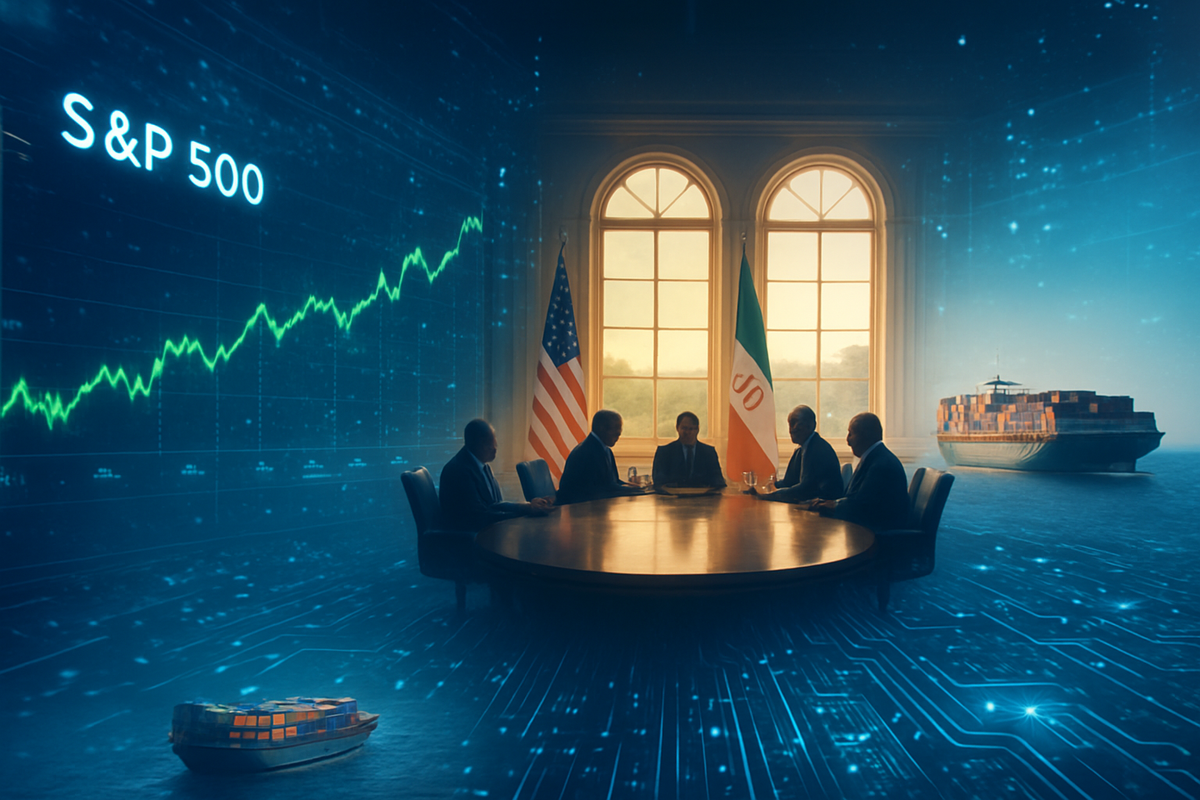
Wall Street experienced a massive "risk-on" surge on Tuesday, April 14, 2026, as investors reacted with overwhelming optimism to reports of a potential diplomatic breakthrough in the Middle East. The S&P 500 (NYSEARCA: SPY) surged by 81.14 points, or approximately 1.18%, to close at 6,967.38, while the tech-heavy Nasdaq Composite jumped 455 points. This rally signals a growing belief among market participants that a viable "off-ramp" is finally emerging to de-escalate the hostilities that have gripped the region for over a year.
The sudden pivot in sentiment comes as high-level diplomatic talks between United States and Iranian officials reportedly resumed in Islamabad, Pakistan. With the S&P 500 now on track to recoup all losses sustained since the onset of the conflict in early 2025, the market appears to be pricing in the possibility of a return to geopolitical stability. For an economy that has spent the last 14 months navigating high energy costs and supply chain anxieties, the Islamabad talks represent more than just a ceasefire; they represent a potential restoration of global trade routes.
The current rally is the culmination of a volatile timeline that began in early 2025 following the collapse of nuclear negotiations and the subsequent launch of "Operation Epic Fury"—a series of targeted strikes on military infrastructure. For much of the past year, the market has been haunted by the "war premium," with recurring blockades in the Strait of Hormuz causing periodic spikes in shipping insurance and energy prices. However, the tide began to turn this week when Pakistani mediators, who have long maintained a unique dual-channel with both Washington and Tehran, successfully brought representatives from both nations to the negotiating table.
The involvement of Pakistan as a neutral ground has been a critical factor in the market’s positive reaction. Historically, the Embassy of Pakistan in Washington has served as the diplomatic link between the two nations, but the elevation of these talks to a formal summit in Islamabad suggests a higher level of commitment than previous back-channel efforts. Initial reports indicate that the primary focus of these discussions is a phased withdrawal of naval blockades in exchange for a temporary freeze on regional proxy activity. This "tit-for-tat" de-escalation has provided the first tangible hope for a lasting truce since the conflict reached its zenith last winter.
The market's reaction has created a distinct divergence between sectors that thrive on stability and those that had capitalized on the chaos. Tech behemoths led the charge on Tuesday, with Nvidia (NASDAQ: NVDA) and Apple (NASDAQ: AAPL) seeing significant gains as concerns over semiconductor supply chain disruptions began to fade. The tech sector has been particularly sensitive to the conflict’s impact on global shipping, making the prospect of open sea lanes a primary catalyst for the Nasdaq’s 455-point leap. Similarly, Palantir Technologies (NASDAQ: PLTR), which had seen its stock rise on the back of increased military AI contracts during the war, remained resilient as investors pivoted toward its commercial applications in a post-war economy.
Conversely, the "war hedges" that dominated portfolios in 2025 are facing a cooling period. Traditional energy giants like ExxonMobil (NYSE: XOM) and Chevron (NYSE: CVX) saw their shares underperform the broader market as crude oil prices retreated from their "conflict highs." The disappearance of the $20-per-barrel war premium is weighing on the immediate revenue outlook for the oil sector. Defense contractors are also seeing a shift in momentum; RTX Corporation (NYSE: RTX) and Lockheed Martin (NYSE: LMT), which saw massive order backlogs during "Operation Epic Fury," are now being re-evaluated by investors who anticipate a potential slowdown in emergency munitions procurement if the Islamabad talks prove successful.
The significance of this rally extends beyond daily point gains; it marks a fundamental shift in the market’s assessment of geopolitical risk. For the past decade, investors have frequently discounted the possibility of a direct conflict involving a major oil producer, but the events of 2025 shattered that complacency. The current move toward a 7,000-level S&P 500 suggests that the market is ready to remove the "geopolitical discount" that has suppressed valuations for the last 18 months. If the Islamabad talks lead to a formalized treaty, it could set a historical precedent for how modern regional conflicts are resolved through third-party mediation.
This event also highlights a shift in industry trends, specifically the "reshoring" vs. "globalization" debate. While the war forced many companies to diversify their supply chains away from volatile regions, a successful ceasefire may slow the aggressive—and expensive—retreat from global trade. The ripple effects are already being seen in the shipping industry, where carriers are beginning to adjust their long-term fuel hedging strategies in anticipation of safer passage through the Middle East. Compared to the oil shocks of 1973 and 1979, the 2025-2026 crisis may be remembered for its shorter duration, thanks to the speed of modern diplomatic intervention and the diversification of global energy sources.
While the market is celebrating the "off-ramp," the road ahead remains fraught with strategic challenges. In the short term, the primary risk is "negotiation fatigue" or a potential "spoiler" event from regional actors who do not benefit from a US-Iran rapprochement. Investors must remain wary of "head-fake" rallies; history shows that ceasefire talks can often stall over technicalities regarding monitoring and verification. For companies like Microsoft (NASDAQ: MSFT) and Alphabet (NASDAQ: GOOGL), the focus will likely shift from managing crisis-driven logistics back to aggressive R&D and expansion in emerging markets.
In the long term, a successful resolution could trigger a massive rotation of capital back into international equities and emerging markets that were sidelined during the conflict. However, the strategic pivot required for defense and energy companies will be more complex. These firms may need to accelerate their transition into "dual-use" technologies and renewable energy to maintain growth in a de-escalated environment. The market is currently operating on "best-case scenario" assumptions, but the actual implementation of any Islamabad agreement will be the true test of this bull run.
The events of April 14, 2026, will likely be remembered as the day Wall Street decided the worst of the Middle East crisis was over. With the S&P 500 reaching 6,967.38 and nearing its pre-war peaks, the message from the trading floor is clear: diplomacy is the ultimate market catalyst. The rally reflects a collective sigh of relief from an investment community that has been on edge for over a year, signaling that the "fear trade" is officially being replaced by the "recovery trade."
Moving forward, the market’s trajectory will be almost entirely dependent on the dispatches coming out of Islamabad. Investors should watch for concrete signs of de-escalation, such as the confirmed movement of naval assets or the lifting of specific sanctions, as these will serve as the next milestones for the rally. While the road to 7,000 for the S&P 500 seems clear, the lasting impact of this period will be a redefined understanding of how quickly geopolitical storms can form—and how efficiently the market can price in their conclusion.
This content is intended for informational purposes only and is not financial advice.