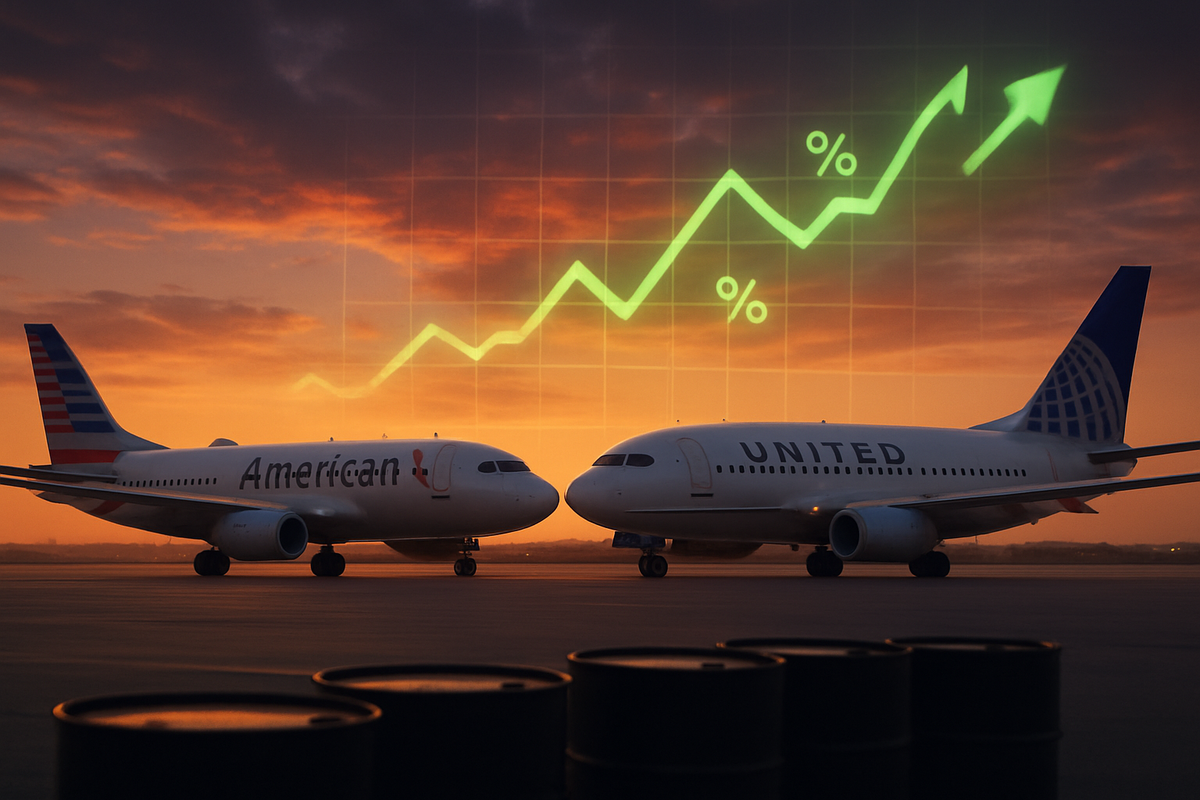
In a dramatic day of trading on Wall Street, the airline sector witnessed a massive relief rally on April 14, 2026, as a sudden downturn in crude oil prices provided a much-needed reprieve for fuel-sensitive carriers. Shares of American Airlines (NASDAQ: AAL) skyrocketed 8.9%, while United Airlines (NASDAQ: UAL) climbed a robust 4%, leading a broad sector advance that has investors questioning if the industry is finally exiting a period of extreme turbulence.
The surge follows a volatile start to 2026, during which geopolitical tensions in the Middle East pushed jet fuel costs to levels not seen in years, threatening to erase the industry's post-pandemic profitability gains. However, the confluence of a diplomatic breakthrough in energy-producing regions and whispers of a massive "mega-merger" between the nation's largest carriers has fundamentally shifted the market’s sentiment from defensive to aggressively optimistic.
Fuel Relief and Geopolitical Thaw
The primary catalyst for the rally was a sharp reversal in the crude oil market. After Brent crude flirted with $115 per barrel earlier this month due to the closure of the Strait of Hormuz, prices began to retreat today following news of a confirmed two-week ceasefire and the potential reopening of critical shipping lanes. For the airline industry, where fuel typically accounts for 25% to 35% of total operating expenses, the decline represents an immediate and significant boost to the bottom line.
Throughout late February and March 2026, the "fuel shock" had become a primary concern for analysts, as jet fuel prices reached $4.88 per gallon. American Airlines, which famously operates without a comprehensive fuel-hedging program, was particularly exposed; market experts estimate that every one-cent rise in jet fuel increases the carrier’s annual costs by approximately $50 million. Today’s price drop signals a potential end to that bleeding, allowing the market to re-evaluate the carrier’s 2026 earnings projections.
This sudden shift in energy dynamics comes at a time when global passenger demand is at an all-time high, with IATA projecting 5.2 billion passengers for the year. Prior to today's rally, the "premiumization" of cabins—a trend where carriers like Delta Air Lines (NYSE: DAL) and United have focused on high-margin luxury seating—was the only factor keeping margins afloat. With fuel costs now moving in the right direction, the prospect of a high-demand, low-cost environment has triggered a buying spree across the sector.
The timeline of this recovery was accelerated by the unexpected resilience of non-OPEC+ producers. While the conflict restricted supply in the Middle East, record production from the United States, Guyana, and Brazil has created a structural surplus that is now beginning to manifest as tensions ease. Analysts at J.P. Morgan have noted that if the current ceasefire holds, the market could transition from a deficit to a surplus of nearly 2 million barrels per day by the end of the year, providing a long-term tailwind for the aviation sector.
Winners and Losers in the New Sky
The immediate winners of today’s market action are the unhedged and highly leveraged legacy carriers. American Airlines (NASDAQ: AAL) sits at the top of this list; its 8.9% jump reflects investor confidence that the carrier can now capture the full benefit of falling oil prices without the drag of expensive hedge contracts. United Airlines (NASDAQ: UAL) similarly benefited, though its diversified international network and more robust corporate travel bookings had already provided some insulation during the energy spike.
Conversely, some low-cost carriers (LCCs) and ultra-low-cost carriers (ULCCs) like Frontier Group Holdings (NASDAQ: ULCC) and Spirit Airlines (NYSE: SAVE) have seen more modest gains. While lower fuel helps everyone, these carriers struggle to pass on costs to price-sensitive economy travelers as effectively as their premium peers. Furthermore, Southwest Airlines (NYSE: LUV), known for its historically sophisticated hedging strategies, may see less of a relative "bounce" because its fuel costs were already partially capped during the price peak, though its shares still rose 2.5% in sympathy with the sector.
The broader logistics and cargo sector, including companies like FedEx (NYSE: FDX) and UPS (NYSE: UPS), are also expected to see a secondary benefit. As jet fuel and diesel prices correlate closely, the reduction in transportation costs will likely ripple through the supply chain, potentially lowering inflationary pressures on consumer goods and further stimulating the travel demand that airlines rely on.
On the losing side of this equation are the energy-focused Exchange Traded Funds (ETFs) and major oil producers like ExxonMobil (NYSE: XOM) and Chevron (NYSE: CVX). After months of reaping record profits from geopolitical instability, these firms faced a sell-off today as the "conflict premium" began to evaporate from the price of a barrel.
The Kirby Pitch: A Potential Industry Consolidation
Adding fuel to the fire—this time metaphorically—are growing rumors of an industry-reshaping merger between United Airlines and American Airlines. Reports have surfaced that United CEO Scott Kirby has initiated discussions regarding a potential combination that would create a dominant global titan. If such a deal were to proceed, the combined entity would control an estimated 30% to 40% of the U.S. domestic market, effectively ending the era of the "Big Four" and creating a "Big Three" alongside Delta and Southwest.
This potential merger represents a radical departure from recent regulatory trends. Historically, the Department of Justice has been wary of further consolidation in the airline industry, as evidenced by the blocking of the JetBlue-Spirit merger years prior. However, speculators suggest that a pro-business administration in 2026 might be more receptive to the idea of a "national champion" carrier that can compete more effectively against state-subsidized international rivals in the Middle East and Asia.
The strategic logic behind a United-American tie-up is significant but fraught with difficulty. The carriers share major hubs in Chicago and Los Angeles, and a merger would likely require the divestiture of hundreds of flight slots to satisfy antitrust concerns. Critics argue that such a concentration of power would lead to higher fares and reduced service for smaller regional airports. Yet, proponents believe the operational efficiencies and combined fleet power would allow the new entity to invest more heavily in sustainable aviation fuels and next-generation aircraft.
The historical precedent for such a move is the 2013 merger between American Airlines and US Airways, a deal that Kirby himself helped orchestrate. Having been a key architect of the current airline landscape, Kirby’s rumored involvement in a "final consolidation" deal has given the rumors enough weight to move the stocks, even in the absence of an official filing.
Looking Ahead: Navigating the Recovery
In the short term, the market will be hyper-focused on the longevity of the Middle East ceasefire. If shipping through the Strait of Hormuz remains uninterrupted, the downward pressure on oil could see Brent crude hit the $60 mark by late 2026, as some analysts predict. This would represent a paradigm shift for airline profitability, potentially leading to record dividends and share buybacks in 2027.
However, challenges remain. The industry must still navigate a pilot shortage that has persisted into the mid-2020s and the rising costs of labor as unions negotiate for a share of the revitalized profits. Furthermore, any formal move toward a United-American merger would likely trigger a multi-year regulatory battle, creating uncertainty that could lead to significant stock price volatility.
Investors should also watch for strategic pivots toward fleet modernization. If fuel prices remain lower for longer, the urgency to replace older, less efficient aircraft may temporarily wane, allowing carriers to strengthen their balance sheets. Conversely, if the merger rumors solidify, we may see a flurry of activity as other carriers, such as Delta or Alaska Air Group (NYSE: ALK), look for their own partners to maintain competitive parity.
The Final Verdict
Today’s rally is a reminder of how quickly the fortunes of the airline sector can change. The combination of a macro-economic "gift" in the form of lower oil prices and the "wildcard" of a massive potential merger has breathed new life into a sector that many had written off as overly burdened by debt and energy costs. The 8.9% surge in American Airlines is a testament to the high-beta nature of these stocks and their sensitivity to energy markets.
Moving forward, the primary takeaway for investors is that the "fuel shock" of early 2026 appears to be a transitory event rather than a permanent state of affairs. While the merger rumors add an exciting layer of speculative value, the underlying story remains the return of a more favorable operating environment.
Investors should keep a close eye on weekly EIA petroleum status reports and any official statements from the Department of Transportation regarding airline competition. In the world of aviation, the weather can change in an instant, but for today at least, the skies are looking decidedly blue.
This content is intended for informational purposes only and is not financial advice.