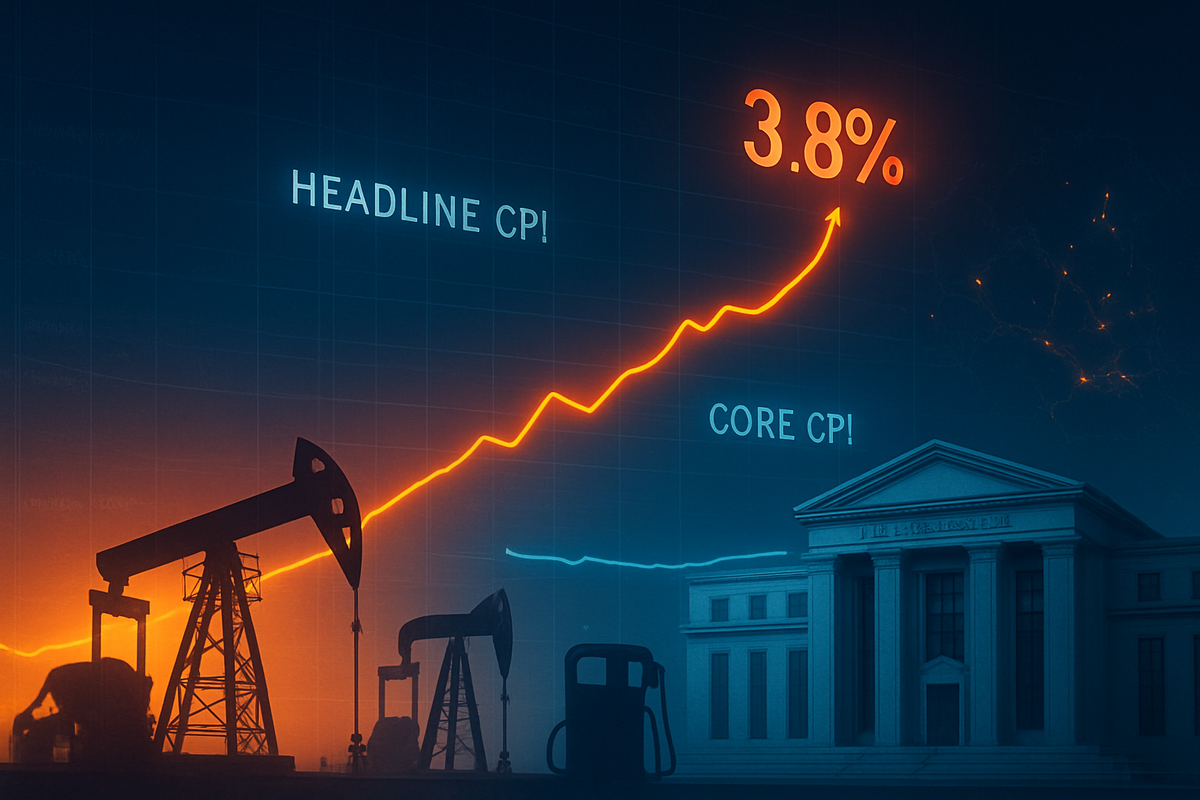
The Bureau of Labor Statistics released the March 2026 Consumer Price Index (CPI) data today, April 10, 2026, revealing a headline inflation rate of 3.8% year-over-year. This figure, while slightly higher than the previous month, was largely expected by market participants who have been monitoring the volatile energy landscape. The data confirms a growing "inflationary dualism" in the U.S. economy: a sharp spike in energy-related costs contrasted against a relatively steady, albeit "sticky," core inflation rate which excludes volatile food and energy components.
The report has immediately solidified the Federal Reserve's current "patient" stance. By maintaining the federal funds rate in the 3.5% to 3.75% range, the Fed is betting that the current energy-driven surge is a "one-channel event" that will not necessarily bleed into the broader service economy. Markets reacted with a surprising "relief rally" as the 3.8% headline figure, despite being high, managed to avoid the 4.0% "nightmare scenario" that many analysts feared would force an emergency rate hike.
The Tale of Two Inflations: Energy Shocks vs. Core Stability
The 3.8% headline figure was almost entirely propelled by a massive surge in energy costs, which rose nearly 20% in March alone. This spike is directly linked to the "Iran War Shock," a geopolitical conflict that has severely disrupted supply through the Strait of Hormuz since early 2026. With Brent crude averaging $103 per barrel and West Texas Intermediate (WTI) hovering between $90 and $100, the "war premium" has become a permanent fixture in the monthly data. Retail gasoline prices reached a four-year high of $4.30 per gallon this month, putting immediate pressure on American households and transportation-heavy industries.
In stark contrast, Core CPI remained more contained at 2.8% for the month of March. This divergence is the primary reason the Federal Reserve has refrained from aggressive tightening. The moderation in core inflation is largely attributed to a steady deceleration in shelter costs—which had been the primary driver of inflation in 2024 and 2025—and a cooling labor market where wage growth has settled at approximately 3.5%. Key stakeholders, including Fed Chair Jerome Powell and Vice Chair Philip Jefferson, have spent the weeks leading up to this release emphasizing that the central bank will not "hike into a supply-side shock," preferring to see if energy costs begin to impact core services before shifting their policy.
Winners and Losers: The Energy Boom and the Retail Squeeze
The energy sector has emerged as the clear winner in this high-inflation environment. ExxonMobil (NYSE: XOM) and Chevron (NYSE: CVX) have seen their shares trade near all-time highs as the $100+ oil environment drives record upstream earnings. While global production has seen some "shut-in" effects due to Middle East instability, the sheer price of crude has more than compensated for volume losses. Investors have increasingly viewed these energy giants as "safe havens," with the Energy Select Sector SPDR (NYSEARCA: XLE) significantly outperforming the broader market year-to-date.
Conversely, the retail sector is witnessing a bifurcated struggle. Walmart (NYSE: WMT) has managed to navigate the crisis by leaning into its grocery dominance. As high-income earners—those making $100,000 or more—increasingly "trade down" to mitigate rising fuel and food costs, Walmart has seen record grocery penetration. However, Target (NYSE: TGT) has faced a more difficult path. Heavily reliant on discretionary "general merchandise" like clothing and electronics, Target has been forced to implement price hikes of 8–10% to cover rising freight and fuel costs. This has led to a noticeable squeeze in margins as consumers prioritize "needs" over the impulsive "Target Run" discretionary purchases.
Policy Implications and the "Higher-for-Longer" Reality
This March CPI report fits into a broader trend of "persistent but narrow" inflation that has characterized the first quarter of 2026. The 2.8% core figure suggests that the Fed’s previous rate-hiking cycle successfully dampened domestic demand, yet the 3.8% headline serves as a reminder that global geopolitical factors remain outside the central bank’s control. This has led to a "higher-for-longer" interest rate environment, where the possibility of any rate cuts in 2026 is rapidly vanishing. Current FOMC "dot plots" indicate that at least seven committee members now favor zero rate cuts for the remainder of the year.
Historically, this situation draws parallels to the energy shocks of the late 1970s, though today's economy is notably less energy-intensive. The primary ripple effect today is felt in the bond market; the 10-year Treasury yield stabilized near 4.5% following the report, as bond traders found solace in the stable core inflation figure. For competitors in the logistics and airline industries, such as United Airlines (NASDAQ: UAL), the energy spike represents a significant headwind that may soon lead to increased "fuel surcharges," further testing the resilience of the American consumer.
What Lies Ahead: Strategic Pivots and Market Scenarios
In the short term, the market will likely remain hyper-focused on the Strait of Hormuz and any signs of de-escalation in the Middle East. If oil prices begin to stabilize or retreat toward the $80 mark, the headline CPI could rapidly converge with the core 2.8% figure, potentially opening the door for a late-year rate cut. However, if energy costs remain elevated through the summer travel season, the risk of "second-round effects"—where companies raise prices of non-energy goods to protect margins—could force the Fed to reconsider its "patient" stance in favor of a more hawkish approach.
Investors should prepare for a period of high volatility in the consumer discretionary sector. Companies will need to engage in "strategic pivots," focusing on value-tier products and supply chain efficiency to maintain market share. The emergence of a "two-speed economy," where energy producers thrive while consumer-facing brands struggle, requires a disciplined approach to sector allocation. Watch for the April PPI (Producer Price Index) data later this month to see if wholesale costs are mirroring the retail energy spike.
Closing Thoughts: A Delicate Balancing Act
The March 2026 CPI data highlights the delicate balancing act facing the Federal Reserve and the global economy. While the 3.8% headline inflation is a jarring reminder of the impact of geopolitical instability, the 2.8% core inflation figure provides a glimmer of hope that the underlying economic engine remains healthy. The market's positive reaction to the news reflects a collective sigh of relief that the data was not worse, yet the path forward remains fraught with uncertainty.
Moving forward, the narrative will shift from "when will the Fed cut?" to "how long can the consumer withstand $4.00+ gasoline?" Investors should remain vigilant, watching for signs of inflation "bleeding" from energy into services. For now, the "patient" Fed and the resilient core inflation figures suggest that while the road is bumpy, the economy has not yet veered off the tracks.
This content is intended for informational purposes only and is not financial advice