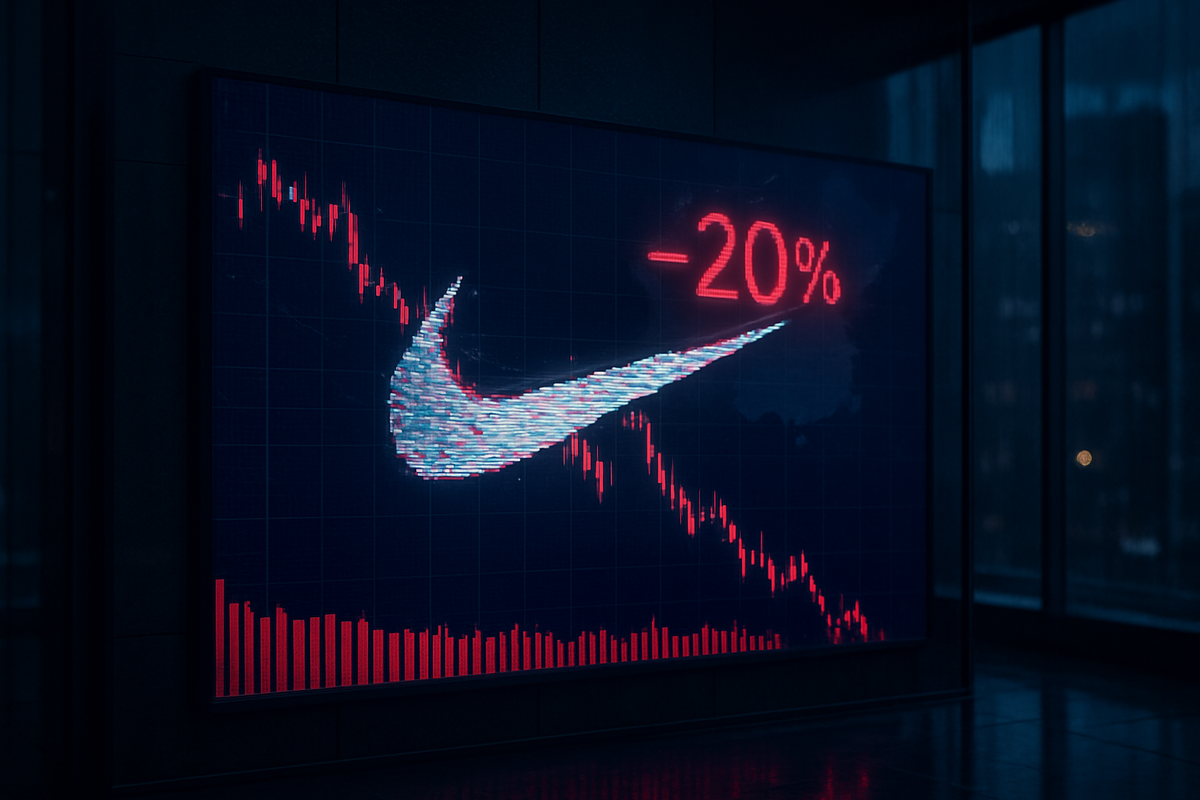
BEAVERTON, Ore. — In a staggering blow to the world’s largest sportswear brand, shares of Nike (NYSE: NKE) plummeted to a nine-year low of $48.12 on Wednesday. The crash, which saw the stock lose nearly 18% of its value in a single trading session, came immediately following the company’s fiscal third-quarter earnings report. While Nike managed to narrowly beat analyst expectations for both top-line revenue and bottom-line earnings per share, the victory was hollowed out by a dire outlook for the upcoming fiscal year.
The primary catalyst for the sell-off was a shock revision to the company’s guidance for the Greater China region. Management warned investors to expect a staggering 20% decline in sales across China for the remainder of 2026, citing a "structural shift" in consumer behavior and a deepening economic malaise in the world's second-largest economy. For a company that has long relied on China as its primary engine for growth, the forecast signaled that the "Swoosh" is facing its most significant identity crisis since the late 1980s.
The Q3 Paradox: Beats, Misses, and the China Cliff
The financial results for the quarter ending February 28, 2026, initially painted a picture of a company stabilizing under the leadership of CEO Elliott Hill. Nike reported revenue of $12.1 billion, slightly above the consensus estimate of $12.05 billion, and earnings per share of $0.74, beating the $0.71 projected by Wall Street. However, the optimism vanished the moment Hill addressed analysts during the post-earnings conference call. Hill, who took the helm in late 2024 to spearhead a "back-to-basics" turnaround, admitted that while the domestic recovery was "on track," the international headwinds—specifically in China—had reached a breaking point.
The timeline leading to this crash began in late 2024 when Elliott Hill was brought out of retirement to replace John Donahoe. Hill immediately dismantled the "Consumer Direct Acceleration" strategy, which had prioritized digital sales at the expense of wholesale partnerships. Throughout 2025, Hill successfully mended fences with retailers like Foot Locker (NYSE: FL) and Dick’s Sporting Goods (NYSE: DKS), helping Nike regain physical shelf space. However, the "Win Now" plan hit a massive wall in Asia. Despite a high-profile marketing blitz ahead of the 2026 World Cup, Chinese consumers have continued to pivot toward domestic brands and value-oriented choices, leaving Nike with a glut of inventory and shrinking margins.
Initial market reactions were swift and unforgiving. By midday, trading was briefly halted due to volatility as institutional investors moved to de-risk their portfolios. "The China story for Nike isn't just a sneeze anymore; it’s a full-blown pneumonia," said Sarah Collins, a senior equity analyst at Goldman Sachs. "Beating Q3 numbers means very little when your most profitable growth market is projected to contract by a fifth in the coming year."
Winners and Losers in the Great Sportswear Realignment
The fallout from Nike’s crash has created a clear divide in the retail sector. Among the immediate losers is Foot Locker (NYSE: FL), which saw its own shares slip 6% in sympathy. As Nike’s largest wholesale partner, Foot Locker remains tethered to the brand's ability to drive "heat" and foot traffic. If Nike’s product innovation fails to resonate or if their inventory management continues to falter, the ripple effect will likely result in more aggressive discounting and lower margins for secondary retailers. Similarly, luxury sportswear players like Lululemon Athletica (NASDAQ: LULU) saw slight declines as investors worried that the Chinese consumer slowdown might be a "canary in the coal mine" for the entire premium apparel sector.
Conversely, the "challenger brands" are emerging as the primary beneficiaries of Nike's struggle. On Holding (NYSE: ONON) and Deckers Outdoor Corporation (NYSE: DECK), the parent company of Hoka, both saw their shares rise by 4% and 3%, respectively, following the Nike news. These brands have successfully captured the "wellness" and "performance running" categories that Nike ceded during its multi-year focus on lifestyle and digital apps. Analysts note that for every dollar Nike loses in the premium running space, On and Hoka are currently capturing nearly 40 cents.
In China, the clear winners are local giants Anta Sports and Li-Ning. These companies have capitalized on the guochao movement—a trend of nationalistic pride among younger Chinese consumers who increasingly view domestic brands as technologically equal to, and culturally more relevant than, Western imports. By 2026, Anta’s market share in China is expected to rival Nike's for the first time in history, marking a tectonic shift in global brand dominance.
A Wider Industry Crisis: Innovation Gaps and Geopolitics
Nike’s current predicament reflects a broader malaise within the global sportswear industry. For decades, the industry operated on a simple formula: innovate in the West and scale in the East. However, that formula has broken down. The "innovation gap" has become a glaring vulnerability for Nike; while they dominated the "Super Shoe" era of marathon running, they have struggled to produce a culturally defining "must-have" sneaker since the heights of the Jordan Brand’s resurgence years ago. The market has moved toward specialized performance and "quiet luxury," while Nike remains bogged down in its legacy of mass-market appeal.
Furthermore, the 20% projected decline in China highlights the increasing difficulty of navigating geopolitical tensions. Regulatory shifts in China and the rise of local competition are no longer temporary hurdles but permanent fixtures of the landscape. Historically, when Nike faced similar slowdowns—such as the mid-2000s transition—it could rely on a new technological breakthrough like Flyknit or the expansion into new categories like Yoga. Today, the competition is faster, more specialized, and less reliant on the American "cool factor" that Nike exported for fifty years.
The ripple effects are also being felt in the advertising and sports marketing sectors. Nike has traditionally been the largest spender on athlete endorsements. With a $48 stock price and shrinking margins, the industry is watching closely to see if Nike will scale back its massive sponsorship deals with major leagues and international stars, potentially opening the door for competitors like Adidas (OTC: ADDYY) or New Balance to snag top-tier talent.
What Comes Next: Pivots, Layoffs, or a Sale?
In the short term, Elliott Hill is under immense pressure to accelerate his "Win Now" strategy. Market watchers expect a series of drastic measures in the coming months, which may include another round of corporate layoffs and a further reduction in the company's "lifestyle" SKU count to focus purely on high-performance athletic gear. There is also speculation that Nike may need to undergo a massive restructuring of its China operations, perhaps moving toward a localized joint-venture model similar to how other Western brands have managed to survive in increasingly hostile or insular markets.
Longer-term, the question remains whether Nike can reclaim its status as an innovation leader. The upcoming 2026 FIFA World Cup and the 2028 Los Angeles Olympics are critical milestones. If Nike cannot debut a "game-changing" technology that captures the public imagination before these events, it risks being relegated to a legacy brand—still large, but no longer the arbiter of global cool. Potential scenarios also include an aggressive stock buyback program to floor the share price, though with cash flows tightening, that may be a risky move.
Closing Thoughts: A New Era for the Swoosh
The crash of April 1, 2026, will likely be remembered as a watershed moment for Nike. It is a stark reminder that even the most iconic global brands are not immune to the dual pressures of local competition and shifting consumer preferences. The takeaway for investors is clear: the "China growth story" that fueled Nike’s ascent for the last two decades has reached its conclusion. Moving forward, the company's valuation will be determined by its ability to innovate and compete on a level playing field with nimble, specialized rivals.
As the market moves forward, all eyes will be on the back half of 2026. Investors should watch for Nike’s inventory levels in Asia and the performance of Hill's new sport-centric product lines during the back-to-school season. For Nike, the path back to $100 is no longer a sprint; it is a grueling marathon that will require every bit of the athletic grit the brand has spent fifty years marketing to the world.
This content is intended for informational purposes only and is not financial advice.