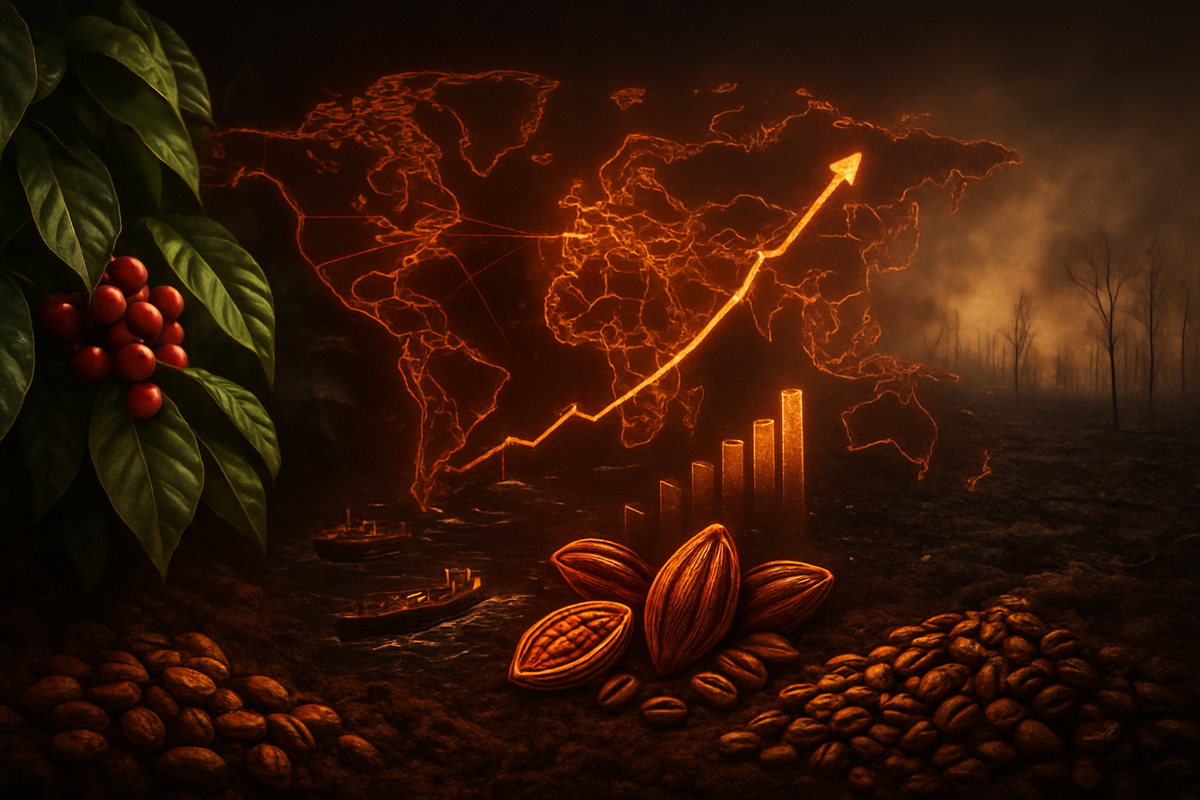
As of March 27, 2026, the global commodities markets are finally beginning to breathe a sigh of relief after a two-year supply crisis that fundamentally altered the economics of the breakfast table. What began in early 2024 as a series of isolated weather disruptions blossomed into a full-scale systemic failure, sending cocoa prices up by a staggering 300% and pushing coffee prices to historic highs. The fallout has been more than just expensive lattes and chocolate bars; it has forced a massive restructuring of global supply chains and a painful reckoning for some of the world’s largest food and beverage corporations.
While current data suggests a fragile "price normalization" is underway, the scars of the 2024–2025 cycle remain visible. The crisis, driven by a lethal combination of El Niño-induced droughts, record-breaking wildfires in South America, and crop diseases in West Africa, has proven that climate volatility is no longer a peripheral risk for investors. Instead, it has become the primary driver of market valuations, reshaping how food moves across borders and forcing companies to abandon "just-in-time" logistics for a more expensive, resilient "just-in-case" model.
A Two-Year Perfect Storm: From 300% Surges to Scorched Earth
The timeline of the crisis traces back to early 2024, when the cocoa market entered a "parabolic" phase. Benchmark New York futures, which had historically stabilized between $2,000 and $4,000 per tonne, skyrocketed to over $12,500 per tonne by April 2024. This 300% increase was triggered by back-to-back harvest failures in the Ivory Coast and Ghana, which together supply 60% of the world's cocoa. Heavy unseasonable rains led to the spread of Black Pod disease, followed by an extreme El Niño drought that allowed the Cacao Swollen Shoot Virus (CSSV) to decimate over 80% of crops in certain regions of Ghana.
Simultaneously, the coffee market faced its own existential threat. In late 2024, Brazil, the world's largest coffee producer, suffered its worst drought in over seven decades. This culminated in a catastrophic wildfire season where the National Institute for Space Research recorded over 110,000 fires, scorching an estimated 114,000 square kilometers (44,000 square miles) of land—an area larger than South Korea. These fires decimated coffee plantations in the critical growing regions of São Paulo and Minas Gerais, destroying thousands of trees and compromising the flowering cycles for the 2025/26 crop that is only now beginning to reach the market.
Meanwhile, in Southeast Asia, Vietnam—the top producer of the Robusta variety used in espresso and instant coffee—spent much of 2024 and 2025 battling severe water shortages. At the height of the drought, production fell by an estimated 20%, sending Robusta prices to their highest levels in nearly 50 years. However, as we move through March 2026, Vietnam is showing signs of a robust recovery. High export prices, which averaged over $5,600 per tonne during the peak of the crisis, incentivized farmers to invest heavily in irrigation and fertilizers, leading to a projected 2025/26 harvest of approximately 31 million bags.
Corporate Fallout: Winners, Losers, and the Margin Squeeze
The financial impact on public companies has been uneven, defined largely by their hedging strategies and pricing power. The Hershey Company (NYSE: HSY) emerged as one of the hardest-hit players in the confectionery space. As cocoa prices peaked, Hershey’s gross margins plummeted from 47.3% in early 2024 to a low of 33.5% in 2025. The company was forced to implement 10% price hikes and launch an aggressive "AAA" (Agility, Automation, Analytics) cost-saving initiative to offset a nearly 60% drop in net income during the worst of the crunch.
Similarly, Mondelez International (NASDAQ: MDLZ), the maker of Cadbury and Milka, saw its 2025 earnings-per-share (EPS) estimates slashed by double digits. While Mondelez had hedged its cocoa needs more aggressively than some competitors, those hedges eventually rolled off, leaving the company exposed to "unprecedented" raw material inflation. In the coffee sector, Starbucks Corporation (NASDAQ: SBUX) reported a significant contraction in operating margins, which fell from 15% to 7.9% in fiscal year 2025. The coffee giant is currently in the midst of a "Back to Starbucks" turnaround plan designed to regain efficiency and target 3% comparable store growth for 2026, even as it navigates the high cost of Robusta beans.
On the other hand, diversified conglomerates like Nestlé S.A. (OTCMKTS:NSRGY) utilized their scale to navigate the turbulence, though not without pain. Nestlé initiated a massive global restructuring that included cutting 16,000 positions to protect its bottom line. The company has also pivoted toward research into new cocoa processing methods that require less raw material, effectively turning a supply crisis into an R&D catalyst. For investors, the "winners" have been the logistics and agricultural technology firms that provide the infrastructure for this more volatile world, while the "losers" have been consumer-facing brands unable to pass 300% cost increases onto an already inflation-weary public.
The Structural Shift: Reshaping Global Food Logistics
The significance of this crisis extends far beyond the price of a chocolate bar; it marks a structural change in global trade. A landmark 2025 report from global logistics firm DP World highlighted that "climate volatility is reshaping how food moves across borders." This is no longer about seasonal weather; it is about the "weaponization" of climate patterns against traditional supply routes. The drought that hit the Panama Canal in 2024, coupled with low water levels in the Rhine and Mississippi rivers, delayed agricultural exports for months, forcing a total rethink of how perishables are moved.
Historically, the global food system relied on a highly efficient, "just-in-time" delivery model. That model has been broken by the unpredictability of the last two years. Companies are now moving toward "just-in-case" sourcing, which involves building larger domestic stockpiles and diversifying origin countries. This has redrawn the map of agricultural trade, favoring regions with higher climate resilience and more sophisticated irrigation infrastructure. We are seeing a move away from hyper-specialized regions (like West African cocoa) toward a more fragmented, yet redundant, global supply network.
This event also shares historical parallels with the 1970s coffee crisis, but with a modern twist. While the '70s crisis was driven by a single frost in Brazil, the 2024–2026 crisis is multifaceted, involving biological threats (viruses), thermal threats (fires), and logistical threats (waterway failures). This complexity has prompted regulators in the EU and North America to accelerate policies regarding "deforestation-free" supply chains, as the pressure to find new planting land often leads to further environmental degradation, creating a feedback loop of climate risk.
The Path Forward: A Fragile Normalcy
Looking ahead to the remainder of 2026, the market is entering a transition phase. The emergence of a strong La Niña pattern has brought much-needed rain to West Africa and Southeast Asia, leading the International Cocoa Organization (ICCO) to project a modest surplus of 150,000 tons for the upcoming season. Cocoa spot prices have moderated from their $12,000 highs to approximately $4,100 per ton. However, analysts warn that the "new normal" for prices will likely remain significantly higher than pre-2024 levels due to the permanent loss of trees in Brazil and the high cost of anti-viral treatments in Ghana.
For companies, the strategic pivot is now toward "climate-smart" agriculture. We expect to see increased investment in heat-resistant coffee hybrids and indoor cocoa cultivation experiments. The market opportunity now lies in the "resilience economy"—technologies that help farmers predict and mitigate extreme weather. However, the challenge remains: can the global consumer afford the price of resilience? While some commodity prices are cooling, the "just-in-case" logistics model adds a permanent layer of cost to the final product.
In the short term, investors should watch for the 2026 Q2 earnings reports of major food processors to see how effectively they are unwinding their high-priced hedges. In the long term, the focus will be on whether Vietnam can sustain its Robusta recovery and whether Brazil's newly planted coffee trees can survive the increasingly frequent heatwaves.
Summary and Market Outlook
The coffee and cocoa crisis of 2024–2026 has been a masterclass in the fragility of globalized food systems. The 300% surge in cocoa and the devastation of 114,000 km² of Brazilian land served as a wake-up call for the financial world. Key takeaways include the total collapse of the old price ceilings, the brutal margin compression of consumer staples, and the emergence of climate volatility as a permanent structural force in logistics.
Moving forward, the market will likely be characterized by higher baseline prices and increased volatility. The era of "cheap" luxury ingredients is likely over, replaced by a premium on security and traceability. Investors should keep a close eye on the following:
- Inventory Levels: Watch for a build-up in "just-in-case" stocks by major retailers.
- Climate Policy: Monitor new EU and US regulations on agricultural imports.
- Agricultural Tech: Look for growth in companies providing precision irrigation and drought-resistant seeds.
As we move deeper into 2026, the "Bittersweet Recovery" will continue to test the adaptability of the world's most iconic brands.
This content is intended for informational purposes only and is not financial advice.