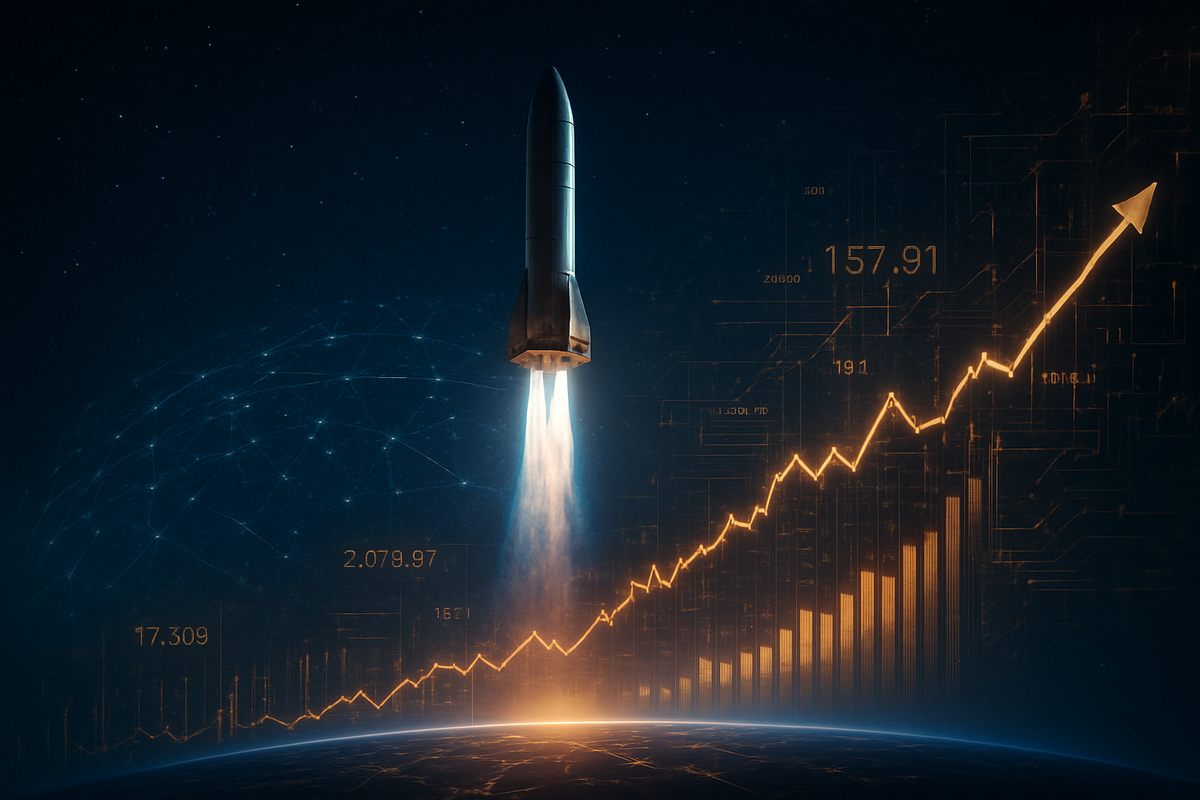
In a move that signals the definitive maturation of the commercial space age, reports emerged on March 26, 2026, that SpaceX is preparing to file a confidential S-1 prospectus with the Securities and Exchange Commission (SEC) for what is expected to be the largest Initial Public Offering in financial history. Sources close to the company indicate that the aerospace juggernaut, led by Elon Musk, is targeting a June 2026 listing with a staggering valuation estimated between $1.5 trillion and $1.75 trillion. This valuation follows the high-profile February 2026 merger of SpaceX with Musk’s artificial intelligence venture, xAI, effectively rebranding the company as the world’s first "orbital intelligence" utility.
The immediate implications for the global markets are profound. By transitioning from a private venture to a public entity, SpaceX is poised to unlock unprecedented liquidity for early investors while providing a massive capital infusion—rumored to be a record-breaking $75 billion raise—to fund its ambitious Starship-led missions to Mars. For the broader investment community, the IPO represents more than just a stock listing; it is the birth of a new asset class where space-based infrastructure and artificial intelligence converge, potentially reshaping the "Magnificent Seven" into a "Musk-Centric" market index.
The Path to a Trillion-Dollar Listing
According to reports from major financial outlets on March 26, the decision to go public was accelerated by the successful integration of xAI’s "Grok" infrastructure into the Starlink V3 satellite constellation. This technological synergy has allowed SpaceX to begin deploying "Orbital Data Centers," which utilize the vacuum of space for cooling and solar energy for power, bypassing the terrestrial limits of traditional AI compute facilities. The timeline leading to this moment has been a whirlwind of strategic consolidations: following a private valuation of $800 billion in late 2025, SpaceX absorbed xAI in an all-stock deal that valued the AI firm at $250 billion, creating the trillion-dollar behemoth that now sits at the doorstep of the public markets.
Key stakeholders, including SpaceX President and COO Gwynne Shotwell, have been instrumental in professionalizing the company’s financial reporting to meet the rigorous standards of the SEC. Industry insiders suggest that Musk is pushing for an unconventional 20% to 30% allocation for retail investors, a move intended to maintain the "cult-like" loyalty of his fan base and stabilize the stock against institutional short-selling. Initial market reactions on March 26 were electric; while SpaceX remains private for the next few weeks, the "rising tide" of the IPO news sent shockwaves through the aerospace sector, with secondary market shares of SpaceX reportedly trading at a 15% premium within hours of the leak.
Winners, Losers, and the New Space Hierarchy
The impending SpaceX IPO has created a stark divide between the "New Space" winners and the traditional "Aerospace Primes." Companies like Rocket Lab (Nasdaq: RKLB) and AST SpaceMobile (Nasdaq: ASTS) saw their stock prices surge by over 10% on March 26 as investors looked for "pure-play" space stocks that might be revalued in the wake of SpaceX’s massive benchmark. Rocket Lab, in particular, is seen as a primary beneficiary, as it remains the only other Western company with a proven high-cadence launch record, making it an attractive "diversification" play for those who find SpaceX’s $1.7 trillion valuation too steep.
Conversely, legacy giants such as Boeing (NYSE: BA) and Lockheed Martin (NYSE: LMT) face a challenging recalibration. Boeing, still reeling from the 2024 Starliner setbacks, has seen its space revenue share continue to erode, with NASA increasingly favoring SpaceX’s Dragon and Starship for critical missions. While Lockheed Martin remains a dominant force in deep-space defense contracts, the SpaceX IPO threatens to drain institutional capital away from these slower-growth "dividend" stocks in favor of Musk’s high-growth AI-Space hybrid. Northrop Grumman (NYSE: NOC) has managed to maintain its footing by pivoting to satellite mass production for the Space Development Agency, but the sheer scale of SpaceX’s Starlink dominance makes it difficult for any competitor to maintain margins in the commercial satellite internet market.
The Convergence of Space, AI, and Regulation
Beyond the immediate financial figures, the SpaceX IPO represents a tectonic shift in the global industrial landscape. It fits into a broader trend of "Vertical Sovereignty," where a single company controls the launch vehicle, the satellite, the data transmission, and now the AI processing power. This convergence renders traditional industry silos obsolete. However, this dominance has invited intense regulatory scrutiny. The SEC is reportedly investigating the February merger with xAI to ensure that the $250 billion valuation of the AI unit wasn't inflated to mask the high capital expenditures of the Starship program. Simultaneously, the FAA’s recently implemented "Part 450" licensing framework is being tested by SpaceX’s goal of 150+ launches in 2026, leading to friction over environmental impacts and orbital debris management.
Historically, the SpaceX IPO is being compared to the 2019 listing of Saudi Aramco, though with a futuristic twist. While Aramco represented the peak of the carbon economy, SpaceX is being marketed as the foundation of the "Off-World Economy." The ripple effects extend to international policy; as SpaceX deploys orbital data centers, a "Jurisdictional Mirage" is emerging where data stored in orbit may exist outside the traditional legal reach of terrestrial governments. This has sparked a new wave of policy debates regarding data sovereignty and the weaponization of orbital AI, pitting Musk’s libertarian tech-vision against the regulatory frameworks of the US and EU.
The Final Frontier of Finance: What Comes Next?
In the short term, all eyes are on the SEC’s review of the S-1 filing and the finalized June listing date. The primary challenge for SpaceX will be managing the "Musk Discount" or "Musk Premium"—the high volatility associated with its CEO’s public persona and his other ventures like Tesla (Nasdaq: TSLA) and X. Analysts expect that if the IPO is successful, it will trigger a wave of spinoffs from other private space firms like Blue Origin or Sierra Space, as venture capitalists seek to exit their long-held positions in the sector.
Long-term, the capital raised from this IPO is intended to catalyze the "Mars Economy." Strategic pivots may include the development of lunar-based manufacturing hubs and the mass production of Starship variants for point-to-point terrestrial travel. The market opportunity is vast: by 2030, the "Orbital Compute" market alone could rival the current cloud computing industry. However, the company must navigate the "Debris Ceiling"—a scenario where the sheer number of satellites in Low Earth Orbit makes further launches prohibitively dangerous. The success of SpaceX as a public company will likely depend on its ability to prove that its AI-driven collision avoidance systems can keep the "final frontier" open for business.
Conclusion: A New Era for Investors
The reports of SpaceX’s March 2026 IPO filing mark a "Rubicon" moment for the financial world. The transition from a secretive, visionary private company to a $1.7 trillion public titan is the ultimate validation of Elon Musk’s long-term gamble on reusable rocketry and global satellite internet. For investors, the key takeaways are the unprecedented scale of the offering and the strategic merger with xAI, which positions the company not just as a transport provider, but as the backbone of the next generation of AI infrastructure.
Moving forward, the market will be characterized by a "Space-AI" gold rush, but caution is warranted. The regulatory hurdles from the SEC and FAA, combined with the technical risks inherent in Starship’s development, mean that volatility will be a constant companion for SpaceX shareholders. Investors should watch for the formal S-1 release in April, any further details on the retail investor allocation, and the progress of the Starlink V3 deployment. As SpaceX prepares to go public, the boundary between science fiction and high-finance has never been thinner.
This content is intended for informational purposes only and is not financial advice.