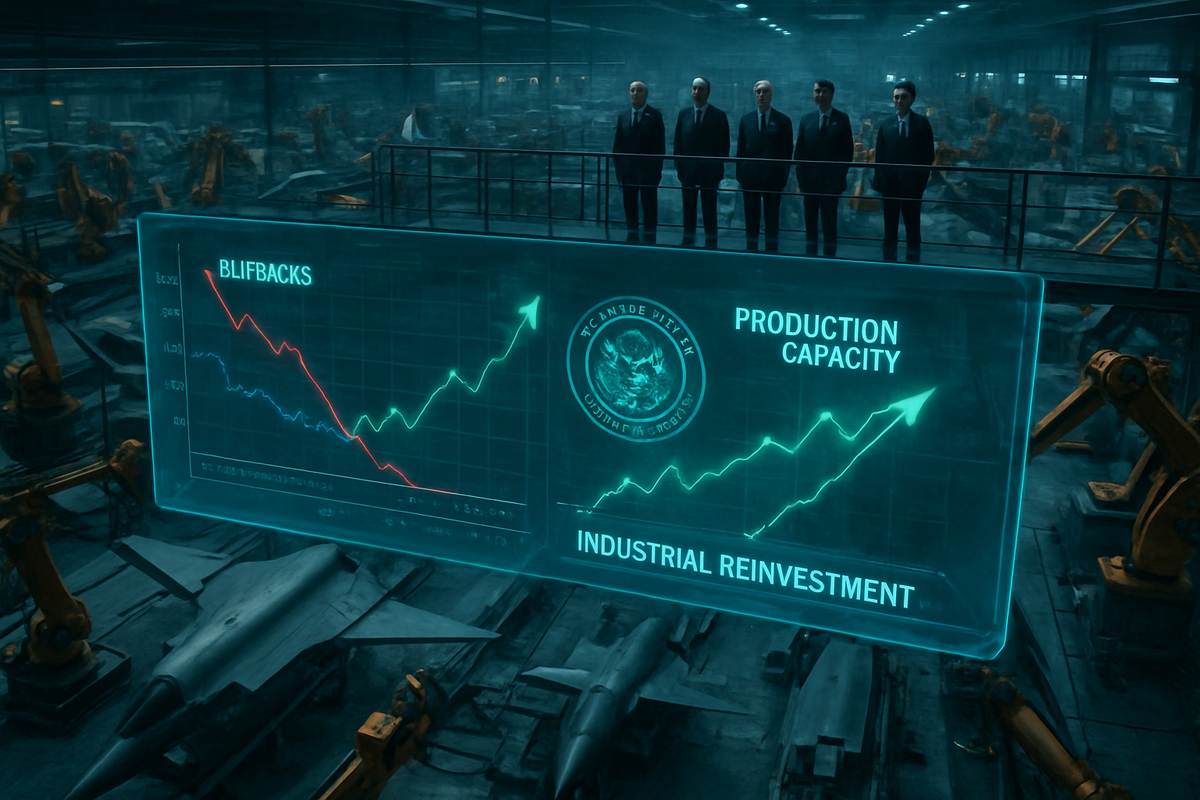
In a move that has fundamentally rewritten the social contract between the American government and its largest military contractors, the U.S. has officially implemented a sweeping series of capital controls on the defense industry. These measures, spearheaded by Executive Order 14372, titled "Prioritizing the Warfighter in Defense Contracting," and the subsequent introduction of the "Prioritizing the Warfighter Act of 2026," effectively end the era of unfettered shareholder returns in the aerospace and defense sectors. Under the new regime, the federal government now holds the power to block stock buybacks and dividend payments for any major contractor deemed to be "underperforming" in its delivery of critical military hardware.
The immediate implications of this shift have sent shockwaves through Wall Street, forcing a radical "re-rating" of how defense companies are valued. For decades, the sector was prized by investors as a "bond-proxy"—a source of steady, predictable dividends and massive share repurchases. Now, that capital is being forcibly redirected toward expanding domestic production capacity and accelerating the delivery of next-generation weapon systems. While the initial market reaction was one of panic, a massive, front-loaded defense budget exceeding $1 trillion has begun to transform the sector into a high-volatility, high-growth "tech-like" play, signaling a permanent transition to a "wartime footing" for the U.S. industrial base.
The End of the Buyback Era: A Timeline of the Great Pivot
The implementation of these controls was not an overnight occurrence but rather the culmination of years of mounting frustration in Washington over the perceived hollowization of the U.S. defense industrial base. The pivotal moment arrived on January 7, 2026, when the administration issued an Executive Order that linked a contractor’s financial flexibility directly to its operational performance. Specifically, the order established that any company with more than $250 million in annual defense revenue would be prohibited from conducting share repurchases or increasing dividends if they failed to meet strict "on-time" delivery thresholds or if they were found to be underinvesting in domestic manufacturing facilities.
The momentum accelerated throughout the first quarter of 2026. Following a series of high-profile missile strikes in the Middle East in February, known as "Operation Epic Fury," the administration moved to codify these executive actions into permanent law. On March 26, 2026, the "Prioritizing the Warfighter Act" was introduced with bipartisan support, lead by a coalition of populists and national security hawks. Key stakeholders, including the Secretary of War—a title recently revived by the administration to replace the "Secretary of Defense" in official communications—argued that the $1.5 trillion in projected spending for FY2027 required a "hard wall" between taxpayer funds and shareholder pockets.
Initial market reactions were swift and severe. On the afternoon of the January announcement, the defense sector saw its steepest single-day decline in years as algorithms reacted to the loss of the "buyback floor." However, this "Black Wednesday" for defense stocks was short-lived. By the following week, the realization that the government was effectively "guaranteeing" growth through the "One Big Beautiful Bill Act" (OBBBA)—a $150 billion reconciliation package for munitions and shipbuilding—caused a massive rotation back into the sector, albeit with a new focus on production speed over earnings-per-share (EPS) growth.
Winners and Losers in the New Industrial Regime
The impact of these capital controls has been uneven across the sector's heavyweights. Lockheed Martin (NYSE: LMT) has emerged as an early winner in this transition. Despite an initial 5.5% drop following the January EO, the company was quickly re-rated by analysts as a "structural growth beneficiary." Because Lockheed Martin had already pivoted toward massive capacity expansion for its munitions and F-35 lines, it was able to secure an early "Performance Waiver," allowing it to maintain its dividend while others were frozen. By late March, LMT's price-to-earnings multiple had expanded to 31x, a level usually reserved for high-flying software firms.
Conversely, RTX Corporation (NYSE: RTX) faced a more turbulent road. The company was singled out by administration officials early in the year for what was described as "systemic underinvestment" in legacy production lines. Following the January order, RTX shares tumbled 10% in post-market trading as investors realized the company’s massive $30 billion buyback plan was effectively dead on arrival. While RTX has since recovered some ground due to the surge in demand for its Patriot missile systems, the company remains in a "remediation" phase, with executive compensation capped at $5 million annually until production targets are met.
In the shipbuilding and specialized aerospace sub-sectors, the results have been mixed. General Dynamics (NYSE: GD) and Huntington Ingalls Industries (NYSE: HII) have seen stable, if unspectacular, growth. These firms are perceived as "safe havens" due to their massive, multi-decade backlogs in the nuclear submarine and carrier programs, which make them less susceptible to the month-to-month delivery volatility that plagues aircraft and missile manufacturers. Meanwhile, Northrop Grumman (NYSE: NOC) has hit new 52-week highs as the ramp-up of the B-21 Raider program has been designated a "National Priority One" project, exempting the firm from certain capital restrictions in exchange for 24/7 production cycles.
A Global Shift: From Free Markets to "Fortress Finance"
The implementation of these controls fits into a much broader trend of "Fortress Finance," where national security concerns override traditional neoliberal economic policies. The 2026 capital controls are a direct descendant of the COINS Act (Comprehensive Outbound Investment National Security Act), which was folded into the FY2026 National Defense Authorization Act (NDAA). The COINS Act already prohibited these same companies from investing capital in "countries of concern" like China and Russia; the new domestic controls simply close the loop by ensuring that the capital remains within the U.S. borders and the defense ecosystem.
Historically, this level of intervention has only been seen during the world wars of the 20th century. By capping executive pay and mandating reinvestment, the U.S. government is effectively treating defense contractors as public utilities or strategic assets rather than independent, profit-maximizing corporations. This has created a massive ripple effect among partners and competitors. European defense firms, such as BAE Systems and Rheinmetall, are now facing similar pressure from their respective governments to adopt "production-first" financial models, leading to a global decoupling of the defense industry from the standard commercial capital markets.
Furthermore, the "Department of War" rebrand signals a regulatory shift toward "wartime procurement." The Defense Contract Audit Agency (DCAA) has seen its budget tripled, with new powers to perform "real-time" audits of production lines. This regulatory environment has made it significantly more difficult for smaller, venture-backed "defense tech" startups to compete, as the compliance costs of the "Prioritizing the Warfighter Act" are prohibitive for firms without massive legal and accounting departments.
The Path Ahead: Adaptation and Strategic Pivots
Looking forward, the defense industry must prepare for a future where "alpha" is generated through engineering excellence rather than financial engineering. In the short term, the primary challenge for companies like Boeing (NYSE: BA) and RTX will be the potential for a "talent drain." With executive and high-level managerial pay capped by the new legislation, there are growing concerns that top-tier talent may flee to the unregulated tech sector or private equity. To counter this, many firms are expected to pivot toward "performance-based" non-monetary incentives and increased R&D grants to retain their most vital engineers.
In the long term, we are likely to see a wave of "strategic consolidation" as smaller players, unable to navigate the new capital restrictions, seek shelter under the umbrellas of the "Big Five" contractors. This will likely trigger a new round of antitrust debates, as the government must balance its desire for a robust, competitive industrial base with its need for massive, centralized production hubs. The emergence of "Performance Waivers" as a tradable commodity or a key valuation metric will also change the nature of equity research, as analysts will need to become experts in factory throughput and supply chain logistics rather than just balance sheet analysis.
Market opportunities will emerge in the "industrial enablement" sector—companies that provide the robotics, AI-driven logistics, and 3D printing technology required to meet the government's aggressive new production quotas. As the U.S. continues to move toward a $1.5 trillion defense budget, the firms that can demonstrate an ability to "reinvest and deliver" will be the ones that survive this new era of directed capitalism.
Conclusion: A Permanent Change in Market DNA
The early 2026 implementation of capital controls on the defense industry marks the definitive end of the "peace dividend" era. The core takeaway for the market is clear: the U.S. government no longer views defense spending as a stimulus for the private sector, but as a mandatory investment in national survival. The transition from a dividend-focused sector to a production-mandated sector has permanently altered the DNA of the defense trade, rewarding companies that prioritize the "Warfighter" over the "Wealth-manager."
Moving forward, the market will likely remain in a state of high-growth volatility. Investors should watch for the first round of "Performance Waiver" announcements in late 2026, which will serve as the first real test of how strictly the administration intends to enforce these new rules. Furthermore, any sign of a "talent drain" in SEC filings or executive departures will be a critical red flag for the sector’s long-term health. As we enter the second half of 2026, the defense industry is no longer just a part of the market—it is an arm of the state, and its financial performance will be judged by the speed of its assembly lines rather than the size of its buyback programs.
This content is intended for informational purposes only and is not financial advice.