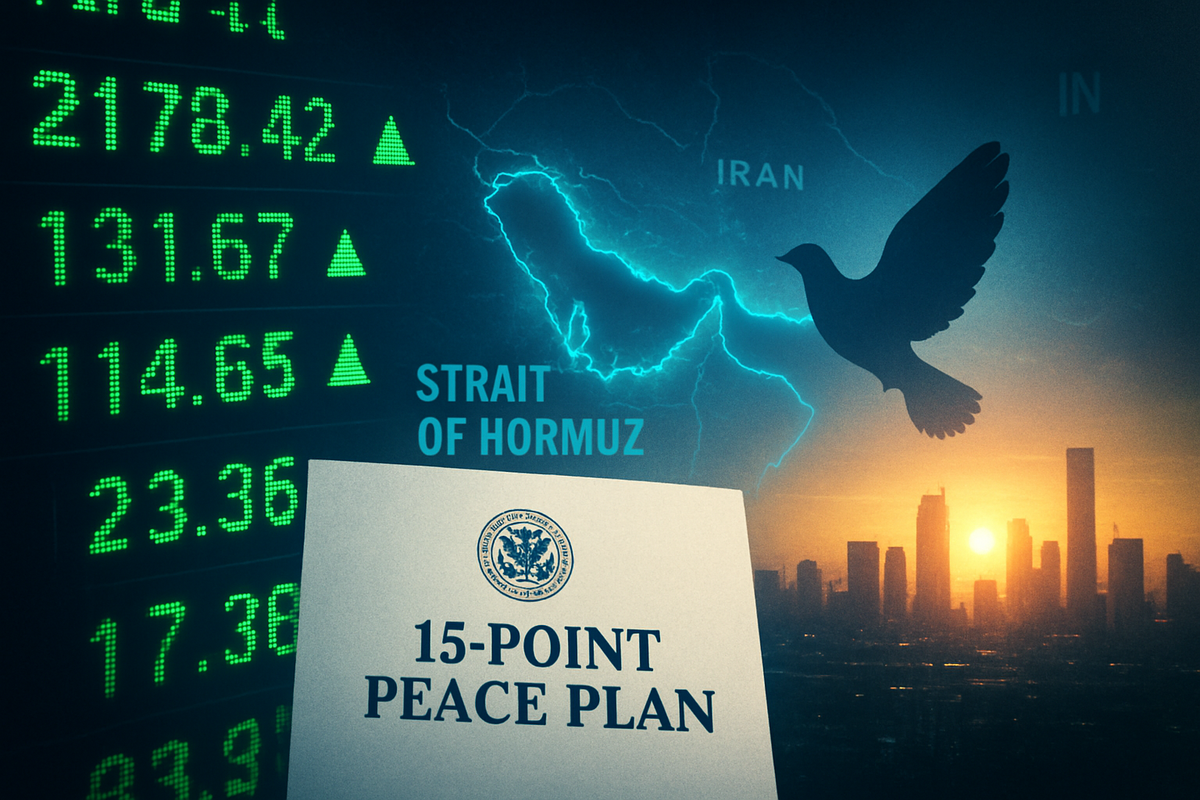
The 'Peace Dividend' Reborn: Markets Surge as U.S. Unveils 15-Point Plan to End Conflict with Iran
Global financial markets witnessed a seismic shift on Wednesday, March 25, 2026, as the U.S. administration formally introduced a drafted 15-point peace proposal aimed at ending the four-week military engagement with Iran. The announcement, which provides a comprehensive "off-ramp" for the conflict known as "Operation Epic Fury," triggered an immediate and aggressive bullish reaction in U.S. stock futures, as investors pivot from a war-time defensive stance toward a potential era of renewed regional stability and lower energy costs.
The "leak" of the document, reportedly transmitted through Pakistani intermediaries, sent the Dow Jones Industrial Average futures climbing over 500 points, while S&P 500 futures surged nearly 1% before the opening bell. The prospect of a diplomatic resolution has significantly suppressed the geopolitical risk premium that has haunted the markets since late February, leading to a sharp retreat in crude oil prices and a broad-based rally in risk assets.
A Blueprint for Stability: Inside the 15-Point Peace Plan
The 15-point plan, drafted by the administration of President Donald Trump in his second term, represents one of the most ambitious diplomatic efforts in the Middle East in decades. Central to the proposal are demands for the complete dismantlement of Iran’s nuclear infrastructure and the permanent cessation of all uranium enrichment. In exchange, the U.S. has offered a total lifting of economic sanctions and a "Marshall Plan" style assistance program for civilian infrastructure. Key highlights include the reopening of the Strait of Hormuz as a "permanent free maritime zone" and the deployment of an Arab-led International Stabilization Force to oversee security in the region's most volatile corridors.
The timeline leading to this moment has been nothing short of chaotic. "Operation Epic Fury" commenced on February 28, 2026, following a series of escalations that saw the closure of the Strait of Hormuz and a spike in global oil prices to over $115 per barrel. The conflict reached a turning point earlier this month when reports surfaced of a leadership vacuum in Tehran, following a precision strike on military command centers. This vacuum appears to have opened the door for Pakistani Prime Minister Shehbaz Sharif and Field Marshal Asim Munir to act as backchannel mediators between the U.S. State Department and the Iranian transition council.
Initial market reactions have been overwhelmingly positive, reflecting a "relief rally" that many analysts believe could extend into a multi-month bull run. While the military campaign was initially seen as a catalyst for defense and energy stocks, the shift toward diplomacy has ignited interest in growth-oriented sectors. Tech giants and consumer-facing enterprises are leading the charge as the threat of a wider, more prolonged regional war—and the accompanying inflationary energy shocks—begins to recede.
The Market Reshuffle: Winners and Losers in the De-Escalation Era
The immediate impact on public companies has been starkly bifurcated. The primary beneficiaries are the transportation and logistics sectors, which have struggled under the weight of surging fuel costs. United Airlines Holdings, Inc. (NASDAQ: UAL) and Delta Air Lines, Inc. (NYSE: DAL) saw their shares jump in pre-market trading as Brent Crude prices plummeted below $95 per barrel. For these carriers, a return to sub-$80 oil could result in a massive expansion of profit margins, particularly as international travel demand to the Middle East and Europe is expected to rebound following the cessation of hostilities.
Similarly, logistics powerhouses like FedEx Corporation (NYSE: FDX) and United Parcel Service, Inc. (NYSE: UPS) are poised for significant gains. Both companies operate massive air and ground fleets that are highly sensitive to diesel and jet fuel prices. The "Peace Dividend" effectively acts as a corporate tax cut for these entities, lowering operating expenses while simultaneously boosting global trade volumes. On the consumer side, companies like Amazon.com, Inc. (NASDAQ: AMZN) and Apple Inc. (NASDAQ: AAPL) are benefiting from improved consumer sentiment and the removal of potential supply chain bottlenecks that a prolonged war would have exacerbated.
Conversely, the "War Trade" that dominated the first quarter of 2026 is rapidly unwinding. Energy titans such as Exxon Mobil Corporation (NYSE: XOM) and Chevron Corporation (NYSE: CVX) have seen their stocks cool as the supply-side fear premium evaporates. While these companies remain fundamentally strong, the shift away from $100+ oil pressures upstream revenues. Furthermore, defense contractors that saw a "war utility" spike, such as Lockheed Martin Corporation (NYSE: LMT) and Palantir Technologies Inc. (NASDAQ: PLTR), are facing a correction. Investors are now questioning whether the urgency for emergency military spending will sustain at current levels if the 15-point plan is successfully implemented.
The 'Peace Dividend' and the Shift in Global Policy
The current event echoes historical precedents, most notably the "Peace Dividend" of the early 1990s following the end of the Cold War and the swift conclusion of the 1991 Gulf War. Historically, when military spending as a percentage of GDP declines and energy prices stabilize, the broader economy enters a period of low-inflation growth. If the 15-point plan holds, it could signal a long-term shift in U.S. foreign policy toward "maximum pressure" leading to "maximum diplomacy," a trend that would likely encourage more aggressive capital investment in domestic infrastructure and emerging technologies.
Furthermore, the reopening of the Strait of Hormuz is a critical milestone for global supply chains. Roughly 20% of the world's liquid petroleum passes through this narrow waterway. The plan’s insistence on a "free maritime zone" would theoretically end the era of maritime brinkmanship, providing a stable backdrop for global shipping companies and the semiconductor industry, which relies on stable energy costs for its power-intensive manufacturing processes. This de-escalation fits into a broader industry trend where corporations are increasingly seeking "geopolitical insulation"—moving from "just-in-time" to "just-in-case" logistics, which may now pivot back to efficiency as risks diminish.
The Road Ahead: Implementation Risks and Strategic Pivots
While the market is currently celebrating the prospect of peace, the path to full implementation remains fraught with challenges. The 15-point plan is still in the "drafted" phase, and any sign of resistance from Iranian hardliners or a breakdown in negotiations could lead to a violent reversal in market sentiment. Strategic pivots will be required for companies that have heavily invested in "war-proof" portfolios. Hedge funds and institutional investors are already rotating capital out of defensive commodities and into high-beta tech stocks like Tesla, Inc. (NASDAQ: TSLA) and Arm Holdings plc (NASDAQ: ARM), anticipating that a more stable global environment will favor innovation over preservation.
In the short term, the market will be hyper-focused on the official response from Tehran and the first signs of the International Stabilization Force deployment. Long-term, the focus will shift to how the U.S. handles the lifting of sanctions. A sudden influx of Iranian oil back into the global market could keep oil prices suppressed for an extended period, creating a unique challenge for domestic shale producers in the U.S. who require higher price floors to remain profitable. The "Peace Dividend" is a powerful tailwind, but its durability depends entirely on the successful transition from a military offensive to a diplomatic reality.
Final Assessment: What Investors Should Watch
The introduction of the 15-point peace plan marks a potential watershed moment for the global economy in 2026. The key takeaway for investors is the rapid shift in market leadership from energy and defense to transportation, tech, and consumer discretionaries. The immediate bullishness in futures suggests that the market had priced in a much bleaker, multi-year conflict, and the current de-escalation is a massive "reset" of those expectations.
Moving forward, the market will likely remain volatile as the "details" of the 15 points are negotiated. Investors should watch for the formal reopening of the Strait of Hormuz and any "snapback" provisions that could reintroduce sanctions if Iran fails to comply with the nuclear dismantlement phases. For now, the "Peace Dividend" has revitalized the bull case for the U.S. economy, providing a much-needed reprieve from the specter of global conflict and the weight of high energy prices.
This content is intended for informational purposes only and is not financial advice.