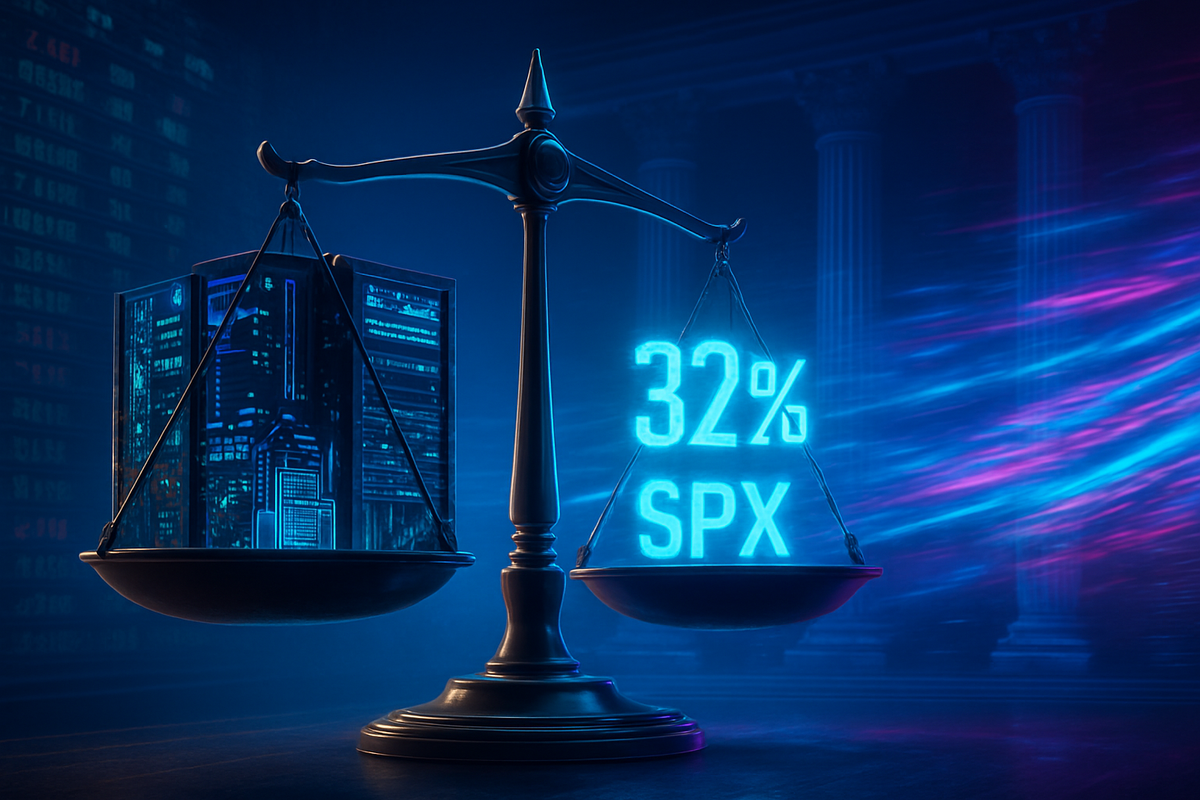
As of March 25, 2026, the S&P 500 (NYSEARCA: $SPY) has undergone a fundamental transformation, evolving from a diversified barometer of the American economy into a concentrated bet on the future of computation. With the Information Technology sector now commanding a staggering 32% of the index's total market capitalization, a historic threshold has been crossed. For the modern investor, the S&P 500 is no longer a "safe" broad-market basket; it has become a high-octane vehicle with a sector beta of 1.6, meaning the entire index now swings 60% more violently than historical norms in response to tech-specific news.
This concentration has created a "volatility multiplier" effect that was on full display during the first quarter of 2026. When a handful of companies—the so-called "Ten Titans"—dictate the movement of nearly $40 out of every $100 invested in the index, the broader market’s traditional safety through diversification begins to evaporate. As Silicon Valley enters a high-stakes "AI Utilization" phase, the ripples from its boardrooms are no longer just industry news; they are the primary drivers of global retirement accounts and institutional stability.
The Rise of the 32%: How the S&P 500 Became the Nasdaq-Lite
The journey to this 32% weighting was not a sudden spike but the culmination of a multi-year "AI Capex Super-Cycle" that accelerated through 2024 and 2025. At the close of 2024, the tech sector sat at a formidable 31.3% weight, already sparking concerns about over-concentration. However, the 2025 transition from building AI infrastructure to monetizing software applications drove a fresh wave of capital into the sector. By January 2026, the pure Information Technology sector reached a peak weight of 34.6%, matching the feverish concentration seen during the height of the dot-com bubble in March 2000.
Unlike the speculative mania of 2000, however, the 2026 dominance is fueled by massive earnings. Technology companies are projected to deliver 32% earnings-per-share (EPS) growth this year, dwarfing the 13% projected for the rest of the index. This fundamental strength has pushed the sector’s beta to 1.6. In practical terms, this means that for every 1% move in the "Old Economy" sectors, the tech-heavy S&P 500 is now primed to move 1.6%. The index has effectively become a "Nasdaq-Lite," making it increasingly susceptible to rapid, news-driven sell-offs, particularly regarding interest rates and artificial intelligence (AI) monetization timelines.
The primary stakeholders in this shift are the "Ten Titans," a group including Nvidia Corp. (NASDAQ: NVDA), Microsoft Corp. (NASDAQ: MSFT), and Apple Inc. (NASDAQ: AAPL), which together account for over 40% of the index’s total value. The first quarter of 2026 saw these giants report a staggering $650 billion in combined AI infrastructure spending—a figure that has markets on edge. The "Capex-geddon" fears that emerged following Microsoft’s January earnings call illustrated the new reality: even a stellar earnings beat can be met with a sell-off if investors feel the return on AI investment is lagging behind the massive spending.
The Titans and the Trough: Winners and Losers in a Concentrated Market
In this top-heavy environment, the "winners" are no longer just the chipmakers, but the companies providing the physical backbone for the tech sector’s expansion. Vertiv Holdings Co. (NYSE: VRT), recently added to the S&P 500 in the March 2026 rebalancing, has emerged as a star performer by providing the liquid cooling systems essential for AI data centers. Similarly, utility giants like NextEra Energy Inc. (NYSE: NEE) have seen their stock prices surge as they pivot from defensive dividend plays to essential "AI Infrastructure" partners, signing massive power-purchase agreements with tech hyperscalers.
Conversely, the "losers" in this environment are the companies that lack a direct AI narrative or have been crowded out of index funds. The "S&P 493"—the remaining stocks in the index—have largely underperformed their tech-heavy counterparts, with the equal-weighted S&P 500 trailing the market-cap-weighted index by its largest margin on record. Small-cap and mid-cap companies have faced a liquidity drain as passive investment flows are sucked into the top ten holdings. Recent removals from the index, such as Match Group Inc. (NASDAQ: MTCH) and Paycom Software Inc. (NYSE: PAYC), highlight the brutal nature of this "winner-take-all" market where failing to keep pace with the tech titans results in immediate institutional divestment.
The energy sector has also provided a stark contrast. While the Energy Select Sector SPDR Fund (NYSEARCA: XLE) has rallied over 33% year-to-date due to geopolitical tensions in the Middle East and South America, its relatively small weighting in the S&P 500 means its gains do little to offset a bad day in Silicon Valley. This decoupling means that even when "Old Economy" sectors are booming, the headline index can remain flat or negative if tech faces a regulatory hurdle or an earnings miss.
The Fragile Foundation: Systematic Risk and the AI Reckoning
The broader significance of a 32% tech weight lies in the systemic risk it poses to the U.S. financial system. Historical precedents, such as the Nifty Fifty era of the 1970s or the 2000 tech bubble, suggest that such extreme concentration is often a precursor to a "Great Rebalancing." When nearly $4 out of every $10 invested in a standard 401(k) is tied to the success of fewer than a dozen companies, the margin for error is razor-thin. A single regulatory blow, such as a forced divestiture in the ongoing DOJ case against Alphabet Inc. (NASDAQ: GOOGL) or a setback in the FTC’s trial against Amazon.com Inc. (NASDAQ: AMZN), could trigger an index-wide correction.
Furthermore, the 1.6 beta has changed the way the Federal Reserve views market stability. In early 2026, the Fed has had to account for the "wealth effect" of tech swings more than ever before. A 10% correction in the tech sector now wipes out trillions of dollars in paper wealth almost instantly, potentially cooling consumer spending and influencing monetary policy. This has led to a "bifurcated" regulatory environment where California’s 2026 antitrust reforms are creating a patchwork of legal standards that tech companies must navigate, adding another layer of volatility to an already sensitive market.
The AI "utilization phase" is also testing the limits of productivity. While the infrastructure phase was defined by buying GPUs, 2026 is defined by the search for ROI. If the $650 billion in projected Capex does not translate into measurable margin expansion for the broader economy by the end of the year, the 1.6 beta could work against investors, leading to a rapid de-rating of the entire index as multiples contract toward historical averages.
The Great Rotation: What Comes Next for the Remainder of 2026
Looking ahead to the second half of 2026, the market appears poised for a "Great Rotation." Analysts are increasingly looking toward the "Tangible Economy"—sectors like Materials, Industrials, and Energy—to provide the next leg of growth as tech faces a "return-on-investment reckoning." The passage of the "One Big Beautiful Bill Act" in late 2025 has provided fiscal tailwinds for domestic manufacturing, which may finally allow the "S&P 493" to close the performance gap with the tech titans.
In the short term, investors should prepare for continued high volatility. The 1.6 beta is here to stay as long as tech maintains its dominant market share. Strategic pivots are already occurring; institutional investors are moving toward equal-weighted funds, such as the Invesco S&P 500 Equal Weight ETF (NYSEARCA: RSP), to mitigate the risks of over-concentration. For individual investors, the challenge will be resisting the urge to chase the "Ten Titans" while maintaining enough exposure to the tech sector to avoid missing out on the AI-driven productivity gains that are expected to materialize by 2027.
The Investor’s Verdict: Navigating the High-Octane Index
The key takeaway for 2026 is that the S&P 500 has lost its status as a diversified safety net. It is now a high-growth, high-volatility instrument that requires a more nuanced approach than the "set it and forget it" strategies of previous decades. The market's extreme sensitivity to tech news means that macro data—like inflation and interest rates—often takes a backseat to Nvidia's guidance or Microsoft's cloud margins.
Moving forward, the primary metric to watch is the "Earnings Gap" between tech and the rest of the market. If the S&P 493 can begin to show double-digit EPS growth, we may see a healthy, gradual rebalancing that preserves index levels. However, if tech earnings falter while its weight remains at 32%, the 1.6 beta will ensure a turbulent ride for the foreseeable future. Investors should maintain a watchful eye on regulatory developments and the "AI Power Crunch," as these will be the true catalysts for the next major shift in market leadership.
This content is intended for informational purposes only and is not financial advice.