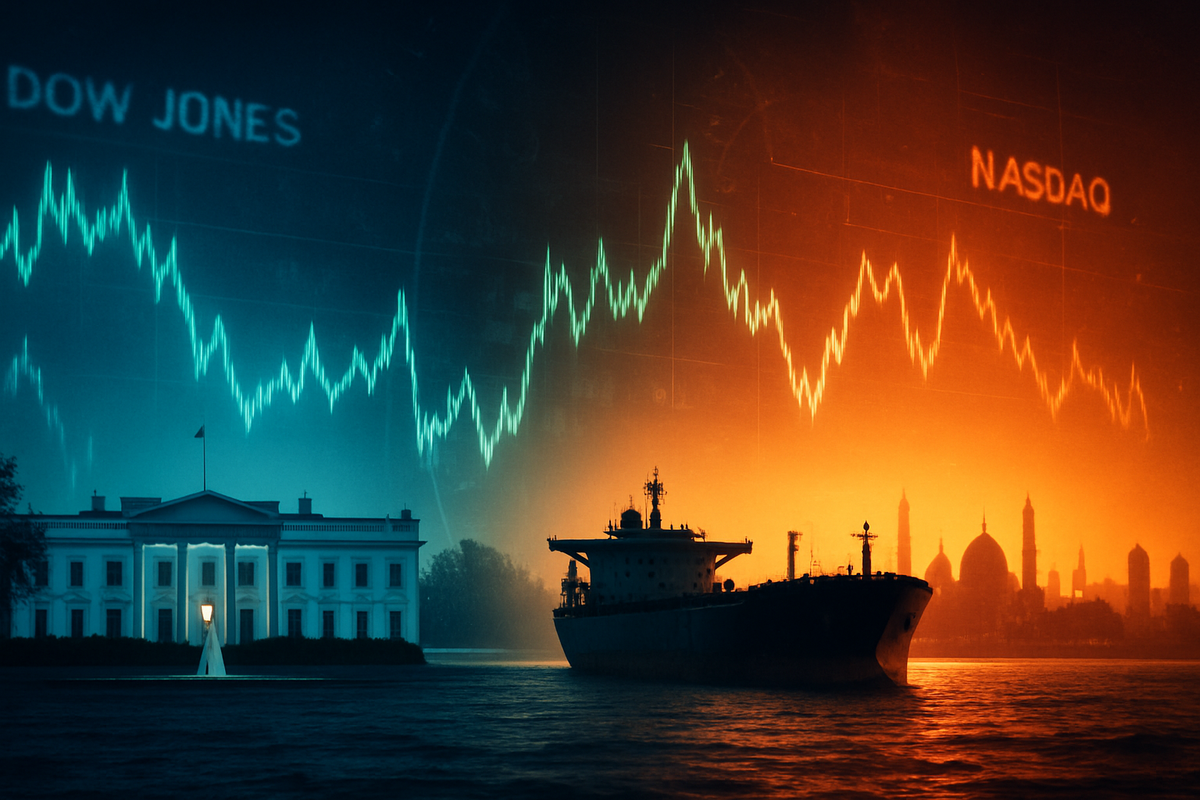
The global financial markets are caught in a state of high-octane volatility today, March 24, 2026, as investors grapple with wildly conflicting reports regarding the state of conflict in the Middle East. After a weekend of escalating tensions that saw oil prices threaten historic highs, President Donald Trump took to social media late Monday to announce "very good and productive conversations" with Iranian leadership aimed at a total resolution of hostilities. The news initially triggered a massive relief rally, but the gains are being erased this morning as Tehran issues a blistering denial, labeling the American claims as "fakenews" designed to manipulate the energy markets.
The disconnect between Washington and Tehran has sent the major indices on a rollercoaster ride. While the Dow Jones Industrial Average is fighting to stay in the green on the back of a rebounding energy sector, the tech-heavy Nasdaq and the broader S&P 500 have slipped into negative territory. This "whiplash" effect highlights the extreme sensitivity of the current market environment to geopolitical headlines, with the "Hormuz Risk Premium" once again becoming the primary driver of daily price action across every asset class from crude oil to semiconductor stocks.
The current crisis reached a fever pitch last week when President Trump issued a 48-hour ultimatum, threatening to "obliterate" Iranian energy infrastructure if the Iranian-led blockade of the Strait of Hormuz was not lifted. As the deadline approached on Friday, March 20, the Dow Jones plummeted nearly 1% and Brent Crude surged as shipping companies declared force majeure in the region. However, the atmosphere shifted dramatically on Monday afternoon when the President announced a five-day postponement of military strikes, citing a breakthrough in indirect negotiations involving Vice President JD Vance and Secretary of State Marco Rubio.
According to the White House, these "productive talks" included an Iranian commitment to permanent denuclearization in exchange for significant sanctions relief. Trump’s announcement sent Brent Crude plummeting nearly 10% in a single session, falling back below the $100 mark as the "peace trade" took hold of Wall Street. The Dow Jones responded with a massive 1,100-point intraday spike, closing Monday up 1.38% as investors breathed a sigh of relief that a direct military confrontation might be avoided.
However, the optimism was short-lived. By Tuesday morning, the Iranian Foreign Ministry and Parliament Speaker Mohammad Baqer Qalibaf categorically denied any direct engagement with the Trump administration. Tehran claimed the U.S. was merely buying time for military positioning while Iranian Revolutionary Guard (IRGC) forces launched a fresh wave of drone strikes against maritime targets in the Gulf. This direct contradiction has thrown the markets back into a state of uncertainty, as traders are now forced to weigh the President’s optimistic rhetoric against the reality of ongoing kinetic warfare on the ground.
The primary winners in this volatile landscape continue to be the major energy producers and defense contractors. ExxonMobil (NYSE: XOM) and Chevron (NYSE: CVX) saw their shares rebound by over 3% this morning as oil prices climbed back above $100 following Iran’s denial of peace talks. These companies are benefiting from the sustained "geopolitical premium" on crude, which offsets concerns about global demand. Similarly, defense giants like Lockheed Martin (NYSE: LMT) and RTX Corporation (NYSE: RTX) have seen increased buy-side pressure as the "five-day pause" looks increasingly like a temporary lull before further escalation.
Conversely, the travel and consumer sectors are bearing the brunt of the uncertainty. Delta Air Lines (NYSE: DAL) and United Airlines Holdings (NASDAQ: UAL), which soared on Monday's peace rumors, have surrendered those gains as the prospect of sustained high fuel costs returns. The volatility is also weighing heavily on high-growth tech firms like NVIDIA (NASDAQ: NVDA) and Tesla (NASDAQ: TSLA). These companies are particularly sensitive to the inflationary pressures caused by energy spikes, which in turn drive up Treasury yields and reduce the present value of future earnings.
The financial sector is also feeling the strain of the unpredictability. Goldman Sachs (NYSE: GS) recently raised its U.S. recession probability to 30%, noting that the extreme swings in energy prices are making it nearly impossible for the Federal Reserve to chart a stable path for interest rates. While traditional "safe haven" assets like gold and government bonds are seeing inflows, the rapid shifts in the narrative are causing massive liquidations for momentum traders who are being caught on the wrong side of each new headline.
This diplomatic tug-of-war is occurring against a broader backdrop of "Maximum Pressure 2.0," a policy shift that has defined the second Trump administration's approach to the Middle East. Unlike the more traditional diplomatic channels of previous years, the current administration is utilizing a mix of social media-driven diplomacy and aggressive military ultimatums. This has created a new paradigm for global trade, where the security of the Strait of Hormuz—a chasm through which 20% of the world's oil flows—is tethered to the daily communications of world leaders rather than formal treaties.
The conflict also highlights the growing influence of regional mediators like Pakistan, Egypt, and Turkey, who are reportedly facilitating the "points" being exchanged between Washington and Tehran. This shift away from European-led mediation marks a significant change in the international order, suggesting that future peace in the Middle East may be brokered by regional powers with direct economic stakes in the stability of the Gulf. The current volatility is a stark reminder that the global supply chain remains incredibly fragile, and any disruption to energy flows can immediately reverse months of progress in cooling global inflation.
Historically, this situation echoes the 1970s oil shocks, but with the added complexity of algorithmic trading and real-time social media influence. In past decades, a denial from a foreign ministry might take days to filter through to market prices; today, it happens in milliseconds. This technological acceleration of geopolitical risk is forcing institutional investors to rethink their risk management strategies, moving away from long-term forecasting toward highly reactive, hedge-heavy positioning.
As the five-day military pause continues, the market is bracing for a "binary outcome" later this week. If the U.S. and Iran can move from conflicting social media posts to a verifiable summit—perhaps in Islamabad, as suggested by Pakistani Prime Minister Shehbaz Sharif—the resulting "Grand Bargain" could trigger one of the largest market rallies in recent history. A permanent resolution would likely crash oil prices to the $70 range, providing a massive stimulus to the global economy and potentially ending the threat of a 2026 recession.
However, the more likely short-term scenario is one of continued "gray zone" conflict. If the five-day window expires without a tangible diplomatic breakthrough, the likelihood of U.S. strikes on Iranian soil increases exponentially. In such a scenario, analysts warn that Brent Crude could spike toward $150 per barrel, leading to a "stagflationary" shock that would hammer the S&P 500 and Nasdaq. Investors must prepare for strategic pivots, potentially rotating more heavily into commodities and short-duration bonds to weather the storm of rising costs and interest rate uncertainty.
The next 72 hours will be critical. The market is looking for more than just tweets; it is looking for physical evidence of de-escalation, such as a reduction in IRGC naval activity or a formal joint statement from the mediating parties. Until such evidence emerges, the volatility is expected to remain extreme, with the major indices prone to 1-2% intraday swings based on the latest unverified reports from both sides of the Atlantic.
In summary, the current market chaos is the result of a profound "information gap" between the U.S. executive branch and the Iranian leadership. While President Trump’s claims of productive talks offered a brief glimmer of hope for a diplomatic solution, the swift and aggressive denial from Tehran has re-injected a heavy dose of realism into the markets. The primary takeaway for investors is that geopolitical risk is currently the single most important factor in portfolio performance, overshadowing traditional economic data and corporate earnings.
Moving forward, the market will likely remain in a "wait-and-see" mode, with a heavy bias toward defensiveness. The "Hormuz Risk Premium" is here to stay until a formal agreement is signed, sealed, and delivered. For the remainder of March, the focus will stay on the price of oil and the movement of the U.S. dollar, both of which will serve as the most accurate barometers of the perceived likelihood of war.
Investors should watch for three key indicators in the coming months: the status of Iranian oil exports, the rhetoric from the IRGC regarding the blockade of the Strait of Hormuz, and any signs of a unified diplomatic front from U.S. allies in the region. Until then, the "diplomatic whiplash" will continue to be the defining characteristic of the 2026 trading year, requiring a level of agility and risk tolerance that few markets have seen in the modern era.
This content is intended for informational purposes only and is not financial advice.