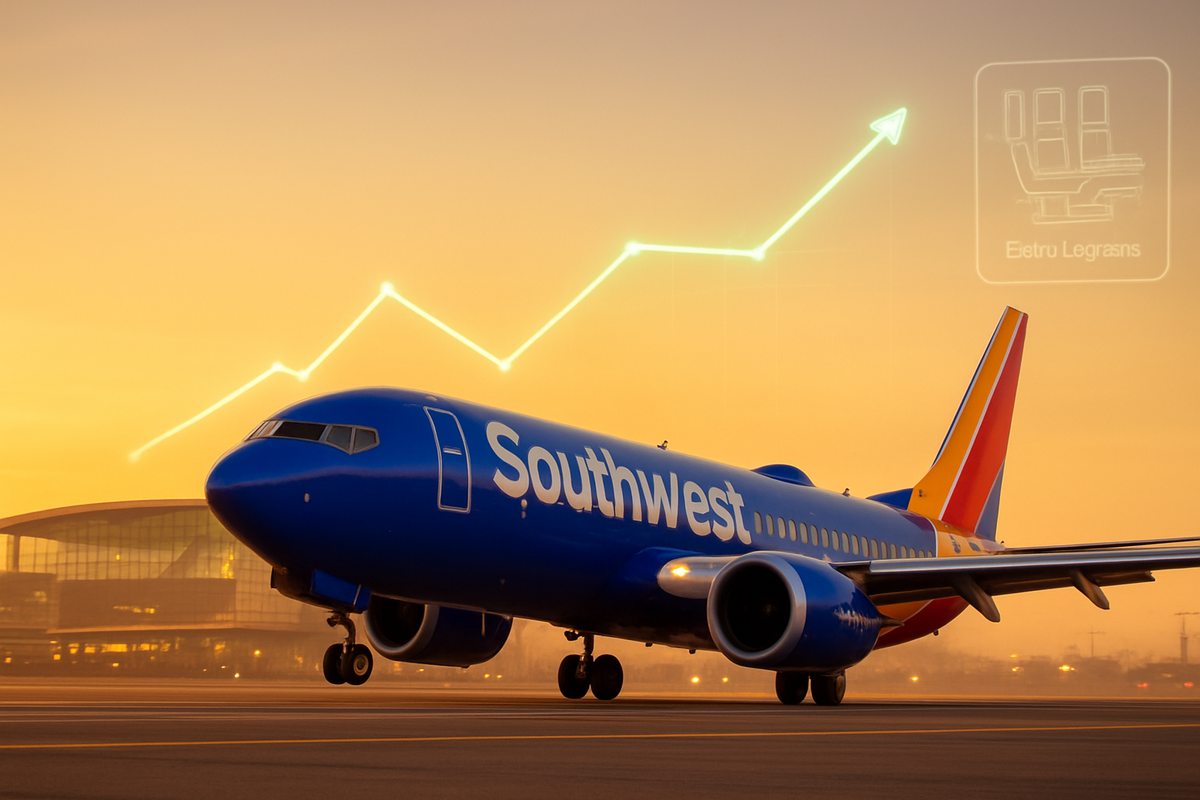
Southwest Airlines (NYSE: LUV) shares surged to a three-year high on Friday, January 9, 2026, as investors aggressively positioned themselves ahead of the carrier’s most significant operational shift in its 55-year history. The stock climbed over 4% in early trading to hit $44.69, fueled by a rare "double-upgrade" from J.P. Morgan (NYSE: JPM), which moved the airline from "Underweight" to "Overweight." The bullish sentiment stems from the imminent end of Southwest’s iconic open-seating policy, a transformation that analysts believe will unlock billions in previously untapped revenue.
The market’s enthusiasm reflects a growing confidence that Southwest is successfully navigating a complex transition from a quirky, low-cost pioneer to a sophisticated, premium-lite competitor. With the official launch of assigned seating and extra-legroom tiers scheduled for January 27, 2026, the airline is finally aligning its business model with modern traveler preferences. This strategic pivot, heavily influenced by a year-long engagement with activist investor Elliott Investment Management, has fundamentally altered the investment thesis for the Dallas-based carrier, turning it into one of the most watched stories in the industrial sector this year.
The End of an Era: Assigned Seating and the Elliott Influence
The primary driver of today’s price action is the final countdown to Southwest’s new boarding and seating reality. For over five decades, the airline’s open-seating policy was its most recognizable—and polarizing—feature. However, starting January 27, the famous A/B/C boarding pillars will be replaced by eight distinct boarding groups. The airline has introduced four new fare bundles—Basic, Choice, Choice Preferred, and Choice Extra—designed to monetize seat selection and offer up to five inches of additional legroom in the front of the cabin. This move is expected to attract higher-yielding business travelers who previously shunned the airline due to the uncertainty of the "boarding scrum."
The timeline leading to this moment was fraught with internal and external pressure. Throughout 2024 and 2025, Elliott Investment Management pushed for a complete overhaul of the airline’s leadership and strategy, citing stagnant margins and an outdated model. While the airline initially resisted, a landmark cooperation agreement in late 2024 led to the appointment of five new board members and the accelerated retirement of Executive Chairman Gary Kelly. CEO Bob Jordan, who remained at the helm, has since become the architect of this "New Southwest," successfully meeting the activist’s demands for modernization while maintaining the airline’s unique corporate culture.
Initial market reactions to the seating overhaul have been overwhelmingly positive, as evidenced by the recent wave of analyst upgrades. Beyond J.P. Morgan, firms like Citigroup (NYSE: C) and Raymond James have raised their price targets, citing the potential for a massive boost in Revenue per Available Seat Mile (RASM). The industry is closely watching how Southwest manages the logistics of this transition, as any technical glitches during the January 27 rollout could temporarily dampen the stock’s momentum. However, for now, the narrative is one of a legacy giant successfully reinventing itself for a new era of aviation.
Identifying the Winners and Losers in the Premium Shift
Southwest Airlines (NYSE: LUV) stands as the clear primary winner in this scenario. By finally offering assigned seats and premium tiers, the airline is plugging a massive revenue leak. For years, the carrier lost out on travelers willing to pay a premium for comfort or certainty. With the new model, Southwest can now compete directly for the lucrative corporate contracts that have long been the domain of legacy carriers like Delta Air Lines (NYSE: DAL) and United Airlines (NASDAQ: UAL). The stock’s recent performance suggests that the market is finally pricing in the "premiumization" of the Southwest fleet.
Conversely, ultra-low-cost carriers (ULCCs) like Frontier Group Holdings (NASDAQ: ULCC) and Spirit Airlines may find themselves as the biggest losers of this shift. As Southwest moves upmarket, it creates a "premium-lite" middle ground that is highly attractive to budget-conscious travelers who are willing to pay slightly more to avoid the bare-bones experience of a ULCC. If Southwest can maintain its reputation for customer service and "bags fly free" while offering the predictability of assigned seats, it could siphon off significant market share from the bottom end of the industry, forcing smaller competitors to further slash prices in an already low-margin environment.
Boeing (NYSE: BA) remains a complicated piece of the puzzle. While Southwest’s transformation requires new, more efficient aircraft, Boeing’s ongoing delivery delays have hampered the airline’s growth. Southwest is currently focusing on using its limited deliveries of the 737 MAX 8 to replace its aging 737-800 fleet rather than expanding capacity. While Boeing benefits from Southwest’s long-term commitment to an all-Boeing fleet, the manufacturer’s inability to deliver the MAX 7—now projected for certification in the first half of 2026—continues to be a drag on Southwest’s operational efficiency. Any further delays from Boeing could jeopardize the full realization of Southwest's 2026 financial targets.
A Sector-Wide Pivot to Premiumization
The transformation of Southwest fits into a much broader trend currently sweeping the global airline industry: the "premiumization" of travel. In the post-pandemic world, the era of "revenge travel" has transitioned into a steady demand for higher-end experiences. Passengers are increasingly prioritizing comfort and reliability over the absolute lowest price. By adding extra-legroom seats and assigned boarding, Southwest is following the lead of global carriers that have seen record profits from their premium economy and business class cabins. This shift suggests that the traditional "low-cost carrier" model is evolving into a hybrid approach that prioritizes unit revenue over pure volume.
This event also highlights the "hardware-constrained" nature of the current aviation market. With both Boeing (NYSE: BA) and Airbus (OTC: EADSY) struggling with supply chain bottlenecks and certification delays, airlines cannot simply grow their way to higher profits by adding more flights. Instead, they must extract more value from every existing seat. Southwest’s move to monetize legroom is a direct response to this environment. When you can't fly more planes, you have to make the planes you are flying more profitable. This trend is likely to persist through 2026 as the industry grapples with a global shortage of aircraft and parts.
From a regulatory and policy perspective, the industry is under increasing pressure regarding fee transparency. While Southwest is unbundling some of its services, it has notably kept its "two bags fly free" policy, which remains a significant competitive advantage. This "transparent premium" approach may serve as a model for other airlines as the Department of Transportation continues to scrutinize "junk fees." Historically, when Southwest makes a major change, the rest of the industry eventually reacts. Just as the industry followed Southwest into the low-cost era in the 1970s, we may be seeing the final nail in the coffin for the traditional open-seating, single-class domestic cabin.
The Road Ahead: 2026 and Beyond
Looking forward, the short-term focus for Southwest will be the flawless execution of the January 27 transition. Any operational hiccups in the new boarding process or the seat-assignment software could lead to a temporary pullback in the stock. However, the long-term outlook hinges on the certification of the Boeing 737 MAX 7. Once that aircraft enters service—likely in late 2026—Southwest will have the flexibility to optimize its route network, particularly in smaller markets where the larger MAX 8 is less efficient. This fleet renewal is critical for the airline to reach its goal of significantly higher operating margins by 2027.
Investors should also keep a close eye on February 14, 2026, which marks the expiration of the cooperation agreement with Elliott Management. While Elliott has recently trimmed its stake to 9.9%, signaling satisfaction with the current trajectory, the expiration of the "truce" could lead to renewed volatility if the airline fails to meet its aggressive 2026 earnings targets. The market will be looking for proof that the seating changes are actually translating into the $1 billion to $1.5 billion in incremental annual EBIT that management has promised.
Strategic pivots may also be on the horizon regarding international expansion. With a more premium product, Southwest could feasibly explore longer-haul routes into South America or even consider partnerships with international carriers—a move that was previously unthinkable under the old operating model. The "New Southwest" is essentially a blank canvas, and the success of the 2026 seating overhaul will determine how much capital and confidence the airline has to pursue these more ambitious growth strategies in the latter half of the decade.
Conclusion: A New Flight Path for Investors
The surge in Southwest Airlines (NYSE: LUV) stock today is more than just a reaction to an analyst upgrade; it is a validation of a multi-year effort to modernize a national icon. The transition to assigned seating and premium tiers represents a fundamental shift in how the airline generates value, moving away from a volume-based model toward a yield-focused strategy. For investors, the key takeaways are clear: Southwest is successfully shedding its legacy constraints, but it remains heavily dependent on Boeing (NYSE: BA) for its long-term fleet health.
As the airline industry moves into a more stable, capacity-constrained environment in 2026, the winners will be those who can most effectively monetize the passenger experience. Southwest’s move to join the premium ranks, while maintaining its core brand identity, puts it in a strong position to outperform its low-cost peers. However, the market will be unforgiving if the promised revenue gains do not materialize by mid-year. Moving forward, the most important metrics for investors to watch will be RASM growth, the progress of the MAX 7 certification, and the airline's ability to maintain its industry-leading labor relations during this period of intense change. For now, Southwest is flying high, but the true test begins when the first assigned seats are filled on January 27.
This content is intended for informational purposes only and is not financial advice