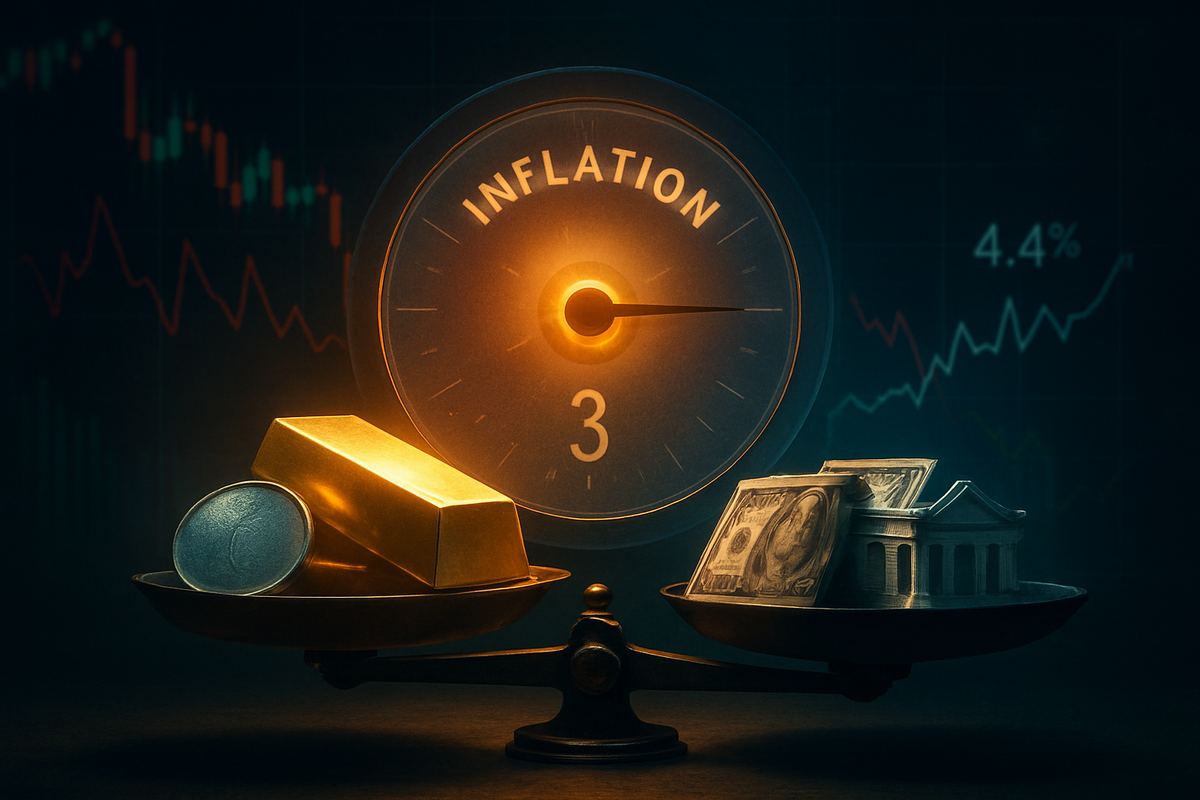
As the Federal Reserve prepares for its first policy meeting of 2026, a strange and unsettling phenomenon has taken hold of global markets. Despite the central bank’s aggressive "higher-for-longer" interest rate stance and a persistent 3% inflation floor, gold has shattered the psychological $5,000 per ounce barrier, while silver has rocketed past $100. Traditionally, high interest rates act as a gravity well for non-yielding assets like precious metals, but a potent cocktail of geopolitical instability and a cooling labor market has turned the historical playbook on its head.
The current economic landscape is defined by a "jobless boom" where GDP remains surprisingly resilient, yet the unemployment rate has crept up to 4.4%. This creates a harrowing dilemma for Fed Chair Jerome Powell and the Federal Open Market Committee (FOMC). With the January Consumer Price Index (CPI) report looming, the central bank is caught between the need to crush a stubborn 2.7% to 3.0% core inflation rate and the growing pressure to support a labor market that is finally showing signs of significant fatigue.
A Tale of Two Realities: 3% Inflation and 4.4% Unemployment
The road to this January 2026 impasse began in the latter half of 2025, when the much-anticipated "soft landing" began to feel more like a structural plateau. Throughout 2024 and early 2025, the market expected inflation to glide back toward the Fed's 2% target. Instead, a "3% floor" emerged, fueled by persistent shelter costs, rising service wages, and a new era of aggressive global tariffs. By December 2025, the Core Personal Consumption Expenditures (PCE) price index—the Fed’s preferred inflation gauge—was stuck at 2.9%, marking nearly six months of stagnation.
While inflation remained "sticky," the labor market began to fray. After years of historic lows, the unemployment rate climbed steadily through 2025, reaching 4.4% in December. This shift has been described by analysts as a "no-hire, no-fire" market; companies are utilizing AI to maintain productivity and high GDP growth, but they have largely ceased new hiring. The Fed reacted by cutting rates three times in late 2025, bringing the Federal Funds Rate to its current 3.5%–3.75% range. However, as of January 26, 2026, the Fed has entered a "wait-and-see" phase, fearful that further cuts could de-anchor inflation expectations permanently.
The initial market reaction to this "higher-for-longer" narrative was expected to be bearish for gold. However, the opposite occurred. As the U.S. national debt surged past $38 trillion and geopolitical tensions flared—ranging from trade wars with traditional allies to maritime disputes in the Arctic—investors fled to the safety of hard assets. In the first three weeks of January alone, gold surged 17%, decoupling from its traditional inverse relationship with interest rates and the U.S. dollar.
Winners and Losers in the New Hard-Asset Economy
The primary beneficiaries of this "Golden Paradox" are the major mining corporations and streaming entities that have seen their profit margins explode. Newmont Corporation (NYSE: NEM), the world’s largest gold producer, has seen its All-In Sustaining Costs (AISC) remain relatively stable around $1,500/oz, allowing for a staggering $3,500/oz profit margin at current spot prices. Similarly, Barrick Gold (NYSE: GOLD) has leveraged its "Tier One" assets to aggressively pay down debt and announce record dividends in early 2026.
In the silver space, the rally has been even more dramatic. Pan American Silver (NASDAQ: PAAS) and First Majestic Silver (NYSE: AG) have become favorites for retail and institutional investors alike, with silver's industrial demand for green technology adding fuel to the safe-haven fire. Wheaton Precious Metals (NYSE: WPM), a streaming company, has outperformed many of its mining peers because its business model—buying metal production at fixed, low costs—insulates it from the 3% inflation currently driving up labor and fuel costs for operators.
Conversely, the "losers" in this environment are clearly demarcated. Large financial institutions like JPMorgan Chase (NYSE: JPM) are facing a dual threat: the high cost of maintaining deposits in a high-rate environment and a spike in loan defaults as unemployment hits 4.4%. Consumer discretionary giants are also feeling the pinch. Home Depot (NYSE: HD) and Kohl's (NYSE: KSS) have reported sluggish numbers as the "wealth effect" from housing evaporates under the weight of 7% mortgage rates, and the 3% inflation rate erodes the real wages of the American consumer. Even the automotive sector is struggling, with Ford Motor Company (NYSE: F) seeing a sharp decline in new car financing as high interest rates make monthly payments untenable for the newly unemployed.
The Ghost of 1970s Stagflation
The current interplay between persistent inflation and rising unemployment has drawn inevitable comparisons to the stagflationary era of the late 1970s. During that period, the Fed, led by Paul Volcker, eventually hiked rates to 20% to break the back of double-digit inflation. While the 2026 figures are less extreme, the psychological impact is similar. Investors are no longer convinced the Fed can achieve its 2% target without causing a major recession, leading to a loss of confidence in fiat currency that mirrors the 1979-1980 gold spike.
This event fits into a broader industry trend of "de-globalization." As countries move toward protectionist trade policies and central banks—particularly in China and the Middle East—continue to diversify their reserves away from the U.S. dollar, the structural demand for gold has shifted. Historically, gold was a tactical play on falling rates; in 2026, it has become a strategic hedge against systemic fiscal instability.
The regulatory implications are also mounting. With Jerome Powell’s term set to expire in May 2026, the political pressure from the White House to slash rates regardless of inflation is at a fever pitch. This perceived threat to Fed independence has added a "sovereign risk premium" to U.S. assets, further driving capital into gold-backed ETFs like the SPDR Gold Shares (NYSE Arca: GLD) and silver miners.
What Comes Next: The January CPI Trigger
The immediate focus for the market is the upcoming U.S. CPI report. If the data shows inflation holding at or above 3.0%, the Fed will be forced to maintain its restrictive stance, even as the unemployment rate threatens to breach 4.5%. This "worst-of-both-worlds" scenario would likely propel gold and silver even higher as the narrative shifts from a "soft landing" to a "hard stagflationary plateau."
In the short term, expect a strategic pivot from institutional funds. We are likely to see a continued rotation out of high-multiple tech stocks and into the "Old Economy" sectors of mining and energy. If the Fed does blink and cuts rates to save the labor market, it could act as rocket fuel for precious metals, potentially sending silver toward the $150 mark as real interest rates turn deeply negative.
The long-term challenge will be the "debt trap." With interest payments on the national debt now rivaling the defense budget, the Fed has limited room to keep rates high indefinitely. Market participants should watch for a potential "Goldilocks" scenario—where inflation finally dips while unemployment stabilizes—though in the current geopolitical climate, that outcome remains a distant hope.
Final Assessment: The New Monetary Reality
As we move through the first quarter of 2026, the "Golden Paradox" serves as a stark reminder that market dynamics are rarely permanent. The decade-long era of low inflation and low rates is dead, replaced by a volatile environment where "safe haven" is the most important phrase in an investor's vocabulary. Gold's rise to $5,000 is not just a price movement; it is a vote of no confidence in the ability of central banks to manage the conflicting goals of price stability and full employment.
Moving forward, the market will remain hyper-sensitive to any sign of Fed capitulation. If the FOMC prioritizes the 4.4% unemployment rate over the 3% inflation target, the flight from the dollar will accelerate. Conversely, if they stay the course, the pressure on the banking and retail sectors could lead to a broader systemic crisis.
Investors should closely watch the February FOMC meeting minutes and the subsequent labor reports. The era of "easy money" has been replaced by the era of "hard assets," and the transition is proving to be as profitable for some as it is painful for others.
This content is intended for informational purposes only and is not financial advice