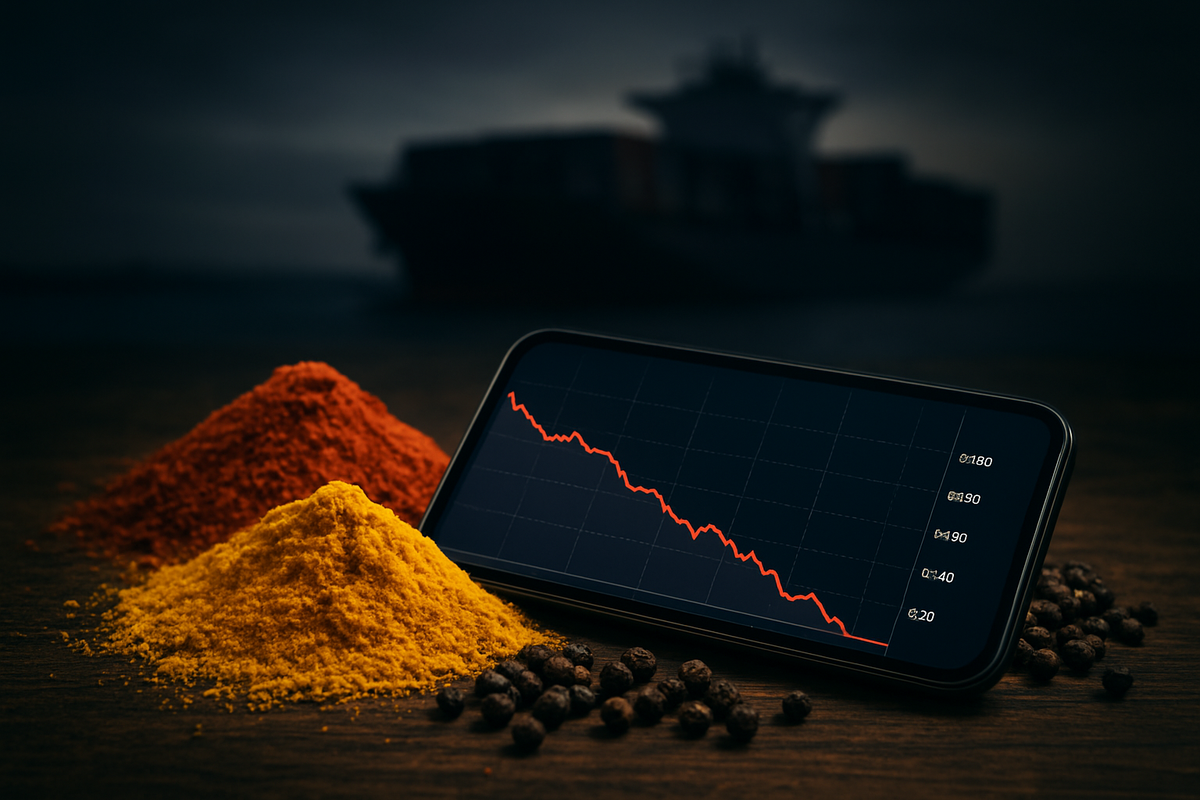
In a jarring start to the fiscal year, McCormick & Company (NYSE: MKC) saw its shares plummet by over 8% on Thursday after the global spice leader issued fiscal 2026 profit guidance that significantly trailed Wall Street expectations. The sell-off reflects growing investor anxiety over the company’s ability to navigate a "shifting global trade environment" and a consumer base increasingly weary of inflationary pricing.
While the company reported a massive boost in projected net sales due to its recent acquisition of a controlling stake in McCormick de Mexico, the underlying organic growth and profitability outlook painted a far more conservative picture. For a market that had expected the "King of Spices" to show more resilience, the admission of significant tariff-related costs and margin pressure has sent shockwaves through the consumer staples sector.
A "Double Miss" and the Shadow of Trade Volatility
The market's visceral reaction was triggered by a dual disappointment: a narrow miss on fourth-quarter 2025 earnings and a 2026 forecast that fell well short of analyst models. McCormick & Company announced that it expects its 2026 adjusted earnings per share (EPS) to land between $3.05 and $3.13. This range sits roughly 4% below the analyst consensus of $3.22 to $3.23, representing a significant disconnect between the company’s internal reality and the market’s optimistic projections.
CEO Brendan Foley, who took the helm in late 2023, pointed directly to a complex geopolitical landscape as a primary culprit. In his address to investors, Foley highlighted a "shifting global trade environment" characterized by a volatile tariff landscape. The company revealed a staggering $140 million in gross annualized tariff exposure. While aggressive mitigation and alternative sourcing strategies have reduced that figure to $70 million, Foley warned that an incremental $50 million in unavoidable tariff-related costs will hit the 2026 bottom line. This fiscal drag is compounded by the final stages of a global SAP rollout, which saw costs accelerated into 2026 to de-risk the transition, further dampening the profit outlook.
The timeline of this downturn began in late 2025, as gross margins contracted by 120 basis points in the fourth quarter. Despite revenue growth fueled by the $1.2 billion Mexico deal, organic sales growth—excluding the impact of acquisitions—is only projected to be a modest 1% to 3% in the coming year. This tepid organic growth suggests that the price increases of the past two years are finally hitting a ceiling with the average household.
Winners, Losers, and the Great Pantry Trade-Down
The fallout from McCormick's guidance has clear winners and losers across the retail landscape. The primary "winners" in this environment are the private label powerhouses. As McCormick (NYSE: MKC) signals that "surgical pricing" is necessary to maintain its own margins, retailers like Walmart (NYSE: WMT) and Kroger (NYSE: KR) are reaping the benefits. Walmart’s newly launched Bettergoods line and Kroger’s Smart Way brand have seen double-digit volume growth as consumers "trade down" from branded seasonings to store-brand alternatives that offer similar quality at a 30-40% discount.
Conversely, mid-tier branded competitors like Kraft Heinz (Nasdaq: KHC) and Conagra Brands (NYSE: CAG) are likely to feel the heat. McCormick’s struggle suggests a broader industry trend where premium brands that aren't quite "luxury" but are significantly more expensive than generics are caught in a "no-man's land." Small, agile players like Badia Spices and specialized direct-to-consumer brands like Spiceology may win by capturing specific niches—such as the Hispanic market or gourmet enthusiasts—leaving the broad-market leaders like McCormick to fight for the budget-conscious middle.
B2B flavor specialists like Kerry Group (OTC: KRYAY) may also emerge as winners. As food manufacturers look to reformulate products to be more nutrient-dense or high-protein—often to cater to the growing demographic of GLP-1 weight-loss drug users—they are seeking concentrated flavor solutions that provide intensity without calories. McCormick's "Flavor Solutions" segment competes here, but the company’s heavy focus on consumer-packaged spices makes it more vulnerable to the retail trade-down than pure-play ingredient manufacturers.
The Global Trade Ripple Effect and the GLP-1 Factor
McCormick’s predicament is a bellwear for the broader consumer goods industry, illustrating how the era of "easy" global trade has come to an end. The $50 million tariff hit cited by Foley is a symptom of a larger shift toward protectionism and near-shoring. McCormick’s move to consolidate its Mexican operations is a strategic hedge against Asian supply chain disruptions, but as the guidance shows, the transition period is expensive. This shift serves as a warning to other multinational staples companies that reliant on overseas sourcing: the costs of de-risking a supply chain will likely weigh on earnings long before the benefits are realized.
Furthermore, the "shifting trade environment" isn't just about tariffs; it's about shifting consumer biology. The rise of GLP-1 medications has begun to alter volume expectations in the food industry. While McCormick expects to benefit from "flavor rescue"—where patients on appetite-suppressing drugs use high-intensity spices to add flavor to smaller meals—the overall reduction in caloric intake across the population represents a structural headwind for volume growth. This, combined with the "inflationary peak" expected in late 2026, suggests that the industry is entering a period of permanent behavioral change where the "brand loyalty" of the past is being replaced by "value-driven utility."
The Path Forward: Surgical Pricing and Mexico Integration
Looking ahead, McCormick is betting heavily on its "Comprehensive Continuous Improvement" (CCI) program to deliver productivity savings that can fund future growth. The short-term focus will be on "surgical pricing"—highly targeted price increases on specific products where the company still has pricing power, rather than broad-based hikes that might alienate customers. The integration of McCormick de Mexico remains the centerpiece of the company’s 2026 growth strategy, providing a footprint for near-shoring and capturing the high-growth Latin American market.
However, the road remains steep. Investors will be watching the global SAP rollout closely; any technical glitches during this expensive transition could further erode confidence. The company must also prove that it can defend its "premium" status against high-quality private labels. If McCormick cannot justify its price premium through innovation—such as its new "Swavory" (sweet and savory) spice blends—it may find itself in a protracted battle for shelf space that pressures margins for years to come.
Closing Thoughts: A Transition Year for the Spice King
The 8% drop in McCormick’s stock is more than just a reaction to a single earnings miss; it is a recalibration of expectations for the entire consumer staples sector in 2026. The company’s guidance highlights a reality where global trade barriers, persistent inflation, and shifting consumer habits are no longer "transitory" issues but structural fixtures of the business landscape.
For investors, the coming months will be a test of McCormick’s brand equity. While the acquisition of McCormick de Mexico provides a much-needed top-line boost, the true health of the company will be measured by its organic volume growth and its ability to mitigate those $50 million in tariff costs. As the "Spice King" navigates this bitter guidance, the market will be looking for signs that McCormick can turn its "surgical pricing" into a scalpel that carves out growth, rather than a blunt instrument that drives customers toward the generic aisle.
This content is intended for informational purposes only and is not financial advice.