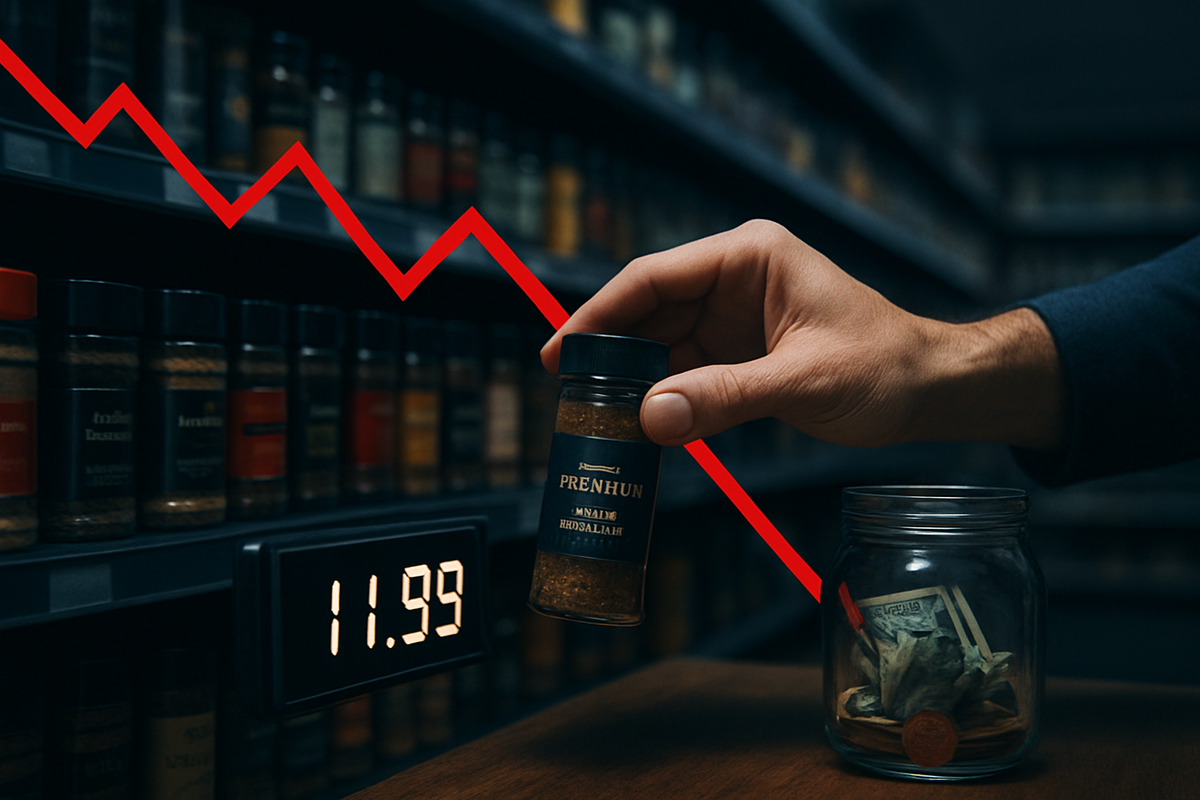
The seasoning industry’s bellwether, McCormick & Company, Inc. (NYSE: MKC), saw its shares plummet by more than 6% on January 22, 2026, following a fiscal outlook that left investors with a bitter taste. The company issued a soft profit projection for the upcoming year, signaling that the "inflation-resistant" reputation of consumer staples may finally be meeting its match in a cash-strapped public.
The sell-off reflects a growing anxiety on Wall Street regarding the sustainability of premium brand pricing. As the global leader in spices and flavors, McCormick’s struggle serves as a canary in the coal mine for the broader food sector, highlighting a dangerous intersection where exhausted household savings and persistent supply-side costs are beginning to erode corporate margins and consumer loyalty alike.
A Tightening Vice: The Fiscal 2026 Projection
The primary catalyst for the stock’s descent was McCormick’s conservative guidance for the 2026 fiscal year. Management projected adjusted earnings per share (EPS) in the range of $3.05 to $3.13, a figure that fell significantly short of the $3.22 consensus among analysts. While the company touted a projected net sales growth of 13% to 17%, the underlying reality was far less robust; a staggering 11% to 13% of that growth is attributed solely to the recent acquisition of a controlling interest in McCormick de Mexico. On an organic basis—which excludes acquisitions and currency fluctuations—sales are expected to grow by a meager 1% to 3%.
This tepid organic growth is being further squeezed by a "double whammy" of rising internal costs and tax headwinds. McCormick anticipates an effective tax rate of 24%, up from 21.5% in the previous year, alongside mid-single-digit cost inflation. Perhaps most concerning for the long term is the company’s ballooning tariff exposure. Management confirmed that annualized tariff costs have swelled from $90 million to $140 million due to the ongoing impact of broad reciprocal trade policies, often referred to by trade analysts as the "Liberation Day" tariffs. These costs, the company noted, will suffer a 12-to-18-month lag before they can be fully passed on to consumers through price hikes.
The timing of the announcement coincided with a grim report from the Bureau of Economic Analysis, which revealed that the U.S. household savings rate has plummeted to 3.5%. This marks the lowest level of financial cushion for American families since late 2022, suggesting that the "excess savings" from the pandemic era have been entirely depleted. With real disposable income growth stagnating at a mere 0.1%, McCormick is facing a consumer base that is increasingly "tapped out" and highly sensitive to any further price increases on the grocery shelf.
Winners and Losers in the Flavor Wars
While McCormick’s premium brands—including French’s and Frank’s RedHot—are feeling the heat, the current economic climate is creating a bifurcated market. The primary winners appear to be private-label brands and store-brand alternatives. As of early 2026, generic spices and seasonings have captured nearly 25% of the total unit volume in the grocery sector. These store brands are benefiting from a "trade-down" effect, where families are opting for lower-cost essentials to maintain their home-cooking habits without the premium price tag.
In the competitive landscape, Conagra Brands, Inc. (NYSE: CAG) has managed to find a surer footing by pivoting toward the "Future of Frozen Food." While its stock has faced historical challenges, Conagra’s focus on high-protein, affordable frozen meals has resonated with a demographic looking for portion control and convenience amidst rising inflation. In contrast, The Kraft Heinz Company (NASDAQ: KHC) continues to struggle, recently hitting a 52-week low of approximately $22.40. Kraft Heinz’s woes were compounded by news that Berkshire Hathaway (NYSE: BRK.B) is seeking to exit its massive stake, and the company is now considering a "split-off" of its high-growth sauces division to save its valuation from its declining grocery segments.
McCormick’s acquisition of the Mexican division remains a strategic bright spot, potentially allowing the company to capture growth in emerging markets and diversifying its supply chain. However, in the short term, the integration costs and the debt associated with the deal are weighing on the balance sheet, making it a "loss" in the eyes of investors focused on immediate dividend safety and EPS stability.
Broad Trends and the Home Cooking Paradox
The McCormick sell-off is emblematic of a broader "home cooking paradox" emerging in 2026. Traditionally, food manufacturers like McCormick are considered defensive plays during economic downturns because consumers save money by eating at home rather than at restaurants. However, in the current cycle, the prices of key commodities like black pepper, ginger, and garlic have spiked faster than the general consumer price index. This has made the "at-home spice cabinet" an expensive luxury, eroding the cost-saving advantage that usually drives McCormick’s volume growth during lean times.
Furthermore, the rise of GLP-1 weight-loss medications—now used by an estimated 12.4% of the U.S. adult population—is beginning to subtly alter flavor profiles and consumption habits. Consumers on these medications often prefer cleaner, less processed flavor enhancers and smaller portions, a shift that requires massive R&D investments from legacy brands to keep pace. The "sticky" inflation of 2.8% on personal consumption expenditures (PCE) further ensures that interest rates will likely stay "higher for longer," keeping the pressure on companies with significant debt loads.
Historically, this period mirrors the stagflationary environment of the late 1970s, where volume growth in consumer staples became nearly impossible to achieve without aggressive innovation or consolidation. McCormick’s current predicament suggests that the era of "pricing power" via brand loyalty alone has reached its limit.
The Road Ahead: Strategic Pivots and Market Outlook
Looking toward the remainder of 2026, McCormick will likely need to undergo a significant strategic pivot to regain investor confidence. This may involve a more aggressive cost-cutting program or a shift in marketing focus toward "value-tier" packaging and bundles. The company’s ability to successfully pass through the $140 million in tariff costs by late 2026 or early 2027 will be the definitive test of its brand equity. If volume continues to decline as prices rise, the company may be forced to sacrifice margins to protect its market share from aggressive private-label competitors.
In the long term, the acquisition of McCormick de Mexico provides a gateway to high-growth regions that could eventually offset the stagnation in North American and European markets. However, the path to that recovery is fraught with execution risks. Investors should also watch for whether McCormick accelerates its entry into the "functional flavor" space—products that offer health benefits beyond simple seasoning—to cater to the health-conscious and GLP-1-using consumer segments.
Conclusion: A Season of Reckoning
The 6% drop in McCormick’s stock price serves as a stark reminder that even the most venerable "blue chip" staples are not immune to the realities of a depleted consumer. The combination of record-low household savings and the "home cooking paradox" has created a challenging environment where volume growth is elusive and cost pressures are relentless. While McCormick has maintained its impressive 40-year streak of dividend increases, the soft 2026 guidance suggests that the payout’s growth may slow as the company prioritizes debt management and acquisition integration.
Moving forward, the market will be watching the "volume vs. price" dynamic closely. For investors, the takeaway is clear: the safety once found in the grocery aisle is no longer a guarantee. In a market defined by economic bifurcation, the companies that can bridge the gap between premium branding and consumer affordability will be the ones that ultimately flavor the portfolios of the future.
This content is intended for informational purposes only and is not financial advice.