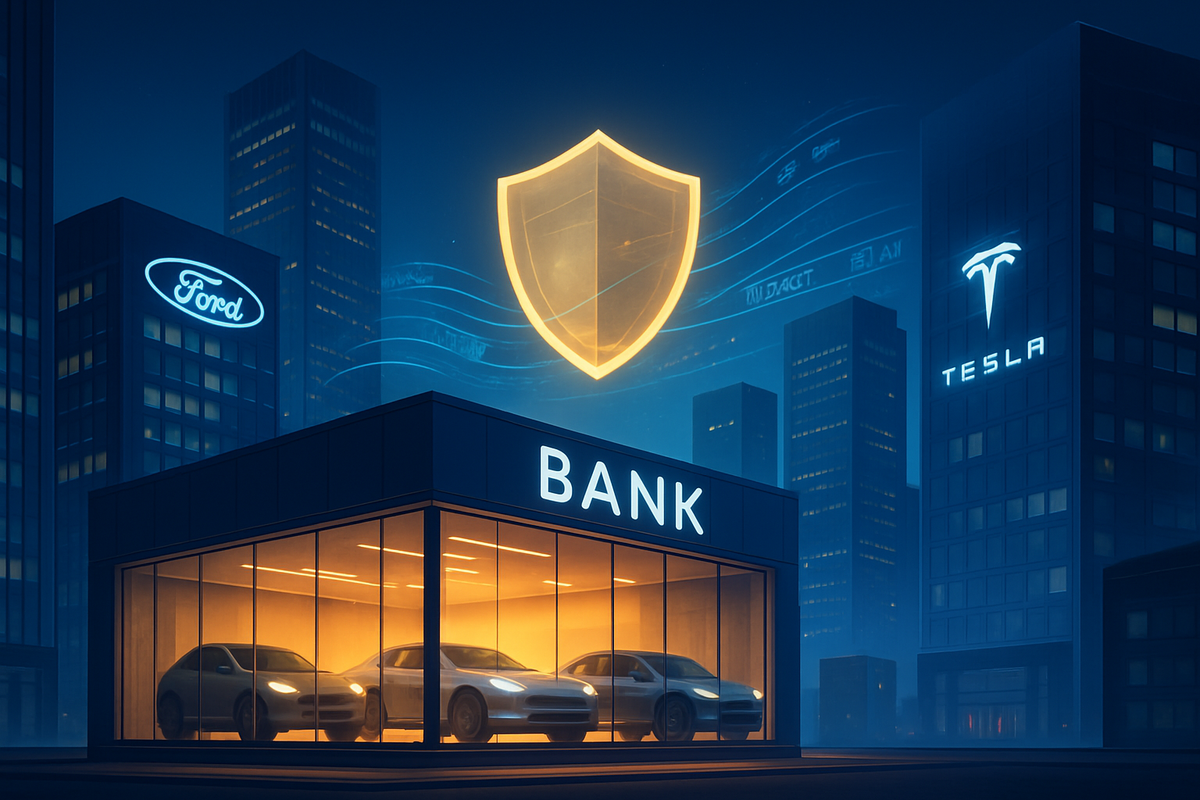
In a landmark decision that promises to reshape the American automotive and financial landscapes, the Federal Deposit Insurance Corporation (FDIC) has officially approved the deposit insurance applications for the financing arms of Ford Motor Company (NYSE: F) and General Motors (NYSE: GM). The move, announced this week in January 2026, grants both companies the right to operate as Industrial Loan Companies (ILCs), effectively allowing the "Big Two" automakers to own and operate their own banks. This approval marks the end of a multi-year regulatory battle and signals a major pivot in how the federal government views the intersection of commerce and banking.
The immediate implications are profound: both Ford Credit and GM Financial will now have access to low-cost, FDIC-insured deposits to fund their lending operations. By shifting away from a reliance on volatile commercial paper and high-interest bond markets, these automotive giants are expected to significantly lower their cost of capital. For consumers, this likely translates to more competitive interest rates on auto loans and leases, particularly as the industry navigates a challenging transition to electric vehicles (EVs).
A Long Road to Regulation: The Path to Approval
The journey to this week’s approval has been nearly six years in the making. General Motors (NYSE: GM) first submitted its application for an ILC charter in December 2020, seeking to regain a banking foothold it hadn't held since the divestiture of GMAC during the 2008 financial crisis. Ford Motor Company (NYSE: F) followed suit in July 2022. However, the path was fraught with setbacks. In June 2024, GM was forced to withdraw its initial application following intense pushback from the FDIC regarding its community reinvestment plans and capital requirements.
The tide began to turn in 2025. After refiling its application in January of last year, GM Financial worked closely with Utah state regulators and the FDIC to address concerns over financial stability and the "banking-commerce divide." Simultaneously, Ford Credit maintained its original application, leveraging the federal government’s focus on green energy to argue that a bank charter was essential for financing expensive EV infrastructure. A critical policy shift occurred in late 2025 when the FDIC Board, under pressure to modernize industrial banking rules, issued new guidance that favored ILCs with specialized, limited-purpose missions. This regulatory opening provided the final green light for both companies to establish their Salt Lake City-based banking hubs.
Winners and Losers: A New Competitive Landscape
The primary winners in this regulatory shift are undoubtedly the automakers themselves. By capturing the spread between low-cost deposits and auto loan interest rates, Ford Motor Company (NYSE: F) and General Motors (NYSE: GM) can bolster their profit margins at a time when EV research and development costs are weighing heavily on their balance sheets. Furthermore, their dealers stand to benefit from more robust and flexible floorplan financing, potentially stabilizing inventory levels during economic downturns.
Conversely, traditional retail banks and regional lenders are bracing for a hit. For decades, companies like Ally Financial (NYSE: ALLY) and Capital One (NYSE: COF) have dominated the third-party auto lending market. With Ford and GM now able to offer "captive" banking services backed by the same deposit-gathering powers as traditional banks, these independent lenders may see their market share eroded. The Independent Community Bankers of America (ICBA), a vocal opponent of the applications, has expressed "grave concern," arguing that the ILC loophole gives commercial firms an unfair advantage and creates systemic risks by allowing "too big to fail" manufacturers to gamble with taxpayer-insured deposits.
The Broader Significance: EV Transition and the Commerce Divide
Beyond the balance sheets, this event signifies a broader industrial trend: the integration of financial services into the "connected car" ecosystem. As the industry moves toward software-defined vehicles and subscription-based services, having an in-house bank allows Ford and GM to offer seamless, integrated payment solutions directly through their vehicle dashboards. More importantly, it provides a dedicated funding vehicle for the Biden administration’s ongoing "green" goals. Ford has specifically noted that its new banking arm will focus on financing EV charging stations for residential customers—a high-risk, low-collateral area that traditional banks have been slow to enter.
This decision also challenges a century-old precedent in American finance: the separation of banking and commerce. Since the Bank Holding Company Act of 1956, the U.S. has generally sought to prevent industrial firms from owning banks to avoid conflicts of interest and the concentration of economic power. By approving these ILC charters, the FDIC is effectively signaling that the "walled garden" approach may no longer be sustainable in a global economy where tech giants and international competitors are already blurring these lines.
What Comes Next: Implementation and Market Evolution
In the short term, both Ford and GM are expected to launch high-yield savings products and certificates of deposit (CDs) to quickly build their deposit bases. Market analysts expect an aggressive marketing push aimed at current vehicle owners, offering "loyalty rates" on savings accounts that can be directly applied to future vehicle purchases. The strategic pivot will require both companies to build out significant compliance and cybersecurity infrastructure to meet the rigorous standards of FDIC oversight, a task that will likely involve hiring hundreds of specialized banking personnel in Utah and beyond.
Long-term, this move could trigger a "gold rush" for other non-financial corporations. If Ford and GM successfully navigate the transition without systemic issues, it is highly likely that tech giants like Apple (NASDAQ: AAPL) or Amazon (NASDAQ: AMZN) may revisit their own ambitions for deeper financial integration. The market will be watching closely to see if the "Big Two" can maintain the firewall between their manufacturing risks and their banking stability, especially if the automotive market faces a cyclical downturn in the late 2020s.
The Final Outlook: A New Era for Detroit
The FDIC’s approval of bank charters for Ford and GM is more than just a regulatory win; it is a fundamental evolution of the American auto industry. By becoming their own bankers, the Detroit giants have secured a more stable financial foundation to weather the volatile transition to electrification and autonomous driving. This move essentially transforms them from traditional manufacturers into diversified financial-technology-industrial powerhouses.
Investors should keep a close eye on the "deposit-to-loan" ratios of these new banking arms over the next several quarters. Success will be measured not just by how many cars are sold, but by how effectively these companies can manage their new roles as fiduciaries of public deposits. As the line between your car dealership and your bank continues to blur, the ultimate winner may be the consumer—provided that the regulatory guardrails remain strong enough to handle this new era of hybrid corporate giants.
This content is intended for informational purposes only and is not financial advice