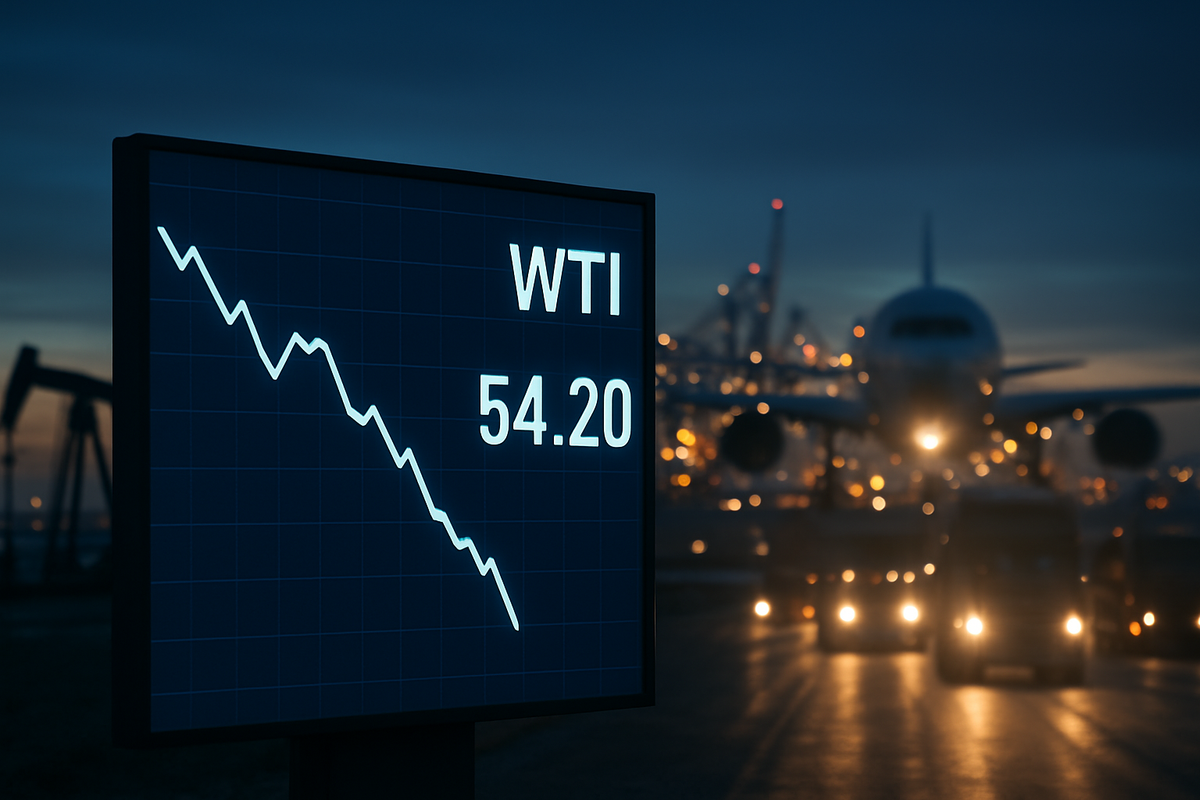
The global energy landscape reached a decisive turning point this week as West Texas Intermediate (WTI) crude oil futures plummeted below the psychologically significant $60-per-barrel mark. On January 22, 2026, the American benchmark touched a multi-year low of $54.20, marking a dramatic shift from the volatility seen in previous years. This downward spiral has been fueled by a combination of surging domestic production and a noticeable cooling in global energy demand, signaling what many analysts are calling a "structural bear market."
The immediate implications are far-reaching, triggering a massive rotation on Wall Street. While the energy sector faces its steepest headwinds since the 2020 pandemic era, transportation and logistics industries are celebrating a "functional tax cut." The erosion of the geopolitical risk premium—which had long kept prices inflated—has left the market vulnerable to a supply glut that many experts believe will persist through the first half of 2026.
The Perfect Storm: Supply Gluts and the Vanishing Risk Premium
The descent below $60 did not happen in a vacuum. By early January 2026, the global market was reportedly "awash in oil," with a surplus estimated between 2.1 and 4 million barrels per day. A major catalyst was the United States hitting a record-shattering production peak of 13.8 million barrels per day. This surge, led by efficiencies in the Permian Basin, effectively neutralized the supply-side control traditionally held by the OPEC+ cartel. In a surprise move, OPEC+ leaders opted for a "strategic pause" in January, refusing to deepen production cuts to defend the price floor, choosing instead to protect their market share.
Geopolitical factors also played a paradoxical role in the price collapse. In early January 2026, the capture of Venezuelan leader Nicolás Maduro by U.S. forces initially caused a brief price spike. However, the market quickly pivoted to the realization that a stabilized, Western-friendly Venezuela would eventually add millions of barrels back to global supply. Simultaneously, the "Arctic Standoff"—a diplomatic friction point between the U.S. and NATO allies over Greenland—raised fears of widespread trade tariffs. Rather than driving prices up through scarcity, these tensions fueled fears of "demand destruction" and a global economic slowdown, further depressing futures.
The final blow came from the cooling of the "China Growth Engine." For decades, Chinese demand was the bedrock of high oil prices. However, by 2026, rapid electric vehicle (EV) penetration in China displaced over 500,000 barrels per day of gasoline demand. Despite the Chinese government’s efforts to fill its Strategic Petroleum Reserve at low prices, the structural shift away from fossil fuels in the world’s second-largest economy has created a permanent hole in global consumption.
Winners and Losers: A Tale of Two Tickers
The impact of sub-$60 oil has created a sharp divide among public companies. For upstream producers like Occidental Petroleum (NYSE: OXY), the price drop has been particularly painful. Following the $9.7 billion sale of its chemical division, OxyChem, to Berkshire Hathaway (NYSE: BRK.B) earlier this month, OXY has become a pure-play commodity stock. Stripped of its industrial hedge, the company was forced to slash its 2026 capital expenditure by 15%, focusing entirely on deleveraging to protect its balance sheet.
In contrast, integrated giants like ExxonMobil (NYSE: XOM) and Chevron (NYSE: CVX) have shown remarkable resilience. ExxonMobil has leveraged its low breakeven assets in Guyana and the Permian to maintain a massive $20 billion annual share buyback program, essentially signaling to investors that it can remain a cash-flow powerhouse even at $50 oil. Chevron, meanwhile, has successfully diversified into natural gas, reaching a final investment decision on the Leviathan gas field expansion in January 2026, providing a stable revenue stream that offsets the volatility of crude.
On the winning side, the transportation sector is experiencing a renaissance. Delta Air Lines (NYSE: DAL) and United Airlines (NASDAQ: UAL) saw their stocks surge by more than 4% in mid-January as jet fuel prices dipped toward $2.00 per gallon. For Delta, the lower fuel bill acts as a vital buffer against rising labor costs, allowing the carrier to project record free cash flow for the fiscal year. Logistics titan United Parcel Service (NYSE: UPS) has also capitalized on the slump; by maintaining its fuel surcharges even as pump prices fall, UPS is expanding its operating margins to levels not seen in years, driving a 30% rally in its stock price over the last three months.
A Broad Shift in Industry Dynamics
This event marks more than just a temporary dip; it represents the "new normal" for the energy industry. The shift fits into a broader trend of energy transition and the "de-risking" of global supply chains. Historically, any major geopolitical event in a producer nation would send oil prices skyrocketing. In 2026, however, the market appears more concerned with oversupply and efficiency than with conflict-driven shortages. The U.S. has effectively become the global "swing producer," a role previously reserved for Saudi Arabia.
The ripple effects are being felt in the regulatory sphere as well. With oil prices low, the political pressure for aggressive green energy subsidies has softened slightly in some regions, though the momentum of EV adoption remains unstoppable in the private sector. Furthermore, the decoupling of oil prices from geopolitical strife suggests that the historical "petrodollar" influence is waning, as trade partners increasingly look toward diversified energy portfolios including hydrogen and nuclear power to ensure long-term stability.
Looking Ahead: The Road to Q2 2026
In the short term, investors should prepare for continued volatility as OPEC+ decides whether to maintain its "market share first" strategy or return to production cuts in the spring. There is a potential for a "relief rally" if U.S. shale producers begin to shutter high-cost wells, but with technology driving breakeven costs lower every year, a return to $80 or $90 oil seems unlikely in the current climate.
Strategic pivots will be required for smaller E&P (Exploration and Production) companies that lack the scale of the majors. We may see a new wave of consolidation as larger players with deep pockets acquire distressed assets. For the broader market, the lower energy costs could serve as a disinflationary force, potentially giving the Federal Reserve more room to navigate interest rate policies as 2026 progresses.
Final Assessment: A Transformed Market
The fall of WTI below $60 per barrel is a clear signal that the era of scarcity-driven pricing is ending. The combination of U.S. energy independence, Chinese technological shifts, and a more disciplined approach to capital among the "Supermajors" has fundamentally altered the risk-reward profile of the energy sector. Investors are no longer valuing these companies solely on their reserves, but on their ability to generate cash in a low-price environment.
Moving forward, the market will be defined by "efficiency over volume." While the energy sector may no longer be the growth engine it once was, it is evolving into a reliable value play for those with low-cost assets. For consumers and the wider economy, sub-$60 oil provides a much-needed tailwind for growth, provided that the geopolitical tensions causing "demand destruction" do not escalate into a full-scale trade war. In the coming months, all eyes will be on the Q1 earnings reports of the major airlines and the production guidance from the Permian Basin to see just how deep this "structural bear" truly goes.
This content is intended for informational purposes only and is not financial advice