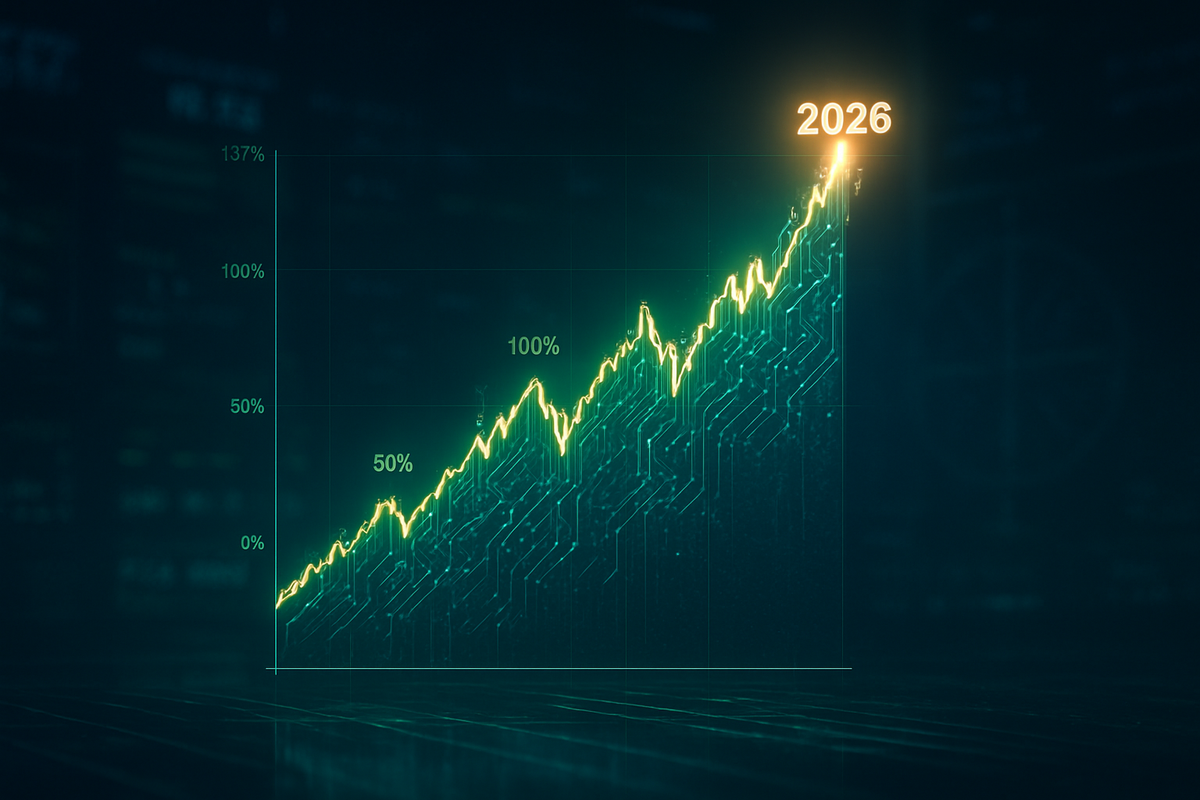
As the opening bell rings on the first trading days of 2026, investors find themselves in rarefied air. The S&P 500 has just closed out 2025 with a total return of approximately 17.8%, marking the third consecutive year of double-digit gains. Following a blistering 26.3% recovery in 2023 and a 25.0% surge in 2024, the index ended 2025 at a record high of 6,845.50. This "triple-double" performance—a cumulative gain of roughly 77.5% over three years—has pushed market valuations to levels rarely seen in modern financial history.
While the momentum of the artificial intelligence revolution and a resilient U.S. consumer have fueled this historic run, the arrival of 2026 brings a sense of cautious introspection. History suggests that while the party may not be over, the "fourth year" of such streaks often demands a price in the form of volatility or moderating returns. As Wall Street analysts digest the data from a transformative 2025, the central question for the new year is whether the market can defy the gravity of mean reversion or if 2026 will be the year the music finally slows down.
A Three-Year Sprint to Record Heights
The journey to the S&P 500’s current record levels began in the ashes of the 2022 bear market. The rally was initially ignited by the 2023 "AI awakening," which saw massive capital inflows into hardware and infrastructure. By 2024, the narrative shifted toward a "soft landing," as the Federal Reserve successfully navigated a path to lower inflation without triggering a recession. However, 2025 proved to be the most complex leg of the journey. The year was defined by the "Tariff Tantrum" in April, a sharp 19% drawdown sparked by global trade tensions and renewed inflationary fears. Despite this mid-year crisis, the market staged a dramatic recovery in the second half of 2025, bolstered by the "One Big Beautiful Bill Act," which provided significant fiscal stimulus and regulatory relief.
Key stakeholders throughout this period have been the "Magnificent Seven" tech giants and a new wave of industrial companies that successfully integrated AI into their legacy operations. The final months of 2025 saw a notable "broadening out" of the rally. For the first time since 2021, all 11 sectors of the S&P 500 finished the year in positive territory. This was driven by a shift from "buying the chips" to "realizing the returns," as companies across the board began to report tangible productivity gains from their multi-billion-dollar AI investments.
The timeline leading to January 2, 2026, was also shaped by a pivot in fiscal policy. While 2023 and 2024 were dominated by monetary policy and interest rate speculation, 2025 saw the return of industrial policy as a primary market driver. The deregulation efforts of the current administration provided a tailwind for the Energy and Financial sectors, helping to offset the higher costs associated with supply chain restructuring. By the time the markets closed on December 31, 2025, the S&P 500 had not only recovered from its April lows but had surpassed every major analyst's year-end price target.
The Titans of the Triple-Double: Winners and Losers
The undisputed champions of this three-year streak have been the architects of the AI infrastructure. NVIDIA (NASDAQ: NVDA) remains the poster child of the era, with its stock price enjoying a meteoric rise as data center demand showed no signs of peaking in 2025. Similarly, Broadcom (NASDAQ: AVGO) capitalized on the networking needs of massive AI clusters, securing its place as a cornerstone of modern institutional portfolios. These companies enter 2026 with massive cash reserves and a dominant market share, though they now face the challenge of meeting increasingly lofty earnings expectations.
On the software and services side, Microsoft (NASDAQ: MSFT) and Alphabet (NASDAQ: GOOGL) have successfully transitioned from the "investment phase" to the "monetization phase." In 2025, these firms began reporting significant revenue growth from AI-integrated cloud services and enterprise software. Meanwhile, Meta Platforms (NASDAQ: META) surprised the market by leveraging AI to drastically improve ad targeting efficiency, leading to record-breaking margins. However, the high valuation of these "winners" has created a narrow path for 2026; any slight miss in guidance could trigger the type of "valuation digestion" that often follows a multi-year run.
Conversely, the losers of this period have been found primarily in sectors that failed to adapt to the high-rate, high-tariff environment of 2025. Highly leveraged companies in the traditional retail and real estate sectors struggled as the cost of capital remained stubbornly high despite Fed interventions. Tesla (NASDAQ: TSLA), while still a major player, faced increased volatility in 2025 as global competition in the EV space intensified and its "AI-first" pivot faced scrutiny from skeptical analysts. For these companies, 2026 will be a year of reckoning, where strategic pivots and debt restructuring will be necessary to survive a potentially leaner market environment.
Historical Echoes and the CAPE Warning
From a historical perspective, a three-year streak of double-digit gains is an exceedingly rare phenomenon. Since 1949, the S&P 500 has achieved this feat only a handful of times. The most notable precedent is the late 1990s, where the market saw four consecutive years of 20%+ gains before the dot-com bubble burst in 2000. Another instance occurred from 2012 to 2014, which was followed by a flat, volatile year in 2015. More recently, the 2019-2021 streak ended abruptly with the -19.4% bear market of 2022. History suggests that the average return for the year following a "triple-double" is a modest 4.6%, significantly lower than the long-term average.
The most concerning signal for 2026 is the Shiller P/E ratio, also known as the CAPE ratio. As of early January, the CAPE ratio is hovering near 40, a level only surpassed during the peak of the 1999 tech bubble. This suggests that the market is currently priced for perfection, leaving a very slim "margin for error." While the fundamental earnings growth of the S&P 500 remains strong—with 2026 earnings forecasted to grow by 15.5%—the high starting valuation means that even positive news may already be "priced in."
This historical context fits into a broader industry trend of "technological exceptionalism." Unlike the 1990s, where many dot-com darlings lacked revenue, the current leaders like Apple (NASDAQ: AAPL) and Amazon (NASDAQ: AMZN) are generating massive free cash flow. This fundamental "floor" is what many bulls argue will prevent a repeat of the 2000 or 2022 crashes. However, the ripple effects of the 2025 "Tariff Tantrum" continue to linger, with policy implications regarding global trade and domestic inflation likely to remain the primary headwinds for the foreseeable future.
The 2026 Outlook: A Year of Valuation Digestion
Looking ahead to the rest of 2026, the consensus among major financial institutions like Goldman Sachs (NYSE: GS) and Morgan Stanley (NYSE: MS) is one of "cautious optimism." Most analysts have set year-end price targets for the S&P 500 between 7,000 and 7,200, representing a gain of roughly 5% to 7%. This would mark a significant deceleration from the double-digit pace of the last three years, as the market enters a "valuation digestion" phase. The short-term challenge will be navigating the first quarter, where the impact of 2025’s fiscal policies will be fully realized in corporate balance sheets.
In the long term, the market's trajectory will depend on whether AI-driven productivity can offset the inflationary pressures of a tighter labor market and trade restrictions. A potential strategic pivot for many investors in 2026 may involve moving away from the "pure-play" AI hardware stocks and toward the "AI adopters"—companies in Industrials, Healthcare, and Finance that are using technology to expand margins. If corporate earnings can meet the 15.5% growth target, the S&P 500 could potentially push toward the 8,000 mark by 2027, though the path there is likely to be much more volatile than the steady climb of 2023-2024.
Potential scenarios for 2026 range from a "melt-up" driven by a final burst of AI euphoria to a "controlled descent" where the market trades sideways for most of the year. The most significant risk remains the Federal Reserve; with some members signaling that no further rate cuts will occur in 2026 due to persistent "tariff-led" inflation, the "higher for longer" narrative could finally begin to weigh on equity multiples. Investors should be prepared for a year where stock picking becomes more important than simply "buying the index."
Closing Thoughts for the 2026 Investor
The S&P 500’s performance over the last three years has been nothing short of legendary, rewarding those who stayed the course through geopolitical tension and economic uncertainty. However, as we enter 2026, the historical signals are clear: the easy money has likely been made. The transition from a momentum-driven market to one based on fundamental earnings execution is rarely a smooth process. While the long-term prospects of the U.S. economy remain bright, the immediate future demands a higher degree of scrutiny and risk management.
Moving forward, investors should keep a close watch on quarterly earnings reports from the mega-cap tech leaders to ensure that AI capital expenditure is translating into bottom-line growth. Additionally, monitoring the inflation data and the Fed’s reaction to ongoing trade policies will be crucial in determining if 2026 will be a year of continued growth or a necessary reset. The "triple-double" has set a high bar, and while history doesn't always repeat, it often rhymes—suggesting that 2026 will be a year where patience and selectivity are the most valuable assets in an investor's toolkit.
This content is intended for informational purposes only and is not financial advice