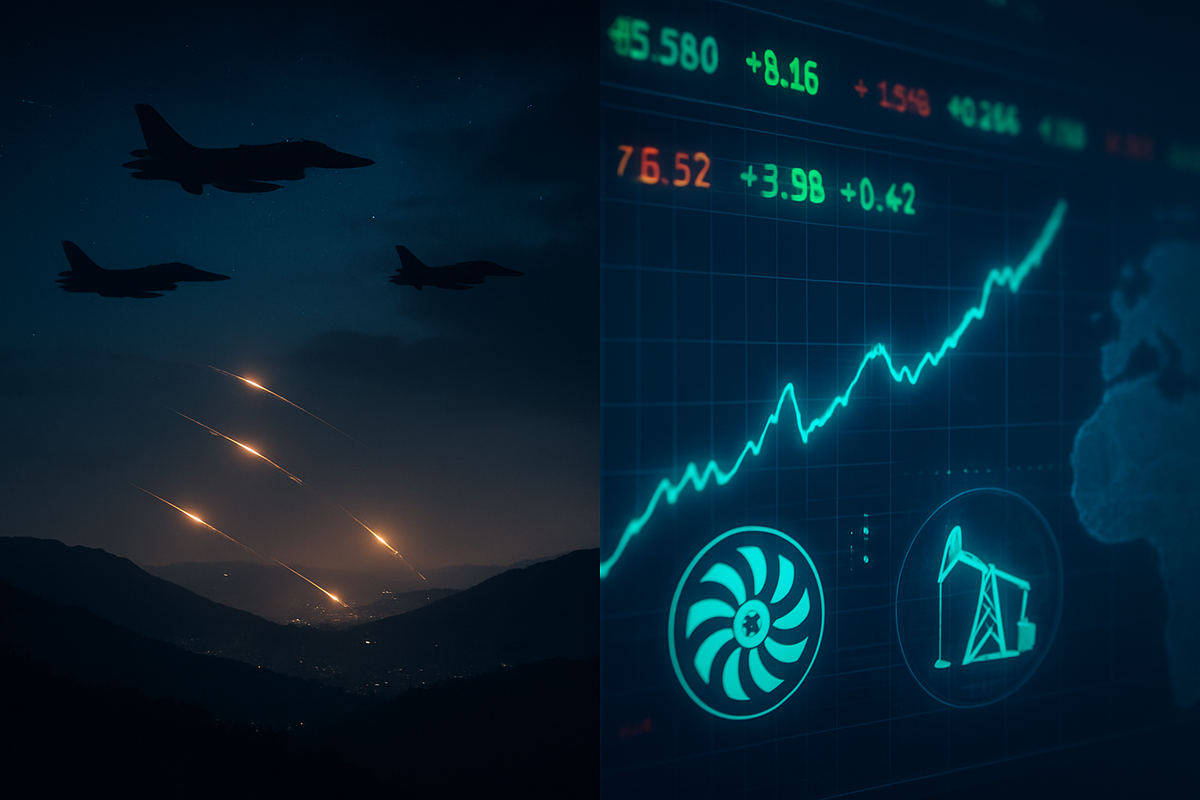
As the global markets open for the first full trading sessions of 2026, the geopolitical landscape in the Middle East has once again taken center stage, dictating the tempo for investors. Following a series of precision strikes by the Israel Defense Forces (IDF) against Hezbollah positions in Southern Lebanon and the Bekaa Valley over the New Year holiday, risk tones across international exchanges have shifted dramatically. The strikes, aimed at neutralizing reconstituted long-range missile batteries, have sparked a "flight to safety," driving significant capital into the defense and energy sectors while casting a shadow of uncertainty over broader equity indices.
The immediate implications of this escalation are twofold: a renewed "geopolitical risk premium" is being priced into crude oil futures, and defense contractors are seeing a surge in buy-side volume. While the broader S&P 500 showed early signs of volatility as traders weighed the potential for a wider regional conflict, the aerospace and defense sub-sectors have emerged as the primary beneficiaries of the heightened tensions. Analysts suggest that these strikes signal a shift from the "armed peace" of late 2025 back into a period of active containment, forcing institutional investors to recalibrate their portfolios for a year that may be defined by strategic instability.
The Return of Kinetic Conflict
The current wave of IDF activity follows a tense 2025, a year characterized by what military analysts called an "exhausted realignment." After the high-intensity conflicts of late 2024—which saw the assassination of key Hezbollah leadership and a limited ground incursion—a fragile, US-brokered ceasefire had largely held through the first half of 2025. However, intelligence reports surfacing in late December 2025 suggested that Hezbollah, backed by regional proxies, had begun a covert effort to bypass the Litani River restrictions, moving advanced drone technology and precision-guided munitions back into striking distance of Northern Israel.
In response, the IDF launched a coordinated multi-domain operation on January 1, 2026. The strikes targeted underground storage facilities and command-and-control nodes, marking the most significant military action in the region in over six months. Initial market reactions were swift; as news of the sorties broke, Brent crude futures spiked by 4%, briefly touching $68 per barrel before settling as traders assessed the likelihood of a disruption in the Strait of Hormuz. The CBOE Volatility Index (VIX) also saw a 12% jump, reflecting the market's unease with the sudden return to kinetic warfare.
Key stakeholders, including the US State Department and regional powers, have called for restraint, yet the market is signaling a belief that this is the start of a prolonged "pre-emptive" campaign. Defense analysts note that the precision and scale of the New Year's strikes suggest a high degree of technological sophistication, relying heavily on the very systems produced by the "Big Three" defense primes. This has led to an immediate decoupling of defense stocks from the broader market, as they trade on the expectation of replenished munitions and accelerated procurement cycles.
Winners and Losers in a Volatile Landscape
The primary winners in this environment are the major defense contractors, who are entering 2026 with record-high backlogs. Lockheed Martin (NYSE: LMT) saw its shares climb 3.2% in early trading, as the company’s F-35 components and missile defense systems remain the backbone of the IDF’s aerial superiority. Similarly, Northrop Grumman (NYSE: NOC) has attracted significant interest, with analysts pointing to its leadership in unmanned systems and digital command platforms as essential for the "pre-emptive" style of warfare currently being witnessed. Northrop Grumman is currently viewed by many as a "Top Pick" for 2026, with price targets suggesting a 14% upside driven by the B-21 program and rising global demand for integrated missile defense.
RTX Corporation (NYSE: RTX), formerly Raytheon, has also seen a robust uptick. The company's production of interceptors for the Patriot and Iron Dome systems is critical during periods of Hezbollah retaliation. With a backlog approaching $500 billion, RTX offers investors a degree of revenue visibility that is rare in a volatile market. On the energy side, giants like ExxonMobil (NYSE: XOM) and Chevron (NYSE: CVX) are serving as vital portfolio hedges. While a projected global oil surplus in 2026 was expected to keep prices capped, the "geopolitical tail-risk" introduced by the IDF strikes has made these high-dividend-yielding stocks attractive to institutional investors looking for a "safe haven" within the commodities space.
Conversely, the losers in this scenario are primarily found in the travel and consumer discretionary sectors. Airlines, such as Delta Air Lines (NYSE: DAL), have faced downward pressure due to rising fuel costs and the potential for flight disruptions in the Mediterranean corridor. Furthermore, technology companies with high valuations and sensitive global supply chains are seeing some profit-taking as investors rotate into "hard assets" and defensive positions. If the conflict escalates to include direct Iranian involvement, the pressure on these "risk-on" sectors is expected to intensify.
Broader Significance and Historical Context
The current escalation fits into a broader global trend of rising military expenditures, with the US defense budget for 2026 proposed at a staggering $1.01 trillion. This "trillion-dollar milestone" reflects a fundamental shift in Western policy toward "Space Security" and AI-enabled warfare. The IDF strikes on Hezbollah are, in many ways, a live-fire demonstration of the next generation of military technology—specifically autonomous drones and orbital surveillance—which are becoming the new standard for modern conflict. This shift is creating a ripple effect, where "legacy" hardware is being phased out in favor of "digital-first" defense systems.
Historically, Mideast tensions have acted as a catalyst for energy market restructuring. In 2026, the significance lies in the "tug-of-war" between the International Energy Agency’s (IEA) predicted 4 million barrel-per-day surplus and the threat of physical supply disruptions. This event serves as a reminder that despite the global transition toward renewables, the "old economy" energy giants like ExxonMobil and Chevron remain the ultimate arbiters of market stability during times of crisis. The current situation echoes the 1970s oil shocks, albeit with a modern twist: the risk is no longer just about supply, but about the security of the maritime routes and pipelines that define the global economy.
Furthermore, there are significant regulatory and policy implications. The US government is increasingly likely to fast-track "Foreign Military Sales" (FMS) to regional allies, providing a long-term tailwind for the defense sector. This event also underscores the growing importance of "Silicon Valley" defense firms, such as Palantir Technologies (NYSE: PLTR), which provide the data analytics necessary for the IDF’s precision targeting. As 2026 progresses, the line between traditional "defense primes" and "tech giants" will continue to blur, as both compete for a share of the burgeoning autonomous systems market.
The Road Ahead: Strategic Pivots
In the short term, investors should prepare for continued volatility as the IDF continues its campaign to dismantle Hezbollah’s strategic assets. The potential for a "tit-for-tat" escalation remains the primary risk; if Hezbollah responds with a sustained barrage of long-range missiles into Israeli population centers, the market could see a more pronounced "risk-off" move. Strategically, defense companies may need to pivot even faster toward "attritable" technologies—low-cost, mass-produced drones and munitions—as the high cost of traditional interceptors becomes a point of contention in budget debates.
Long-term, the opportunity lies in the "re-arming of the West." The 2026 geopolitical environment suggests that the "peace dividend" of the post-Cold War era is officially a thing of the past. Market opportunities will likely emerge in satellite communications and cybersecurity, as these become the front lines of regional conflicts. A potential scenario involves a "realignment" where Israel and certain Gulf states deepen their security cooperation against Iranian influence, further stabilizing regional energy flows but also cementing a permanent, high-level demand for American defense technology.
Market Outlook and Summary
The New Year’s strikes on Hezbollah have served as a wake-up call for the 2026 market, reminding investors that geopolitical risk remains the most potent "X-factor" in financial planning. The key takeaways are clear: the defense sector, led by giants like Lockheed Martin and Northrop Grumman, is no longer just a cyclical play but a structural cornerstone of a modern portfolio. Simultaneously, the energy sector has reclaimed its role as the essential hedge against regional instability, with ExxonMobil and Chevron providing both yield and safety in an uncertain world.
Moving forward, the market will be characterized by a "selective bull" sentiment. While the broader indices may struggle with high interest rates and geopolitical headwinds, specific sectors tied to national security and energy independence are poised to outperform. Investors should watch for the official release of the 2026 US defense budget details and any signs of escalation in the Strait of Hormuz, as these will be the primary triggers for the next leg of market movement. In a world of "exhausted realignment," the only certainty is that volatility is back, and the defense of the status quo has never been more expensive.
This content is intended for informational purposes only and is not financial advice.