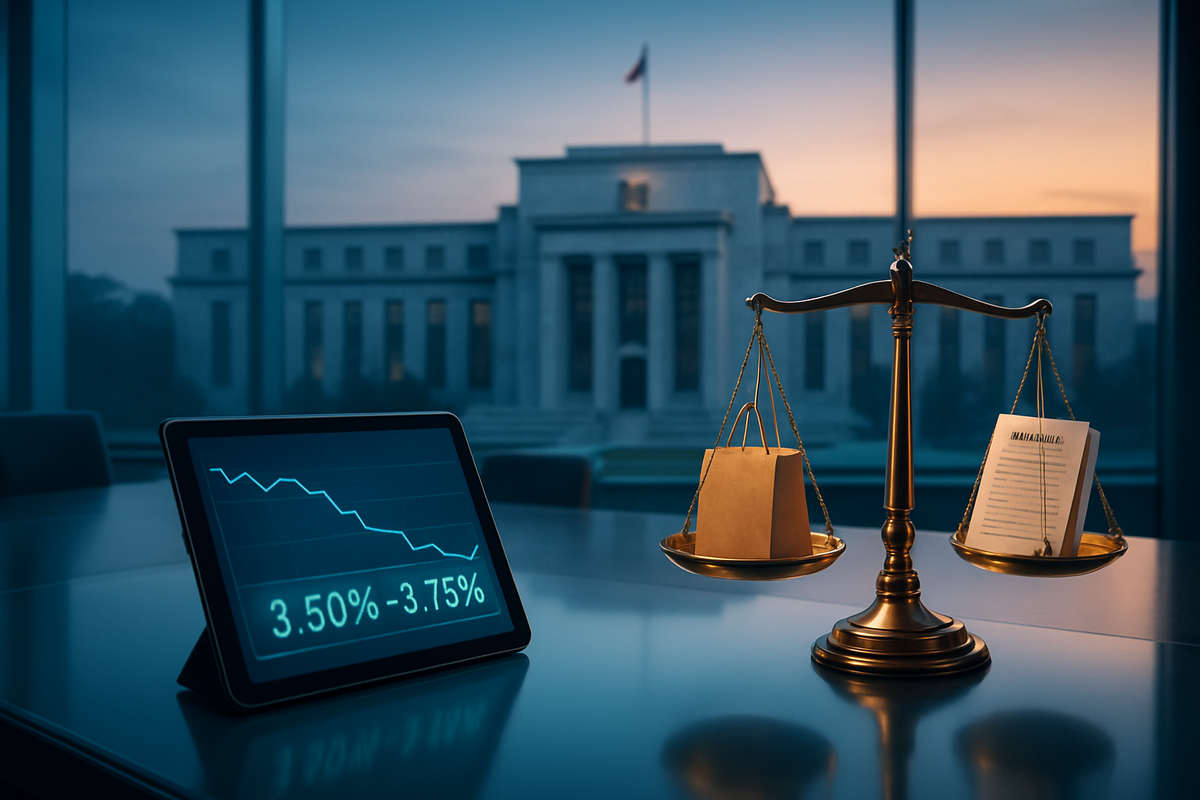
As the calendar turns to January 14, 2026, the Federal Reserve finds itself at a critical juncture in its multi-year campaign to stabilize the American economy. After a series of calibrated adjustments throughout late 2025, the federal funds rate currently sits at a consensus target of 3.50%–3.75%. This "neutral-ish" territory represents the central bank's attempt to find a sweet spot where policy neither aggressively restricts growth nor fuels inflationary fires, yet the path forward remains clouded by a complex divergence between a cooling labor market and a surprisingly resilient consumer.
The immediate implications for the market are profound. With the Fed signaling a potential shift from "inflation fighting" to "growth preservation," investors are recalibrating their expectations for 2026. While the "soft landing" narrative remains the base case for many on Wall Street, the dual-mandate tightrope is thinner than ever. The central bank must decide whether to continue easing toward a 3.25% terminal rate or pause to ensure that sticky retail sales do not reignite a dormant inflationary spark.
The 3.5% Anchor: Deciphering the Fed’s Next Move
The journey to the current 3.50%–3.75% range followed a year of "data-dependent" maneuvers throughout 2025. According to the Federal Reserve’s December 2025 Summary of Economic Projections, the median "dot plot" suggests only one additional 25-basis-point cut is likely for the entirety of 2026. This conservative outlook stems from a labor market that has entered a "low-hiring, low-firing" phase. Nonfarm payrolls for December 2025, reported earlier this month, added a modest 50,000 jobs—significantly trailing consensus expectations and highlighting a cooling trend that has pushed the unemployment rate to 4.4%.
However, the Federal Open Market Committee (FOMC) remains haunted by "sticky" retail sales data. The 2025 holiday season was historic, marking the first time US retail sales crossed the $1 trillion threshold. Despite high prices and lingering consumer "gloom," spending has remained robust, bolstered by a projected $517 billion in tax refunds expected to hit households in early 2026. This consumer resilience, coupled with core inflation still hovering slightly above the 2% target, has created a split among major financial institutions. JPMorgan Chase & Co. (NYSE: JPM) analysts are forecasting a full pause for 2026, while Goldman Sachs Group Inc. (NYSE: GS) and Barclays PLC (NYSE: BCS) anticipate up to three additional cuts to reach a 3.00% terminal rate by year-end.
Adding another layer of complexity to the 2026 outlook is the leadership transition at the Eccles Building. Jerome Powell’s term as Chair is set to expire in May 2026. The uncertainty surrounding his potential successor—and whether the next lead will maintain the current path of cautious easing—has already begun to inject volatility into long-term Treasury yields. As the Fed navigates this transition, the focus has shifted from "how high" to "how long," as they weigh the risk of a labor market fracture against the persistent strength of the American shopper.
Sector Winners and Losers in a Stabilizing Rate Environment
The shift toward a 3.5% rate environment has created a distinct landscape of winners and losers across the equity markets. Technology giants, particularly those leading the artificial intelligence revolution like NVIDIA Corporation (NASDAQ: NVDA) and Microsoft Corporation (NASDAQ: MSFT), stand to benefit from lower "hurdle rates." As the cost of capital stabilizes, the high valuations of these growth-oriented firms become more justifiable to institutional investors. Furthermore, the massive capital expenditure cycles required for AI data centers are more manageable in a declining rate environment, supporting a projected 12% to 15% earnings growth for the S&P 500 in 2026.
The real estate sector is also experiencing a renaissance. After years of being suppressed by high borrowing costs, residential builders like D.R. Horton, Inc. (NYSE: DHI) and commercial Real Estate Investment Trusts (REITs) are seeing a recovery in demand. Lower mortgage rates are slowly unlocking "golden handcuff" inventories, while dividend-paying REITs are becoming increasingly attractive to income-seekers as yields on cash and money market funds begin to recede from their 2024 peaks.
Conversely, the banking sector faces a more nuanced challenge. While a "soft landing" prevents a spike in loan defaults, the narrowing spread between short-term and long-term rates can compress net interest margins. Traditional lenders like Bank of America Corp (NYSE: BAC) and Wells Fargo & Co (NYSE: WFC) must navigate a landscape where the windfall from higher rates is evaporating, forcing a strategic pivot toward fee-based income and wealth management. Small and mid-cap companies, often represented by the Russell 2000 Index, may emerge as the biggest winners, as many of these firms carry floating-rate debt that will see immediate relief from the 175 basis points of cumulative cuts delivered since the easing cycle began.
A Historical Pivot: The AI-Productivity Paradox and Policy Shifts
The Fed’s current path fits into a broader historical trend of post-crisis normalization, but with a modern twist: the AI-productivity boost. Historically, a slowing labor market—evidenced by the current 4.4% unemployment rate—would signal an impending recession. However, in 2026, many economists argue that GDP is decoupling from headcount expansion. Firms are increasingly leveraging automation to maintain output with fewer employees, a trend that may explain why job growth is "subdued" while retail sales remain "sticky." This productivity surge allows the Fed to keep rates higher for longer than they might have in previous cycles, as the economy can handle more "heat" without traditional wage-push inflation.
The broader significance also touches on fiscal-monetary coordination. With 2025 tax policy changes resulting in larger-than-expected refunds for the public in 2026, the Federal Reserve is effectively battling a "stealth" fiscal stimulus. This creates a ripple effect where the central bank must stay more restrictive than global peers like the European Central Bank (ECB), which may lead to a persistently strong U.S. Dollar. This "American exceptionalism" in consumer spending complicates the Fed's efforts to align with the global easing cycle, potentially creating friction in international trade and currency markets.
The Road to the Terminal Rate: What Lies Ahead
In the short term, all eyes will be on the January and February Consumer Price Index (CPI) prints. If the $517 billion tax refund "sugar high" translates into a significant spike in discretionary spending, the Fed may be forced to abandon its projected mid-year cut and maintain the 3.50%–3.75% range indefinitely. Market participants should prepare for a "wait-and-see" approach from the FOMC throughout the first half of 2026, as the committee gauges whether the labor market's "low-hiring" phase is a temporary plateau or a precursor to a steeper decline.
Longer-term, the strategic pivot will likely involve a redefined "neutral rate." Before the 2020 pandemic, a 2.5% rate was considered neutral; in the 2026 reality of higher structural deficits and AI-driven growth, many analysts believe 3.25% or even 3.50% is the new floor. This shift requires investors to adapt their portfolios to a "higher-for-longer" baseline, where the era of near-zero interest rates remains a historical outlier rather than a future destination. The successful navigation of Jerome Powell's departure in May will be the ultimate litmus test for market stability.
Market Outlook and Final Thoughts
As 2026 unfolds, the Federal Reserve’s projected rate path remains a study in cautious balance. The consensus target of 3.50%–3.75% reflects an economy that has survived the most aggressive tightening cycle in decades but is not yet ready to return to the "easy money" era. The key takeaway for investors is the emergence of a "K-shaped" economic signal: a softening labor market that would typically demand cuts, countered by a resilient consumer that demands caution.
The market moving forward will likely be characterized by sector-specific rotations rather than broad-based rallies. Investors should watch for signs of "re-leveraging" in the corporate sector and a potential rebound in M&A activity as the cost of capital stabilizes. While the threat of a deep recession appears to have receded, the risk of a "no-landing" scenario—where inflation remains stubbornly above target—is the primary tail risk. In the coming months, the Fed's ability to communicate its transition to new leadership while maintaining its inflation-fighting credibility will be the most significant factor for global markets.
This content is intended for informational purposes only and is not financial advice.