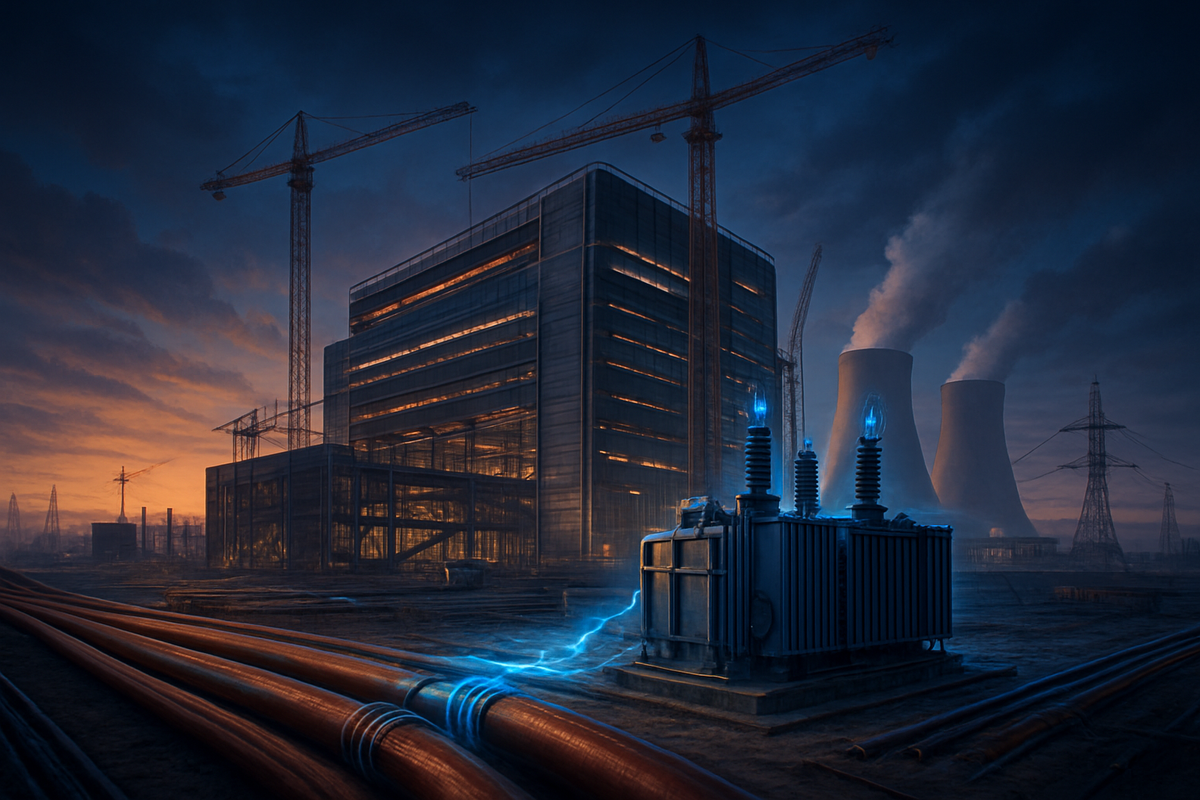
As of January 14, 2026, the narrative surrounding Artificial Intelligence has undergone a profound transformation. What began as a feverish pursuit of large language models and generative software has matured into a massive, tangible "infrastructure supercycle." The focus of the financial markets has shifted from the ethereal world of algorithms to the gritty reality of the "old economy." This pivot is driven by the realization that AI is not just a software theme; it is a physical endeavor that requires unprecedented amounts of steel, copper, electrical equipment, and carbon-free energy.
With hyperscalers like Microsoft Corp. (NASDAQ: MSFT), Meta Platforms Inc. (NASDAQ: META), and Amazon.com Inc. (NASDAQ: AMZN) allocating an estimated $1 trillion toward data center capital expenditures between 2024 and 2026, the immediate implications are reverberating across cyclical sectors. The bottleneck for AI progress has moved down the stack: the primary constraints are no longer just the availability of advanced chips, but the physical capacity of the electrical grid, the supply of specialized cooling systems, and the raw materials needed to build the massive "AI factories" of the future.
The Dawn of the Gigawatt Campus
The current infrastructure explosion is defined by projects of a scale previously unseen in the digital age. Leading the charge is Meta’s "Prometheus" supercluster in New Albany, Ohio, which is slated to come online later this year with a 1-gigawatt (GW) capacity. Not to be outdone, Oracle Corp. (NYSE: ORCL) recently moved into the next phase of its "Stargate I" campus in Abilene, Texas. This 1.2 GW facility is designed to house over 450,000 NVIDIA Corp. (NASDAQ: NVDA) Blackwell-architecture GPUs, representing a physical footprint that rivals some of the world's largest industrial manufacturing plants.
This timeline of massive buildouts was accelerated in late 2025 when Anthropic announced a $50 billion investment into domestic computing hubs, following a trend of "sovereign AI" where infrastructure is increasingly localized to secure data and energy supplies. The market's initial reaction has been a dramatic re-rating of cyclical stocks. Since the start of the 2026 trading year, the industrial and utility sectors have outperformed the broader S&P 500, as investors recognize that the "picks and shovels" of this era are literal transformers, turbines, and copper cabling.
The involvement of key stakeholders has also evolved. While tech giants provide the capital, the heavy lifting is being done by legacy industrial firms. In November 2025, a landmark partnership was formed between Caterpillar Inc. (NYSE: CAT) and Vertiv Holdings Co. (NYSE: VRT) to deliver "pre-designed AI architectures." These modular systems combine Vertiv’s high-density liquid cooling with Caterpillar’s reciprocating engines for on-site power, allowing data center operators to bypass the backlogged electrical grid—a move that has become a necessity as wait times for utility connections in key hubs like Northern Virginia now exceed four years.
Winners in the Trenches and the Grid
The primary beneficiaries of this physical buildout are the companies that provide the "muscles" and "skeletons" of these data centers. Caterpillar Inc., whose market capitalization topped $300 billion this month, is riding a record $39.8 billion backlog. The company has transformed from a construction equipment play into a critical energy partner, providing the gas turbines and backup power systems that keep AI clusters operational during grid fluctuations. Similarly, Eaton Corp. plc (NYSE: ETN) has seen its order books swell as it remains the dominant supplier of the high-voltage switchgear and transformers required to handle the extreme power densities—now often exceeding 100 kW per rack—found in AI facilities.
In the materials sector, Freeport-McMoRan Inc. (NYSE: FCX) is the centerpiece of what analysts are calling the "2026 Copper Supercycle." AI data centers are significantly more material-intensive than their predecessor cloud facilities, consuming up to three times more copper for power distribution and cooling systems. With copper prices hovering near $13,000 per tonne in early 2026, Freeport’s role as a primary producer has made it a darling of institutional portfolios. On the steel side, Nucor Corp. (NYSE: NUE) has capitalized on the trend through its "Nucor Data Systems" unit, which now supplies nearly 95% of the specialized steel products used in a typical data center’s building shell and server racks.
However, the "losers" in this transition are becoming equally apparent. Companies that failed to secure energy pipelines or lacked the capital to pivot toward high-density infrastructure are struggling. Samsung Electronics Co. Ltd. (KSE: 005930) has reportedly lost ground to competitors due to lower yield rates on its 3nm process nodes, while Intel Corp. (NASDAQ: INTC) continues to face hurdles in its foundry transition, leaving it lagging behind Taiwan Semiconductor Manufacturing Co. (NYSE: TSM). Furthermore, enterprise software firms relying on legacy "per-seat" licensing models are seeing their valuations pressured as AI-driven automation threatens traditional software consumption patterns.
The Grid as the Ultimate Choke Point
The wider significance of this buildout lies in its impact on the global energy landscape and regulatory policy. The U.S. electrical grid, much of which was designed for a different era, is being pushed to its breaking point. In response, the Department of Energy (DOE), under the leadership of Secretary Chris Wright, initiated a "fast-track" rulemaking in late 2025 to prioritize the interconnection of large-scale AI loads. This policy shift reflects a broader national security priority: maintaining AI leadership requires not just better code, but a more resilient and high-capacity electrical backbone.
This energy hunger has sparked a "nuclear renaissance." Constellation Energy Corp. (NASDAQ: CEG) is currently leading the restart of the Crane Clean Energy Center (formerly Three Mile Island Unit 1) to provide 835 MW of carbon-free power exclusively to Microsoft. Similarly, NextEra Energy Inc. (NYSE: NEE) has partnered with Alphabet Inc. (NASDAQ: GOOGL) to restart the Duane Arnold nuclear plant in Iowa. This trend of "behind-the-meter" power—where data centers connect directly to a power plant—is becoming the standard for the industry’s elite, effectively creating a private energy network for the tech titans.
Historical precedents for this infrastructure boom are few, but comparisons are being drawn to the railroad expansion of the late 19th century or the buildout of the interstate highway system. Like those events, the AI infrastructure cycle is creating ripple effects far beyond its immediate industry. It is forcing a reorganization of local economies, particularly in "data center hubs" like Abilene, Texas, and New Albany, Ohio, where the influx of capital is driving up local electricity rates and sparking community pushback—a phenomenon now known as the "Data Center Rebellion."
Strategic Pivots and the Road Ahead
Looking toward the remainder of 2026 and beyond, the focus will likely shift from building the "shell" of these facilities to optimizing their internal efficiency. We are already seeing strategic pivots toward liquid-to-chip cooling, as traditional air cooling proves insufficient for the heat generated by dense Blackwell and Rubin GPU clusters. This creates a secondary market opportunity for specialized chemical and thermal management companies that can solve the "heat problem" at scale.
In the short term, the market must navigate the tension between the massive capital requirements of these projects and the still-evolving monetization paths for generative AI software. If the "AI return on investment" (ROI) does not begin to manifest more clearly in corporate earnings by late 2026, there is a risk that the infrastructure spend could lead to overcapacity. However, the hyperscalers appear undeterred, viewing the buildout as a multi-decade strategic necessity rather than a cyclical trend. The long-term possibility of Small Modular Reactors (SMRs) providing dedicated power to data centers remains a key area of development for the late 2020s.
Assessing the Market Moving Forward
The AI infrastructure buildout has successfully bridged the gap between the digital and physical worlds. The key takeaway for investors is that the "AI trade" is no longer confined to the technology sector; it has fundamentally altered the valuation models for industrials, materials, and utilities. The market is now rewarding vertical integration—companies that can own the power source, the cooling technology, and the physical real estate are positioned to lead this new industrial era.
Moving forward, the market will be characterized by a "readiness gap." Large-cap leaders with the balance sheets to fund multi-billion dollar campuses will continue to pull away from smaller competitors who are priced out of the energy and materials markets. Investors should keep a close watch on copper prices and regional electricity rate structures, as these will be the early warning signs of any cooling in the infrastructure fever. As we move through 2026, the success of the AI era will be measured not just in floating-point operations per second, but in megawatts and metric tons.
This content is intended for informational purposes only and is not financial advice