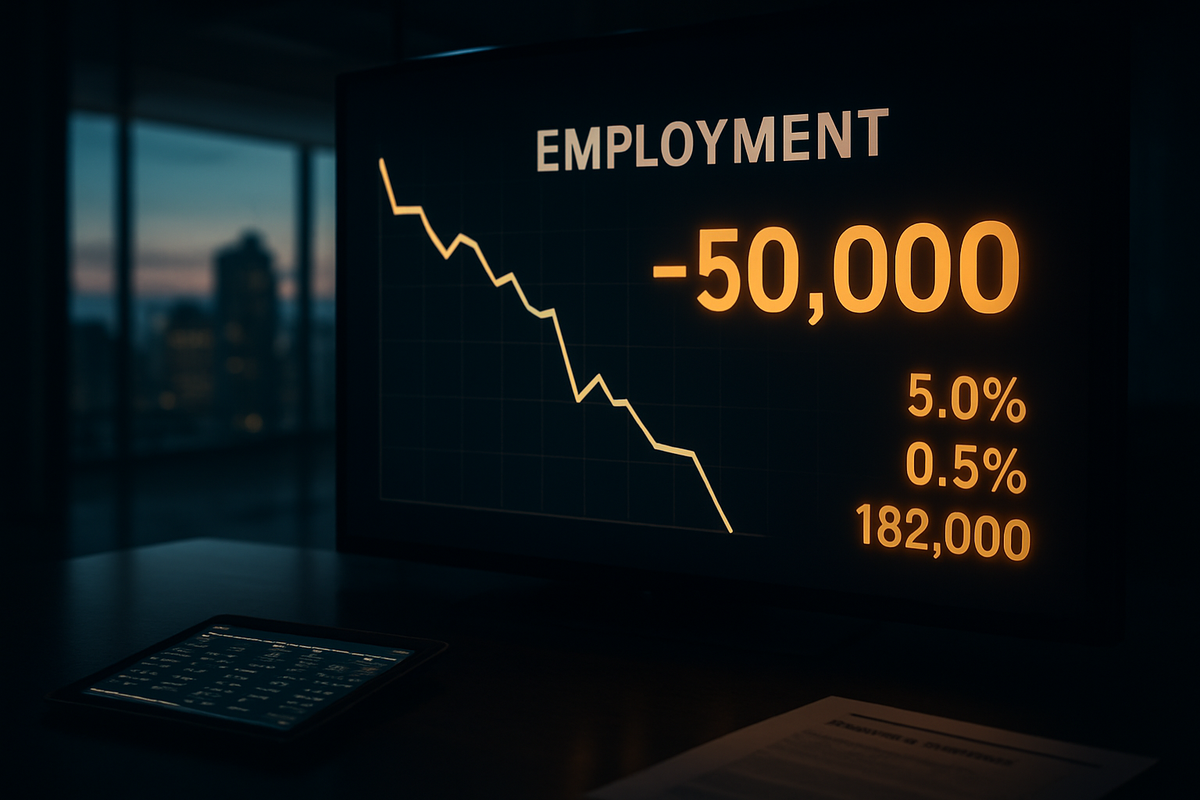
The United States labor market hit a significant speed bump in the final month of 2025, sending ripples of uncertainty through Wall Street and the hallowed halls of the Federal Reserve. According to the latest data released by the Bureau of Labor Statistics, nonfarm payrolls increased by a meager 50,000 in December, falling notably short of the 70,000 additions projected by economists. This surprising slowdown was compounded by sharp downward revisions to October and November’s data, suggesting that the cooling of the American economy may be more systemic than previously realized.
As of mid-January 2026, the market is grappling with the reality that the post-pandemic hiring boom has officially evaporated. While the headline unemployment rate dipped slightly to 4.4%, analysts were quick to point out that this "improvement" was driven by a shrinking labor force rather than robust hiring. For a Federal Reserve that has been cautiously navigating a "soft landing" throughout 2025, these figures present a complex riddle: is the labor market finally finding a sustainable "neutral" level, or is it sliding toward a dangerous "stall speed" that could necessitate a more aggressive monetary response?
A Winter Chill Over Hiring: Breaking Down the December Report
The December jobs report arrived as a cold splash of water for those expecting a year-end rally in labor demand. The 50,000-job print marks the weakest monthly performance of 2025 and caps the slowest year for job creation since 2003, excluding the distortion of the 2020 pandemic. The miss was widespread across sectors, with manufacturing and retail showing particular weakness, while healthcare—the long-standing engine of growth—showed signs of maturing.
Adding to the bearish sentiment were the revisions to the prior two months. November’s initially reported figures were pared back by 15,000, while October saw an even deeper cut of 25,000 jobs. Collectively, these revisions suggest that the momentum entering the fourth quarter was significantly weaker than real-time data had indicated. This "rear-view mirror" adjustment has led many institutional analysts to reassess their models for early 2026, shifting the narrative from growth to preservation.
The timeline leading up to this moment has been defined by the Federal Reserve's pivot in late 2025. Following a series of 25-basis-point cuts that brought the federal funds rate to its current range of 3.50%–3.75%, the central bank had signaled a desire to pause and observe. However, the December data has fractured the consensus within the Federal Open Market Committee (FOMC). Initial market reactions were swift; Treasury yields slipped as investors initially bet on a January rate cut, only to rebound as the "bad" nature of the unemployment rate drop—driven by lower labor force participation—became clearer.
Winners and Losers in a Low-Hire Economy
The cooling labor market has created a stark divide among public companies, particularly those sensitive to interest rates and consumer spending. Recruitment and human resources firms have felt the most immediate sting. ManpowerGroup (NYSE: MAN) and Robert Half Inc. (NYSE: RHI) have seen their stock prices under pressure as the "low-hire" environment reduces the demand for permanent and temporary staffing solutions. For these companies, a stagnant labor market directly translates to lower billable hours and a more competitive environment for thinning margins.
On the other side of the ledger, large-cap technology firms and high-growth stocks may find a silver lining. Companies like Nvidia (NASDAQ: NVDA) and Microsoft (NASDAQ: MSFT) often benefit from lower interest rates, which increase the present value of their future cash flows. If the weak jobs data forces the Fed to reconsider a more aggressive cutting cycle later in 2026, these tech giants could see a valuation boost. However, this is a double-edged sword; if the hiring slowdown is a precursor to a consumer spending slump, the revenue growth that sustains these high valuations could be at risk.
The banking sector faces a more nuanced challenge. JPMorgan Chase & Co. (NYSE: JPM), which has recently taken a more hawkish view on interest rates, may find its "higher-for-longer" (or "higher-than-neutral") thesis tested. While higher rates help net interest margins, a decelerating economy increases the risk of credit defaults. Similarly, real estate investment trusts (REITs) like American Tower Corp (NYSE: AMT) are watching the Fed's path closely. A pause in rate cuts could keep borrowing costs elevated for capital-intensive infrastructure projects, while a shift toward easing would provide much-needed relief to the sector.
The Fed’s Dual Mandate Under the Microscope
The December miss places the Federal Reserve in a precarious position regarding its dual mandate of price stability and maximum employment. Throughout 2025, the focus remained largely on inflation, but with the 50,000-payroll print, the "employment" leg of the mandate is now screaming for attention. Historically, when payroll growth falls below 100,000 for consecutive months, it serves as a harbinger for economic contraction. The current trend suggests that the "neutral rate"—the elusive interest rate that neither helps nor hurts the economy—might be lower than the Fed’s current 3.0% estimate.
Regulatory and policy implications are already beginning to surface. In Washington, the data is being used by proponents of fiscal stimulus to argue for tax cuts or infrastructure spending to prevent a 2026 recession. This creates a friction point with the Fed’s goal of keeping inflation anchored near its 2% target. Analysts at Goldman Sachs Group Inc. (NYSE: GS) have noted that the "stall speed" of the labor market is currently the biggest risk to their 2.6% GDP growth forecast for 2026.
This scenario echoes the "jobless recovery" periods of the early 2000s, where corporate productivity increased but hiring remained anemic. The difference today is the role of artificial intelligence and automation. Many companies are using the current high-rate environment as an excuse to lean into technology rather than human capital, a trend that could permanently alter the relationship between GDP growth and job creation.
Looking Ahead: A Data-Dependent Q1
The immediate future of the market hinges on the Fed’s January meeting. While the December report was weak, the fact that the unemployment rate did not spike has given the Fed's "hawks" enough cover to argue for a pause. Market participants are now pricing in a 95% chance of no movement in January, shifting the focus to the March and May meetings. The "short-term" will be dominated by January's preliminary data, which will reveal whether December was a seasonal anomaly or the start of a protracted downturn.
For corporations, the strategic pivot will likely involve a continued focus on "efficiency." With hiring costs high and demand uncertain, the "low-hire, low-fire" trend is expected to persist through the first half of 2026. This creates a challenging environment for investors, who must now distinguish between companies that are growing through innovation and those that are simply cutting costs to maintain margins.
The most critical scenario to watch is a potential "participation cliff." If the labor force continues to shrink, the Fed may be lulled into a false sense of security by a low unemployment rate, missing the underlying rot in the job market. Conversely, if participation rebounds and the unemployment rate jumps toward 4.8%, the Fed will be forced into "emergency mode," potentially slashing rates back toward 2% by the end of 2026.
Navigating the Labor Labyrinth
The December labor data has effectively ended the debate over whether the U.S. economy is cooling—the question now is how fast and how deep the chill will go. With only 50,000 jobs added and significant downward revisions, the margin for error for policymakers has narrowed to a razor's edge. Investors should prepare for a period of heightened volatility as every subsequent data point—from weekly jobless claims to JOLTS reports—is scrutinized for signs of a hard landing.
Moving forward, the market’s performance will likely be decoupled from traditional growth metrics, focusing instead on the Fed’s willingness to defend the labor market. The "Goldilocks" scenario of a soft landing is still on the table, but the bed is getting colder. Key takeaways for the coming months include the critical importance of the 4.5% unemployment threshold and the sensitivity of the 10-year Treasury yield to any shifts in Fed rhetoric.
As we move deeper into 2026, the resilience of the American consumer remains the final line of defense. If the labor market's weakness begins to infect consumer confidence, the Fed's cautious "normalization" path will be replaced by a frantic race to the bottom. For now, the watchword is "vigilance."
This content is intended for informational purposes only and is not financial advice.