As of January 12, 2026, the financial world continues to orbit a single gravitational center: NVIDIA Corporation (Nasdaq: NVDA). Following a blockbuster showing at the Consumer Electronics Show (CES) last week, the semiconductor giant has once again redefined the ceiling for the technology sector. With a market capitalization now hovering around $4.5 trillion, Nvidia remains the primary engine behind the Nasdaq-100’s resilience, even as the broader market grapples with a shift from the "AI land grab" phase to a more scrutinized "utility phase."
While the stock is currently trading between $184 and $187—slightly down from its October 2025 all-time high of $212.19—the immediate implications of its recent technological reveals are profound. The transition from the Blackwell architecture to the newly unveiled Rubin platform has signaled to investors that Nvidia's "one-year rhythm" of innovation is not just sustainable, but accelerating. This relentless pace is forcing a massive capital expenditure (CapEx) cycle among the world’s largest tech firms, effectively tethering the health of the entire S&P 500 to Nvidia’s silicon roadmap.
The Rubin Reveal and the Road to $300 Billion
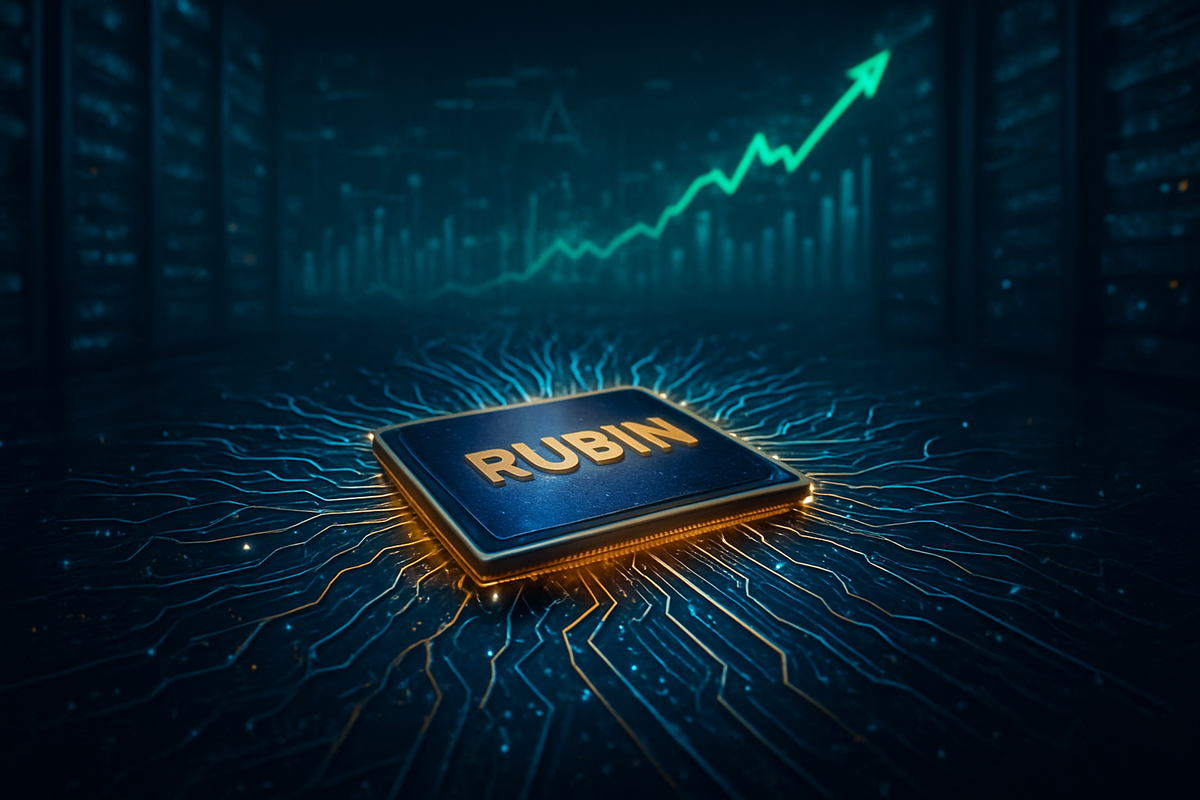
The defining moment of early 2026 occurred on January 5, when Nvidia CEO Jensen Huang took the stage at CES to officially launch the Rubin platform (R200). This next-generation "AI Supercomputer" architecture succeeds the Blackwell line, which dominated 80% of high-end data center shipments throughout 2025. The Rubin platform is a technological marvel, featuring the new Vera CPU, the Rubin GPU utilizing cutting-edge HBM4 memory, and the ConnectX-9 SuperNIC capable of 1.6 Tb/s speeds. Analysts note that Rubin offers a staggering 10x reduction in inference token costs compared to its predecessor, a move designed to make massive Mixture-of-Experts (MoE) models financially viable for enterprise-scale deployment.
This announcement follows a fiscal year 2025 where Nvidia reported a record $213 billion in revenue, a 63% year-over-year increase. The timeline leading to this moment has been one of consistent "beat and raise" quarters, though the market reaction in the first two weeks of 2026 has been characterized by sophisticated profit-taking. Despite the technical brilliance of the Rubin platform, institutional "smart money" has initiated a minor rotation into "old economy" sectors, leading to a slight pullback in Nvidia’s share price from its late-2025 peaks. However, with fiscal 2026 revenue projections now climbing toward $320 billion, the industry consensus remains that Nvidia is the undisputed gatekeeper of the generative AI era.
Winners, Losers, and the Custom Silicon Challenge
The primary beneficiaries of Nvidia’s continued dominance are the "Hyperscalers" and specialized infrastructure partners. Microsoft (Nasdaq: MSFT), Meta Platforms (Nasdaq: META), and Alphabet (Nasdaq: GOOGL) are currently in a high-stakes arms race, with combined 2026 CapEx projections surging toward a range of $527 billion to $602 billion. While these firms are spending heavily, they are also "winning" by being the first to offer Rubin-powered cloud services, which are expected to go live in the second half of 2026. Broadcom (Nasdaq: AVGO) also stands as a significant winner, benefiting from the increased complexity of the networking fabric required to connect tens of thousands of Nvidia GPUs.
On the other side of the ledger, traditional server manufacturers and legacy chipmakers continue to face margin pressure. While Advanced Micro Devices (Nasdaq: AMD) has successfully established itself as a "second-source" provider with its Instinct MI350 and upcoming MI400 series, it still struggles to chip away at Nvidia’s ~90% market share in AI accelerators. Furthermore, the push for custom silicon—such as Amazon (Nasdaq: AMZN) with its Trainium 3 and Google’s TPU v7—represents a long-term threat to Nvidia’s margins. However, as of early 2026, these in-house efforts are largely viewed as complementary to, rather than replacements for, Nvidia’s superior software ecosystem (CUDA) and interconnect technology.
The Systemic Significance of the AI Rally
Nvidia’s influence on the broader market has reached unprecedented levels, creating a concentration risk that occupies the minds of every major fund manager. In 2025, Nvidia alone accounted for 15.5% of the S&P 500’s total returns. When combined with other AI-exposed titans, a small group of seven stocks contributed over 50% of the index's total gains for the year. This level of concentration draws historical parallels to the dot-com era, yet analysts argue the current rally is backed by tangible cash flows and "triple-digit" earnings growth that the year 2000 lacked.
The wider significance of the current rally lies in the transition to "Physical AI" and robotics. Nvidia’s Rubin platform is specifically optimized for these workloads, signaling a shift from text-based chatbots to autonomous systems that interact with the physical world. This trend is expected to create ripple effects across the industrial and automotive sectors, as Nvidia’s Omniverse platform becomes the standard for digital twins and robotic training. However, this dominance also invites increased regulatory scrutiny, with global policymakers keeping a close eye on export bans to regions like China and the potential for antitrust investigations into Nvidia’s tight-knit ecosystem of hardware and software.
Looking Ahead: The $600 Billion Question
The short-term outlook for Nvidia and the Nasdaq will be defined by the "ROI Pivot." As we move deeper into 2026, investors are no longer satisfied with simply buying chips; they are demanding proof of return on investment (ROI) from the software and services built on top of that infrastructure. The potential for a "strategic pivot" is high for companies that cannot demonstrate how AI is improving their bottom line. For Nvidia, the challenge will be managing the transition to Rubin production in the second half of the year while maintaining the high margins that have become its hallmark.
Market opportunities are emerging in the "Agentic AI" space, where AI systems perform complex, multi-step tasks autonomously. If the Rubin architecture delivers on its promise of a 10x reduction in token costs, it could unlock a new wave of software startups that were previously priced out of the market. Conversely, the risk of a "CapEx wall" looms if the hyperscalers decide to slow their spending in late 2026. Most analysts, however, believe that the race for Artificial General Intelligence (AGI) will prevent any significant pullback in infrastructure investment for the foreseeable future.
Conclusion: A Market Moving in Nvidia's Shadow
As we navigate the first month of 2026, the key takeaway is that Nvidia is no longer just a semiconductor company; it is the fundamental infrastructure of the modern global economy. Its role as a market leader is solidified by a product roadmap that leaves competitors scrambling to keep pace. While the early January pullback suggests a period of consolidation, the underlying fundamentals—driven by a projected $600 billion in annual AI spending by the tech giants—remain remarkably robust.
Moving forward, investors should watch for two critical metrics: the production yields of the Rubin HBM4 modules and the quarterly earnings of the major cloud providers for signs of AI-driven revenue growth. The "AI-driven rally" has entered a more mature, disciplined phase, but as long as Nvidia continues to deliver exponential gains in compute efficiency, it will remain the most important stock in the world. The coming months will determine if the "Utility Phase" of AI can generate the productivity gains necessary to justify these historic valuations.
This content is intended for informational purposes only and is not financial advice.