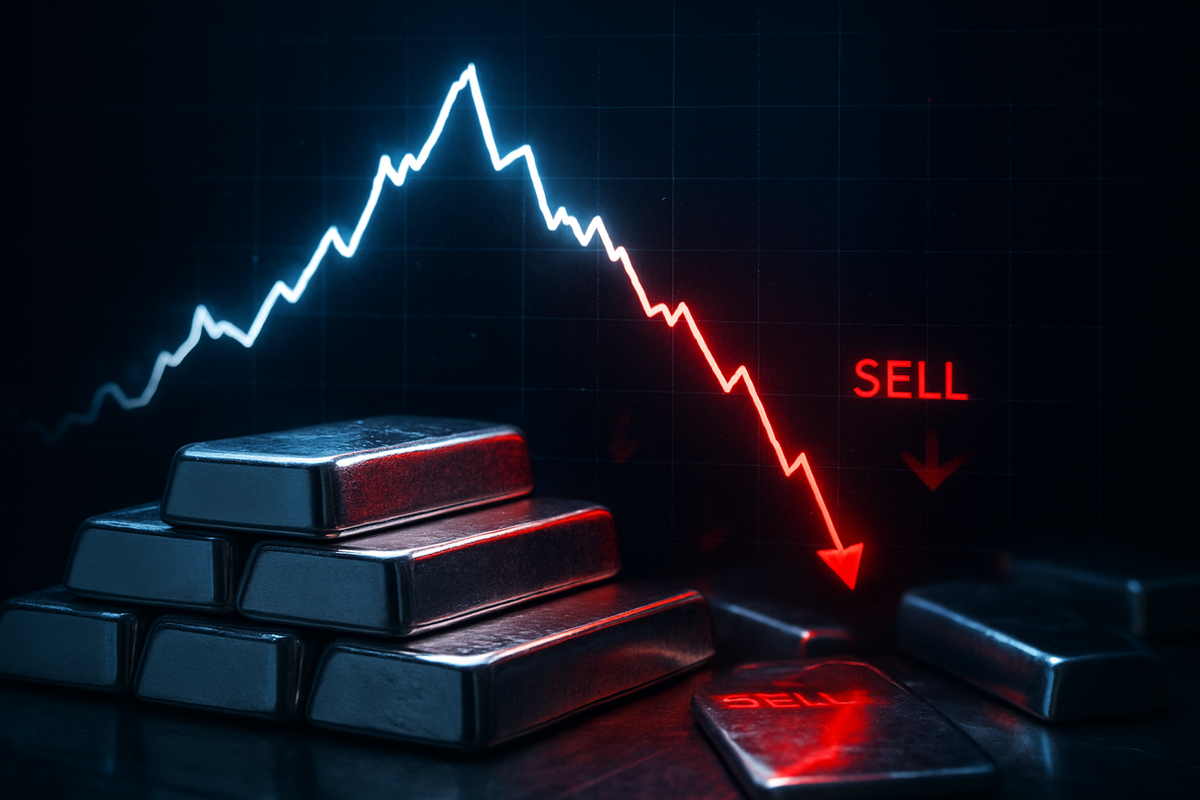
The global silver market experienced a seismic shift on December 29, 2025, as a historic parabolic rally met a brutal wall of liquidations. After shattering all-time records earlier in the morning with spot prices touching a staggering $85.87 per ounce, the "white metal" underwent a dramatic "flash crash," plummeting more than 12% in a matter of hours. This sharp reversal has sent shockwaves through commodity trading floors, marking one of the most volatile single-session movements in the history of precious metals.
The immediate implications are profound for both institutional and retail investors. The sudden retreat, which saw silver futures settle near $75.50 by the day's close, has triggered massive margin calls and wiped out billions in paper wealth for leveraged traders. While the long-term industrial thesis for silver—driven by the insatiable demands of artificial intelligence and green energy—remains intact, the "Great Bullion Retreat" serves as a stark reminder of the technical and regulatory gravity that eventually pulls back even the most aggressive bull markets.
A Perfect Storm: From Record Highs to Regulatory Reality
The collapse on December 29 was not the result of a single failure, but rather a "perfect storm" of technical exhaustion and regulatory intervention. The stage was set during the early morning hours when silver reached its peak of $85.87, fueled by a year-to-date rally of over 180%. However, as the market opened in New York, the weight of the CME Group’s Advisory No. 25-393 began to be felt. Issued just days prior, the advisory raised initial margin requirements for silver futures by 13.6%, increasing the cost of holding a single contract from $22,000 to $25,000. This regulatory "hammer" forced high-leverage players to either inject more capital or liquidate their positions, sparking a chain reaction of selling.
Compounding the margin-driven sell-off was a sudden shift in the geopolitical landscape. Reports emerged of a breakthrough meeting between U.S. President Trump and Ukrainian President Zelenskyy, signaling a potential cooling of the Russia-Ukraine conflict. This "peace pivot" drained the safe-haven premium that had bolstered silver prices throughout the final quarter of 2025. With the US Dollar Index (DXY) simultaneously stabilizing at 98.3 and bond yields ticking upward, the fundamental pillars supporting the $80+ price tag began to crumble.
By midday, the technical damage was irreparable. Silver’s Relative Strength Index (RSI) had been screaming "overbought" for weeks, crossing the 90 threshold—a level rarely seen in commodity history. In the thin liquidity of the holiday trading period between Christmas and New Year’s, there were few buyers willing to step in front of the falling knife. The result was a slide to an intraday low of $71.53 before a modest recovery toward the end of the session.
The Mining Sector: Winners, Losers, and the Resilience of Streamers
The equity markets mirrored the chaos in the pits, with silver-linked stocks bearing the brunt of the volatility. The iShares Silver Trust (NYSE Arca: SLV), the primary vehicle for retail silver exposure, fell 8.7% on the day, recording its largest single-day redemption of 2025. Pure-play miners were hit even harder; Pan American Silver (NYSE: PAAS) saw its shares tumble 7%, as investors rushed to lock in gains from a stock that had risen nearly 150% over the course of the year.
First Majestic Silver (NYSE: AG), which had been a market darling following its successful integration of the Cerro Los Gatos assets earlier in the year, dropped 4.4%. Similarly, Hecla Mining (NYSE: HL) saw a 4% decline in premarket trading that persisted through the afternoon. The common thread among these losers was the high correlation between their share prices and the spot price of the metal, leaving them exposed to the sudden evaporation of the speculative premium.
In contrast, the streaming and royalty space showed relative resilience. Wheaton Precious Metals (NYSE: WPM) experienced only a slight decline compared to its mining counterparts. Because Wheaton’s business model relies on fixed-cost contracts rather than direct operational mining risks, it remains a preferred "defensive" play within the sector. Meanwhile, in London, Fresnillo (LSE: FRES) initially led gains during the European morning, only to be dragged back by the U.S. rout, ultimately ending the day with a modest 2.6% gain, largely decoupled from the late-day carnage in New York.
Industrial Shortages vs. Paper Volatility: The Wider Significance
This event highlights a growing "Great Divergence" in the silver market that has defined 2025. On one hand, the physical market is facing a structural supply deficit of nearly 200 million ounces, driven by the massive silver requirements of AI data centers and photovoltaic cells. On the other hand, the "paper" market—where futures and options are traded—is subject to the whims of interest rates and margin requirements. The December 29 reversal is seen by many analysts as a "regulatory cooling" of a speculative bubble that had detached from the reality of physical delivery.
The significance of this reversal is being compared to the infamous "Silver Thursday" of 1980, when the Hunt Brothers' attempt to corner the market collapsed. However, unlike 1980, the 2025 rally is underpinned by genuine industrial demand. Furthermore, China's announcement of new silver export licensing, effective January 1, 2026, suggests that physical supply may become even tighter in the coming year. This creates a unique situation where the paper price may fall due to margin calls, while the premium for physical bars in Shanghai and London continues to rise.
From a policy perspective, the CME’s decision to hike margins indicates that regulators are becoming increasingly wary of "commodity inflation" and its impact on industrial manufacturing. If silver prices remained at $85, the cost of solar panels and high-end electronics would have faced significant upward pressure, potentially stalling green energy transitions globally.
The Road Ahead: Volatility as the New Normal
In the short term, the silver market is likely to remain in a period of "price discovery" as it digests the recent losses. Commodity traders should expect continued volatility as the market adjusts to the new $25,000 margin requirement. The $70 level is now viewed as a critical psychological and technical support zone; if silver can hold this floor, the long-term bull case remains intact. If it fails, a deeper correction toward $60 could be on the horizon.
Strategically, mining companies may need to pivot their hedging strategies. After a year of record-breaking profits, many producers may now look to lock in prices in the $70–$75 range to protect against further downside, even if they believe the metal will eventually hit $100. For investors, the emergence of "physical-only" premiums suggests that holding physical bullion or vaulted silver may become more attractive than trading leveraged futures contracts that are subject to sudden regulatory hikes.
Conclusion: A Necessary Correction?
The silver market reversal of December 29, 2025, will likely be remembered as the moment the 2025 bull run finally took a breath. While the 12% drop was painful for those caught in the "flash crash," many market veterans argue it was a necessary correction to prevent a total decoupling of price from value. The key takeaway for investors is that while silver's industrial story—the "AI and Green Gold" narrative—is stronger than ever, the path to higher prices is rarely a straight line.
Moving forward, the market will be watching the Federal Reserve's response to stabilizing inflation and the actual implementation of China’s export curbs in January. Investors should keep a close eye on the physical premiums in Asian markets and the total silver inventories in COMEX and LBMA vaults. If inventories continue to drain despite the lower paper price, the "Great Bullion Retreat" may simply be a temporary dip before silver makes its next run at the triple-digit milestone.
This content is intended for informational purposes only and is not financial advice.