One of the biggest mistakes in social media marketing is expecting a single timeline to fit every account, campaign, and industry. Some brands post for two weeks and assume nothing is working. Others expect one boosted campaign, one viral reel, or one content batch to create instant long-term growth. In reality, social media results arrive in layers. Reach may move first. Profile visits may increase next. Engagement quality may improve after that. Conversions, loyalty, and stable audience growth often take longer because they depend on trust, message clarity, and repetition rather than one isolated post.
That is why the question How long will it take to see results from social media marketing deserves a realistic answer instead of a motivational one. The timing depends on platform choice, content quality, posting consistency, niche competition, creative strength, audience-product fit, and whether promotion is being used intelligently or randomly. Some signals can appear quickly, but meaningful results usually come from momentum rather than luck. Social media is rarely linear. A page may look quiet for weeks, then start compounding once the content, offer, and audience timing begin aligning.
This guide explains what “results” actually mean, how timelines differ by stage, what slows progress down, and how marketers can shorten the path without creating unrealistic expectations. It also looks at how supportive tools can fit into a broader strategy when they are used with context, not as a substitute for content. The goal is simple: give the reader a complete answer, not a vague promise.

How long will it take to see results from social media marketing?
The honest answer is that early signals can appear within days or weeks, but stronger business-level results usually take longer. If the account already has a clear niche, consistent posting, and content that connects with the right audience, visibility improvements may be noticeable relatively fast. That could mean more reach, more profile visits, better watch time, or slightly higher engagement on the next few posts. But if the brand is unclear, the content is inconsistent, or the audience fit is weak, results can take much longer because the system has nothing strong to amplify.
For most businesses, the first 30 days are often about pattern recognition rather than dramatic payoff. Around 60 to 90 days, a better picture usually starts to emerge if the strategy is sound. That is often when recurring content themes, stronger audience reactions, and more predictable post performance begin to show. For long-term trust, conversions, and brand recall, the timeline is usually measured in months, not days. Social media works faster when the message is clear, but it still rewards repetition and consistency more than impatience.
What Counts as a “Result” on Social Media?
Many people say they want results, but they never define what that word means. That creates frustration because reach, followers, leads, and conversions do not move on the same timeline. A creator may see more views before seeing more followers. A brand may get more saves and profile visits before seeing direct sales. A service page may attract clicks before it converts into inquiries. If someone measures the wrong indicator too early, they may assume the campaign is failing when it is actually moving through a normal sequence.
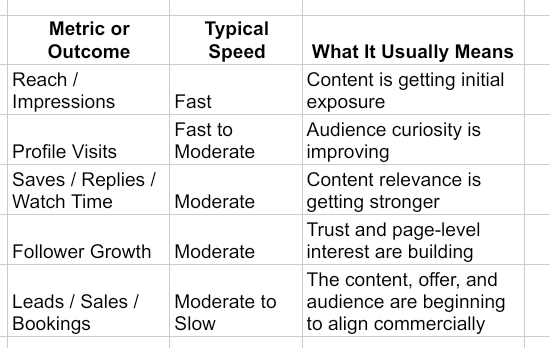
A more useful way to think about results is to divide them into stages. Stage one is attention: impressions, views, reach, and discovery. Stage two is interest: profile visits, watch time, saves, replies, and return visits. Stage three is trust: comments with intent, higher quality engagement, DMs, click-through behavior, or subscriber growth. Stage four is commercial payoff: leads, purchases, bookings, retained followers, or consistent conversions. Once you understand those layers, the timeline of social media becomes easier to interpret and much less emotionally confusing.
Why Some Accounts See Early Movement Faster Than Others?
Two accounts can post at the same frequency and get completely different timelines because the underlying conditions are different. An account with a sharp niche, clear visual identity, and strong opening hooks will usually see movement faster than an account posting generic content to a vague audience. Platform history matters too. If a page already has some baseline activity, even modest improvements in content quality can produce visible momentum sooner than a brand-new account starting from zero.
Another major factor is operational clarity. Accounts that publish with intent tend to learn faster. They test angles, compare formats, adjust hooks, and identify what their audience actually responds to. That is why marketers who use structured support intelligently often shorten the trial-and-error phase. In that context, some teams explore platforms offering smm panel solutions for marketing when they want campaign support to sit inside a broader workflow that already includes planning, timing, and content improvement. The surrounding strategy is what gives the tool meaning.

A Realistic Timeline: 30, 60, and 90 Days?
During the first 30 days, most useful progress is diagnostic. You learn what themes attract reach, what formats generate retention, and which posts create profile curiosity instead of empty impressions. In this phase, the best outcome is usually clarity, not explosive growth. At 60 days, patterns should begin to repeat. If the content direction is improving, you may see stronger consistency in reach, better engagement depth, and signs that the audience is beginning to recognize the account’s value proposition.
By 90 days, the account should usually reveal whether the strategy is truly working. This is where some creators and brands start seeing stronger compounding effects: more stable post performance, higher follower-to-view conversion, more repeat viewers, and better alignment between content and audience intent. If there is still no movement at all by this stage, the problem is often not “time.” It is usually message quality, audience mismatch, poor format choices, weak positioning, or inconsistent execution. Time only helps when the inputs are improving.
How Platform Choice Changes the Speed of Results?
Different platforms create different result curves. Short-form video platforms often produce faster visibility signals but less stable loyalty if the content lacks brand continuity. Instagram can reward strong reels quickly, but profile trust and follower retention usually depend on what the rest of the page looks like after discovery. Telegram and community platforms may grow slower in raw discovery terms, yet produce stronger retention once a channel feels active and useful. LinkedIn may take longer for compounding reach, but the quality of attention can be much higher in certain professional niches.
That is why platform-specific strategy matters so much. A brand targeting Instagram should not expect the same pattern as a business growing on Telegram or YouTube. The most effective marketers adjust both their expectations and their toolset to the platform they care about most. For example, users focused specifically on Instagram sometimes compare a reliable instagram smm panel for growth only after they have already considered how Instagram behavior works—story consumption, reel discovery, profile conversion, and visible consistency. The context around the campaign always matters more than the label on the tool.
What Usually Slows Results Down the Most?
The most common growth delays are not mysterious. Weak hooks, inconsistent posting, poor positioning, and repetitive content are usually responsible for more underperformance than people admit. A business may blame the algorithm when the real problem is that the page never gave viewers a strong reason to care. Another frequent issue is mismatch between content and offer. The page may attract general curiosity but fail to convert because the audience being reached is not the audience most likely to act.
There is also the problem of impatience disguised as strategy. Some marketers change direction every week, which resets learning before it compounds. Others post with no clear content framework, so each post becomes a random experiment with no meaningful sequence. Social media starts working faster when the brand becomes easier to understand. That means clearer themes, cleaner audience targeting, stronger post openings, and enough repetition for the market to remember what the account stands for.
Can Paid Support or SMM Panel Support Shorten the Timeline?
Support tools can shorten the timeline only when they are applied to something already worth amplifying. If the content is unclear, the profile feels weak, or the message is generic, faster exposure may only reveal the weakness sooner. But when the account already has solid creative direction, visible consistency, and a defined audience, selective support can help content gain traction earlier and create stronger learning loops. In that sense, support does not replace strategy. It can accelerate feedback when the foundation is strong enough.
This is one reason some marketers evaluate social media growth services through smm panel systems as part of a wider campaign structure rather than as an isolated tactic. When the surrounding content is semantically aligned with audience intent, when the post format is already strong, and when the profile looks conversion-ready, support can help move the account from “invisible” to “noticed” more efficiently. The tool matters, but the context around it matters even more.
How to Know Whether Results Are Delayed or the Strategy Is Weak?
This is one of the most important questions in social media marketing. If impressions are improving but engagement depth is not, the content may be discoverable but not persuasive. If profile visits rise without follower growth, the page may be attracting curiosity but failing the trust test. If engagement rises yet conversions remain low, the content may be working better than the offer. These are not signs that “social media takes too long.” They are signs that one stage of the funnel is improving while another still needs work.
A delayed strategy usually shows some positive movement, even if the final business result has not arrived yet. A weak strategy often shows scattered metrics with no repeating pattern. That is why marketers should track layered indicators rather than obsessing over one headline number. A good campaign usually leaves clues before it leaves revenue. The brands that grow faster are often the ones that learn how to read those clues without panicking too early.
Timeline Overview: What Usually Improves First?
The table below helps clarify which outcomes often appear first and which usually require more time and stronger strategic consistency.
What Is the Smartest Way to Speed Results Up Without Creating Unrealistic Expectations?
The smartest way is to improve the quality of your inputs before demanding faster outputs. Refine the hook. Clarify the niche. Make the profile easier to understand in five seconds. Build content pillars instead of posting random topics. Strengthen the CTA. Fix the landing page or profile flow. Support the strongest content instead of spreading effort equally across weak posts. Most brands do not need more activity. They need better sequencing and better judgment.
When you speed up learning, results often speed up too. That means reviewing content weekly, not emotionally reacting daily. It means identifying which posts create interest, not just which ones create vanity numbers. And it means understanding that social media rewards strategic repetition. Fast results are possible, but they usually happen because the system got clearer—not because someone got lucky once.
Frequently Asked Questions
The questions below answer the concerns most people still have after hearing the usual vague advice about “being patient” on social media.
How long does it usually take to see real social media growth?
Some early indicators can appear within days or weeks, especially reach, impressions, and profile visits. More meaningful growth such as follower consistency, stronger engagement quality, and commercial outcomes often takes longer. For many brands, 60 to 90 days is where the strategy becomes easier to judge honestly.
Why do some accounts grow fast while others stay stuck for months?
The difference usually comes down to content clarity, audience fit, and consistency. Faster-growing accounts often have stronger hooks, a clearer niche, and a better overall profile experience. Slower accounts are often not just “unlucky”; they are usually sending weaker or less focused signals to the audience.
Can social media marketing work in 30 days?
Yes, but usually in the form of learning and early movement rather than full business payoff. In 30 days, you can often identify which content formats and angles work better. Expecting complete long-term success in that time is usually unrealistic unless the account already has strong fundamentals in place.
Does using an SMM panel make results faster?
It can help shorten the timeline when it is used to support already strong content and clear campaigns. It is most effective as a structured support layer, not as a replacement for audience understanding or content quality. Promotion works better when the underlying message already deserves attention.
How do I know whether I should wait longer or change strategy?
If you are seeing some improvement in impressions, profile visits, watch time, or engagement quality, the strategy may simply need more time and refinement. If nothing meaningful is improving after sustained effort, the problem is usually not patience. It is more likely weak positioning, unclear content, or poor audience alignment.
Conclusion
So, how long will it take to see results from social media marketing? The most honest answer is that the first signs can appear quickly, but meaningful results usually arrive in stages. Visibility may improve first, trust later, and commercial payoff after that. The exact timeline depends less on hope and more on whether the content, profile, audience, and campaign structure are actually aligned.
The strongest brands do not just wait longer. They learn faster. They define the right result, track the right signals, and improve the system instead of chasing instant certainty. When that happens, social media starts to feel less random and more measurable. And that is usually the point where results begin to move with much more consistency.