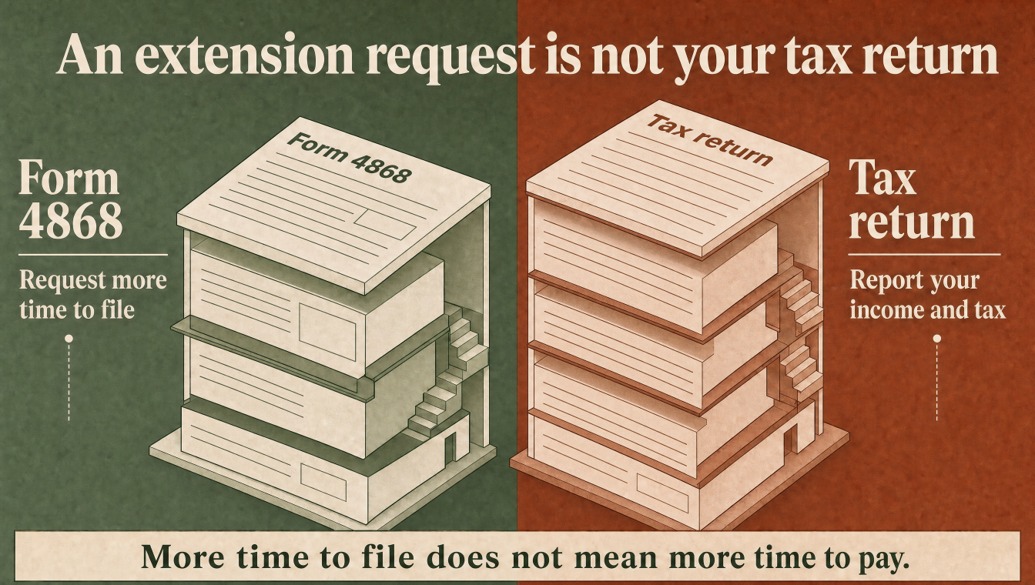
Form 4868 requests additional filing time. It does not replace the tax return or extend the payment deadline.
How much of Form 4868 do you need to fill in? Nine lines across two parts, and two of those are checkboxes that usually stay empty.
Part one asks who you are, so it wants your name, your address, your Social Security number, and your spouse’s number if you file jointly. Part two asks for four numbers, on lines 4 through 7. Estimate your total tax for the year, subtract the payments you have already made, enter the difference, then enter whatever you are sending now.
That is the whole form. Knowing it is that short changes what is worth comparing. The differences between these platforms show up after you hit send, in what they keep ready for your return and in what they tell you if the IRS sends the request back.
What Form 4868 Requires
You do not have to explain yourself. The instructions say so directly, and the IRS will contact you only if it denies the request.
Qualifying takes three things. You estimate your tax liability based on the information you have, enter that figure on line 4, and file by the due date. None of the three involves sending the IRS money. An extension with no payment attached is still a valid extension.
Line 4 asks for the total tax you expect to report on line 24 of your eventual return. Your income figure is a different number. If you expect that figure to be zero, you enter zero. Line 5 is the payments you expect to report on line 33, and the payment you make with the extension does not belong there.
You can show a balance due on line 6, pay $0 on line 7, and still receive an extension. However, you must make a reasonable estimate of your total tax liability using the information available to you. If the IRS later determines that your estimate was unreasonable, it may treat the extension as null and void.
The penalty arithmetic is why you file anyway. Filing late costs about 5% of what you owe per month. Paying late costs 0.5%, one tenth as much, so the request is worth sending even when the payment is not ready. There is a safe harbor on top of that. Pay at least 90% of your total tax by the April date and settle the rest with the return, and the IRS will generally treat you as having reasonable cause.
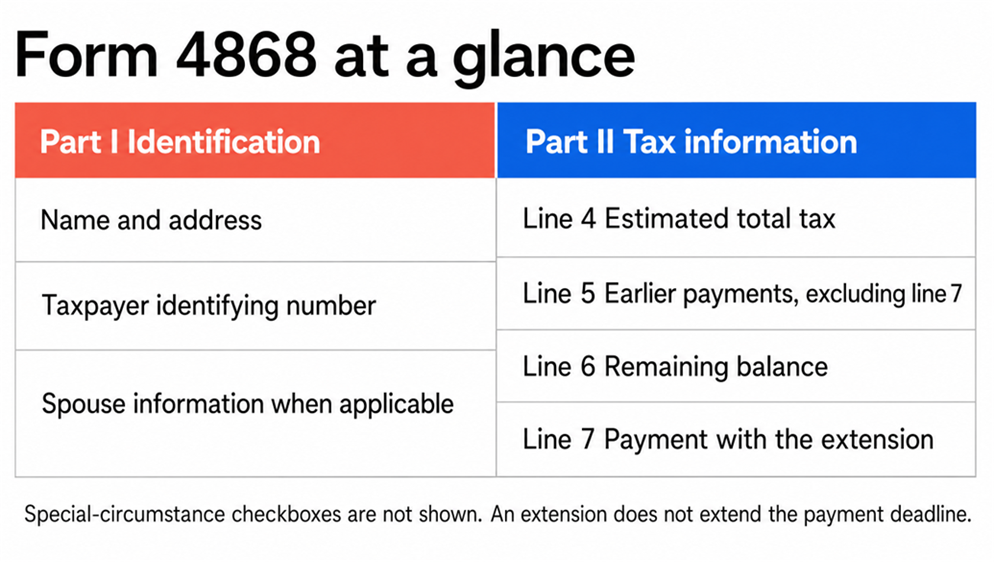 Simplified map of Form 4868. Line 5 excludes the payment entered on line 7, and special-circumstance checkboxes are not shown. Source: IRS Form 4868 and instructions. Source
Why Extensions Get Rejected
Rejections are usually about identity. One common rejection code means your Social Security number and name control don’t match the IRS database.
Your name control is the first four characters of your last name. That is why marriages, divorces, and hyphenated names cause so many rejections, and why the instructions tell you to report a name change to the Social Security Administration before you file. Other codes cover a spouse mismatch, a number outside the valid range, and an address rule that catches military and overseas filers using APO, DPO, or FPO cities.
One rejection behaves differently. A duplicate taxpayer identification number error means something has already been filed under your number, and resubmitting will not fix it. Check your account transcript instead.
A rejection gives you five days. That window is called the perfection period, and a corrected request accepted inside it counts as received on the date of the first rejection. It only exists if your original transmission was on time, so a first attempt made on April 16 is late and stays late.
1. FileTax.com
FileTax.com is registered with the IRS in three capacities. It writes its own software, begins the submission, and transmits the data directly to the IRS, so fewer parties stand between your nine lines and the agency.
It covers both forms in the family, Form 4868 for an individual and Form 7004 for a business, including the single-member business that needs only one of them.
Rejection handling is the piece worth comparing, since a five-day window only helps if you know what to correct. When you submit Form 4868 online, FileTax.com tells you the reason a request came back, so those days become time you can use.
2. TaxSlayer
You can’t amend Form 4868 once it is filed, and you don’t need to. TaxSlayer states that outright, and few of the sites publishing guidance on this form do.
An incorrect estimate made in good faith does not invalidate the extension. If you underestimated, pay more as soon as you can. If you overestimated, do nothing. Either way, the extension stands, and that is the part worth knowing before you type line 4.
3. TurboTax
Nothing extra is needed to finish the return after a TurboTax extension. The product has a dedicated flow for the form and publishes what happens next, and the return picks up from where the extension left off.
Support starts with a public question-and-answer forum. For a nine-line form, that is usually enough, since your question has almost certainly been asked before. The duplicate-number rejection, the one resubmitting will not fix, is documented there in detail.
4. H&R Block
H&R Block is unusually precise about what the six months after filing look like. You can finish the return anytime within that window by logging in to the same account with the same credentials, and the product walks you through the forms question by question.
Check line 7 twice before you transmit, because you can’t change an authorized debit amount attached to the extension afterward.
It also offers in-person help at offices where someone will go through the form with you before transmitting it.
5. FreeTaxUSA
FreeTaxUSA covers a wide set of forms, so the return behind your extension can include itemized deductions, investment income, or health savings account contributions.
It also puts a number on support. Messages through the in-account center typically get a reply in about half an hour, and the trade-off for that is no phone line.
Come back when the return is due, log in to the same account, and the data you entered is still there.
6. TaxAct
TaxAct publishes a resource page on Form 4868 and files the form electronically. It also documents a sequencing rule specific to its own product.
If you e-file the extension before importing last year’s data, you cannot import that data into the return afterward. TaxAct says the block prevents overwriting what you already sent the IRS, and the extension payment becomes a figure you re-enter later.
The order only matters if you did not know about it, so import first and e-file second.
What to Check After You File
Your proof comes from the IRS. An accepted extension shows up as transaction code 460 on your account transcript. Your return transcript will still say no record of return found for that year, which looks alarming but is normal until the return itself is processed, so the confirmation you want is on the account transcript.
There is a second route to the same result. If you pay part or all of your estimated tax electronically and flag the payment as an extension, the IRS processes the extension automatically, and the confirmation number becomes your record.
A fiscal-year filer files Form 4868 on paper, since the IRS does not accept this form electronically for a fiscal year. A new address on Form 4868 updates nothing on the IRS side because changing your address of record requires Form 8822 instead.