
Farmers markets got bigger, and nobody sent the organisers a memo about how to handle it. LocalStalls built market management software for exactly that situation - the craft fair coordinator drowning in vendor applications, the festival manager who can't remember which stallholder's insurance expired last month, the community market organiser still using a spreadsheet that crashes every time someone tries adding a new row to the vendor list. All of it goes into one platform instead of scattered across email threads and shared documents that nobody can find when they need them.
What used to work fine doesn't anymore for a lot of these events. Thirty vendors and a clipboard, that was manageable. People knew each other, payments happened in cash, and if someone's insurance was out of date, it would be sorted out on the day. But markets have grown. A hundred applications competing for fifty spots means somebody has to track who applied, what they're selling, whether their documents are current, and where exactly they'll set up if they get approved. Doing that through email chains and shared Google Sheets falls apart around the edges pretty fast once the numbers climb.
So LocalStalls handles the market stall management software piece by moving applications online. Vendors fill out forms, attach their product photos, upload whatever certificates the organiser requires. Everything lands in one dashboard. Approve someone, decline someone, stick them on a waitlist - notification emails fire automatically. No copying and pasting the same "thanks for applying" message into forty separate replies.
The stallholder management software includes site mapping, which matters more than it might sound. Drag-and-drop interface where organisers place vendors into stall positions on a visual layout. Save it, share it with the team, update it when the honey producer cancels three days before the event. Changes show up for everyone immediately. Beats the old method of texting a photo of a hand-drawn diagram to five different people and hoping nobody gets confused.
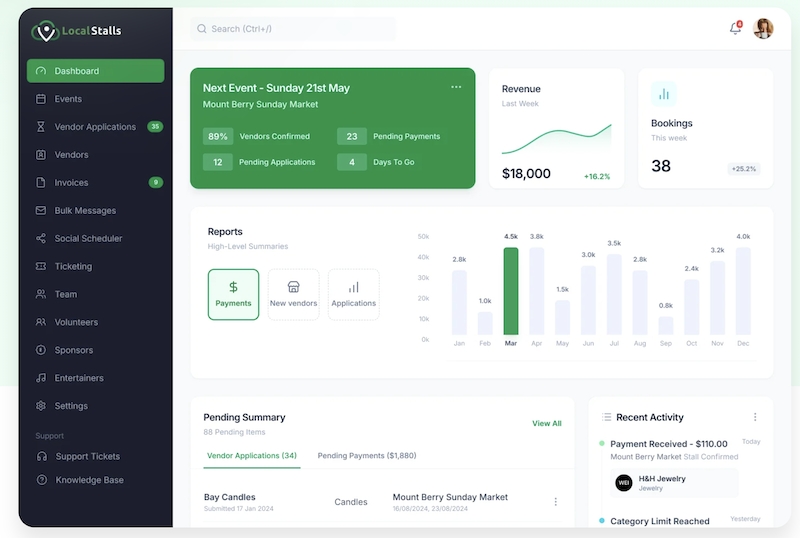
Invoicing is another piece that eats up time when done manually, and it's the part most organisers like least. LocalStalls sends payment requests automatically once a vendor gets approved, tracks who's paid, follows up with the ones who haven't. Connects to Xero and QuickBooks so the accounting side stays current without anyone re-entering numbers at the end of the month. Most organisers got into this work because they care about their community, not because they enjoy chasing people for overdue stall fees.
Market vendor management gets complicated when compliance enters the picture, which it always does eventually. Insurance certificates expire. Food handling certifications need renewal. Keeping track of all those dates across dozens or hundreds of vendors - that's exactly where things slip through the cracks. LocalStalls stores all the documents and watches the expiry dates automatically. Alerts go out before anything lapses. Finding out a vendor's insurance expired on the morning of the market, that's exactly the kind of problem this prevents.
Vendors themselves get portal access to handle their own updates. Change of address, new phone number, checking payment status - they can do it without emailing the organiser. Small thing, but those "can you update my details" requests add up across a full vendor roster. For vendors working across multiple markets and event types, having everything in one place - applications, bookings, payments, and requirements - cuts down the back-and-forth and makes it easier to manage their entire schedule from a single dashboard.
Event stall management scales differently depending on the operation, and LocalStalls built the platform to handle that range. A monthly neighbourhood market with twenty-five regular vendors needs less complexity than a three-day festival with two hundred stallholders and volunteer coordination layered on top of everything else. Both work. Councils and larger organisations running multiple events across different locations can get white-label setups with custom integrations built for their specific workflows.
There’s a broader community layer built into the platform as well. LocalStalls connects organisers with vendors, vendors with new opportunities, and the public with events happening in their area. Instead of each market operating in isolation, the platform helps build a network where discovery flows both ways - organisers reach more relevant stallholders, vendors find markets that fit their products, and visitors can explore what’s on locally.
There's a directory component too, which adds some marketing value. Vendors looking for markets can find new opportunities, visitors can discover events nearby. Extra visibility for organisers who list their markets on the platform.
Feature development keeps going based on what organisers actually say they're missing in practice. Ticketing showed up recently, along with volunteer management, sponsor tracking, and social scheduling tools. The platform started as vendor management but has been expanding into running the whole event from a single dashboard.
More information is available on the official website.
Media Contact
Company Name: LocalStalls
Contact Person: Aaron Busary
Email: Send Email
Country: United States
Website: https://localstalls.com/en/