As of March 13, 2026, the enterprise software landscape has undergone its most significant transformation since the dawn of the cloud. At the center of this revolution is Salesforce, Inc. (NYSE: CRM), a company that has redefined itself from a customer relationship management (CRM) provider into the definitive "Agentic AI" platform for the global enterprise.
The narrative surrounding Salesforce has shifted from cautious optimism to a recognition of structural dominance. While the broader software sector faced headwinds from the "SaaSpocalypse"—a fear that AI would cannibalize human-centric software seats—Salesforce has successfully pivoted. The company's recent announcement of a staggering 114% surge in AI platform Annual Recurring Revenue (ARR) has silenced many skeptics. This growth is anchored by the meteoric rise of "Agentforce," an autonomous AI platform that has fundamentally altered how businesses interact with their customers. In an era where "Co-pilots" were the buzzword of 2024, Salesforce has led the market into the era of "Agents," proving that autonomous software can drive massive top-line growth and margin expansion.
Historical Background
Founded in 1999 in a small San Francisco apartment by former Oracle executive Marc Benioff and his co-founders, Salesforce was the pioneer of the "No Software" movement. It was the first major company to successfully deliver enterprise applications via the cloud, effectively ending the era of expensive, on-premise installations.
Over the decades, Salesforce expanded its moat through aggressive acquisitions and internal innovation. Key milestones included the 2005 launch of the AppExchange, the 2018 acquisition of MuleSoft ($6.5B) for data integration, the 2019 purchase of Tableau ($15.7B) for analytics, and the blockbuster 2021 acquisition of Slack ($27.7B) to create a "Digital HQ." By 2023, the company faced activist investor pressure to improve margins, leading to a leaner, more disciplined operational structure. This discipline provided the foundation for the 2024-2025 "AI pivot," culminating in the 2026 reality where AI-driven consumption revenue is the primary engine of growth.
Business Model
Salesforce operates primarily through a subscription-based "Software-as-a-Service" (SaaS) model, organized into several core clouds: Sales, Service, Marketing, and Commerce. However, the business model is currently undergoing a strategic evolution toward consumption-based pricing.
- Subscription Revenue: Traditional seat-based licensing remains the bedrock, providing high-visibility recurring revenue from over 150,000 customers.
- Consumption Revenue (Agentic Work Units): Introduced in late 2024, "Agentic Work Units" (AWUs) allow Salesforce to charge based on the tasks completed by autonomous agents. This model hedges against the potential reduction in human seats, as Salesforce now monetizes the output of the software rather than just the access to it.
- Data Cloud: Acting as the "connective tissue," Data Cloud integrates disparate data sources to fuel AI models, charging based on data volume and processing.
- Professional Services: A smaller segment focused on implementation and strategic consulting.
Stock Performance Overview
Over the last decade, Salesforce has been a cornerstone of tech-heavy portfolios, though its journey has not been linear.
- 10-Year Horizon: Salesforce has significantly outperformed the S&P 500, driven by the mass migration to the cloud and a five-fold increase in revenue.
- 5-Year Horizon: The stock experienced a massive rally during the 2021 tech boom, followed by a sharp correction in 2022-2023 as interest rates rose.
- 1-Year Horizon (2025-2026): The last 12 months have seen a strong recovery. After bottoming out during the "SaaS mid-life crisis" of early 2024, the stock rallied nearly 45% as the market realized the potency of the Agentforce platform. As of March 2026, CRM trades at a premium valuation, reflecting its status as the leading AI application play.
Financial Performance
Salesforce’s Fiscal Year 2026 (ending January 31, 2026) was a landmark year.
- Revenue: The company reported total revenue of $41.5 billion, a 10% year-over-year increase, signaling that the "mature" company can still find double-digit growth.
- AI Surge: The most critical metric was the 114% growth in AI and Data Cloud ARR, which reached a combined $2.9 billion. Agentforce alone accounted for $800 million of that total.
- Margins: Adjusted operating margins reached an all-time high of 34.2%, up from 33.1% the previous year. This efficiency is a direct result of the AI-driven automation of Salesforce’s own internal operations.
- Shareholder Returns: Salesforce continued its aggressive capital return strategy, completing a significant portion of its $50 billion share buyback program.
Leadership and Management
Marc Benioff remains the Chairman and CEO, serving as the primary visionary and "spiritual lead" of the company. Under his leadership, Salesforce has maintained a culture of "Ohana" (family) while pivoting toward hard-nosed operational efficiency.
The management team was bolstered in 2025 with the appointment of new leads in the AI and Data divisions, focusing on technical execution over marketing hype. The board of directors has also been refreshed to include more deep-tech and AI ethics expertise, reflecting the company’s focus on the "Einstein Trust Layer"—a proprietary framework designed to ensure data privacy and prevent AI "hallucinations" in enterprise settings.
Products, Services, and Innovations
The crown jewel of the 2026 product lineup is Agentforce. Unlike the chatbots of the past, Agentforce allows enterprises to deploy autonomous "agents" that can reason, solve problems, and take action across Sales, Service, and Marketing without constant human intervention.
- Data Cloud: This platform has become the fastest-growing product in Salesforce history, reaching $2.1 billion in ARR by 2026. It provides the "clean" data necessary for AI to be effective.
- Einstein Trust Layer: A critical innovation that masks sensitive customer data before it is sent to Large Language Models (LLMs), solving the security concerns that previously stalled enterprise AI adoption.
- Slack AI: Since the 2025 update, Slack has transitioned from a messaging app to an "Agentic Interface," where users manage their AI agents in a conversational format.
Competitive Landscape
The competition in 2026 is a "clash of the titans":
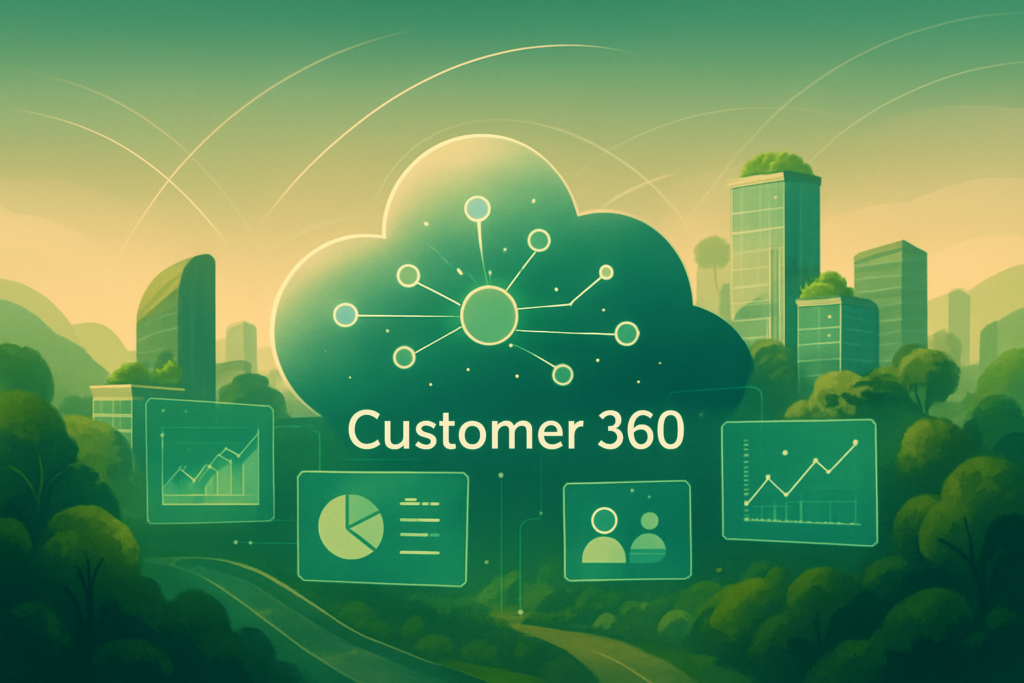
- Microsoft (MSFT: NASDAQ): The primary rival. Microsoft’s Dynamics 365 and Copilot ecosystem leverage its dominant position in OS and Office software. Salesforce counters this with its superior "Customer 360" data and its vendor-neutral approach to AI models.
- Oracle (ORCL: NYSE): Oracle has moved aggressively into the AI infrastructure space. While Salesforce leads in applications, Oracle’s control over the database layer and its multi-cloud partnerships present a persistent threat.
- SAP (SAP: NYSE): Remains strong in ERP and supply chain, but has struggled to match Salesforce’s speed in the "agentic" customer-facing AI space.
Industry and Market Trends
The enterprise software market is currently defined by the shift from Assistive AI (where AI helps a human) to Agentic AI (where AI performs the task).
- Consolidation: Enterprises are looking to consolidate their "tech stacks," favoring platforms like Salesforce that offer a unified data and AI layer.
- Verticalization: There is an increasing demand for "Industry Clouds." Salesforce has responded by tailoring its AI for healthcare, financial services, and the public sector, with its Industry Clouds reaching $6.6 billion in ARR in FY26.
Risks and Challenges
Despite the AI success, Salesforce is not without risks:
- Seat-Count Cannibalization: If AI agents become too efficient, companies may significantly reduce their human headcount, leading to a decline in traditional seat-based revenue.
- Execution Risk: The integration of the $8 billion Informatica acquisition (completed in late 2025) is ongoing and carries the usual risks of cultural and technical friction.
- Valuation: Trading at a high multiple of free cash flow, Salesforce has little room for error. Any slowdown in Agentforce adoption could lead to a sharp re-rating of the stock.
Opportunities and Catalysts
- Monetization of AWUs: As more customers move from testing to production with Agentforce, the "Agentic Work Unit" revenue could provide a massive tailwind in FY27.
- International Expansion: Markets in Europe and Asia are trailing the US in AI adoption; Salesforce is heavily investing in local data centers to capture this "second wave."
- M&A Potential: With a strong balance sheet, Salesforce is well-positioned to acquire smaller AI-native startups that provide specific agentic capabilities.
Investor Sentiment and Analyst Coverage
Wall Street is "cautiously bullish" on CRM. As of March 2026, approximately 65% of analysts cover the stock with a "Buy" or "Strong Buy" rating.
- Bull Case: Analysts at Goldman Sachs point to the 114% AI ARR growth as proof that Salesforce is the primary beneficiary of the AI application cycle.
- Bear Case: Critics argue that the "SaaSpocalypse" is a slow-burning threat that will eventually erode the core subscription business.
Regulatory, Policy, and Geopolitical Factors
Salesforce faces a complex regulatory environment:
- EU AI Act: The company has invested heavily in compliance, positioning its "Trust Layer" as a tool to help other companies comply with strict European transparency and safety laws.
- Data Sovereignty: Increasingly, nations are requiring data to be stored and processed within their borders. Salesforce’s "Hyperforce" architecture allows it to meet these requirements.
Conclusion
By mid-March 2026, Salesforce has successfully navigated the most perilous transition in its history. The 114% surge in AI platform ARR and the rapid adoption of Agentforce demonstrate that the company is not just a legacy cloud provider, but a frontrunner in the autonomous enterprise era.
Investors should watch for the Q1 FY27 earnings report in late May, which will provide the first full quarter of "Agentic Work Unit" consumption data. For those looking for a diversified, cash-flow-rich entry into the AI market, Salesforce remains a foundational holding in the enterprise technology sector.
This content is intended for informational purposes only and is not financial advice.