Rising adoption of AI-driven skincare diagnostics and AR virtual try-on technologies accelerates digital beauty commerce worldwide
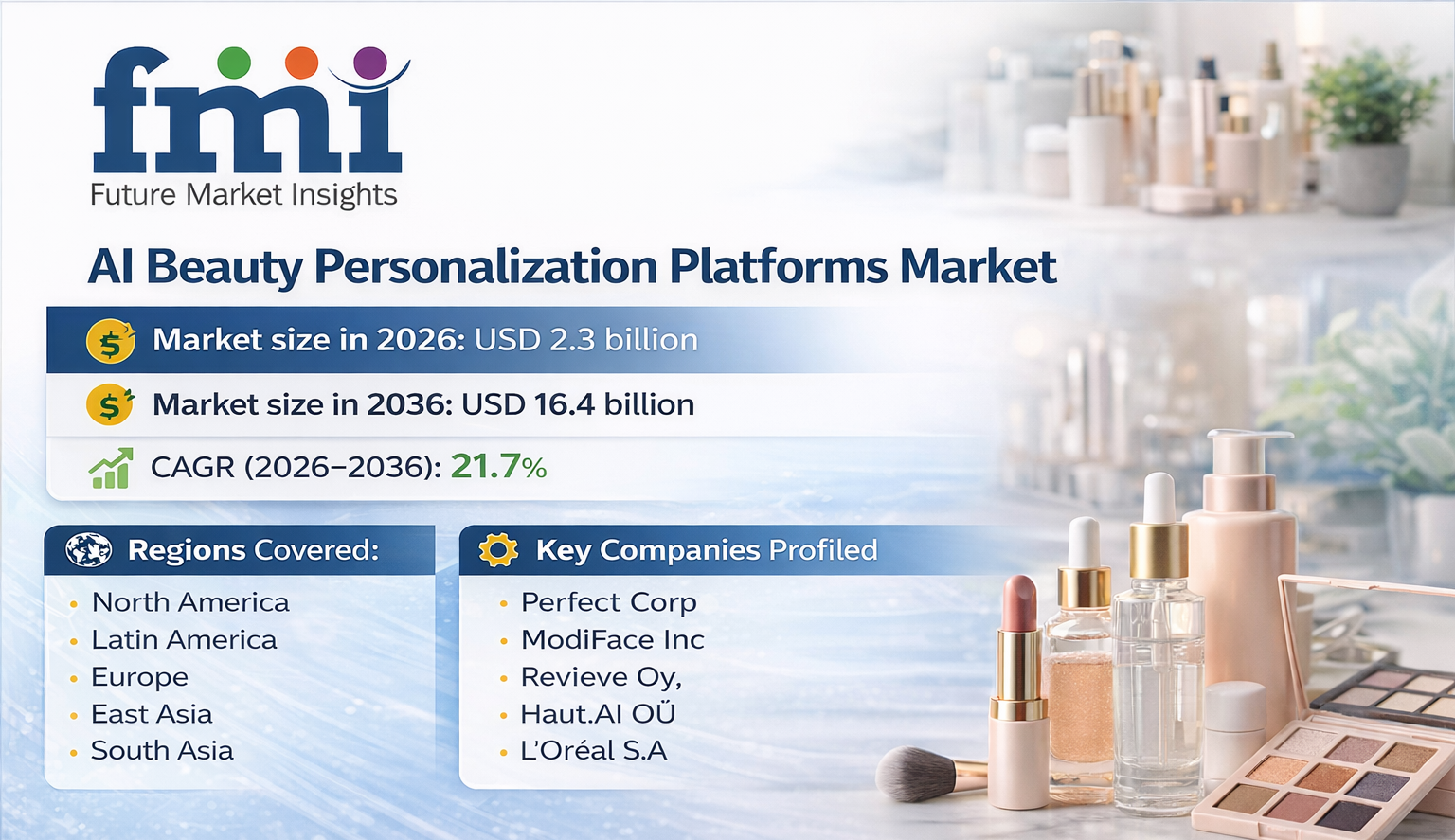
NEWARK, DELAWARE / ACCESS Newswire / March 9, 2026 / The global AI beauty personalization platforms market is poised for rapid expansion over the next decade, growing from USD 2.3 billion in 2026 to USD 16.4 billion by 2036, registering a CAGR of 21.7%, according to the latest analysis by Future Market Insights (FMI). Growth is driven by the transformation of digital beauty retail as brands deploy AI-powered diagnostics, facial mapping algorithms, and augmented reality tools to deliver hyper-personalized product recommendations and immersive shopping experiences.
Traditional retail beauty consultations and trial-based purchasing models are increasingly being replaced by automated AI diagnostic ecosystems. These platforms utilize computer vision, machine learning, and augmented reality to analyze skin conditions, simulate cosmetic applications, and generate ingredient-specific product matches-bridging the gap between physical sampling and digital commerce.
AI Beauty Personalization Platforms Market Snapshot (2026-2036)
Market size in 2026: USD 2.3 billion
Market size in 2036: USD 16.4 billion
CAGR (2026-2036): 21.7%
Leading technology type: AR Virtual Try-On (VTO) Engines (~42.0% share)
Dominant application: Skincare personalization (~45.0% share)
Key growth regions: Asia Pacific, North America, Europe
Fastest-growing countries: India, South Korea, China, Brazil, Mexico, U.S., United Kingdom
Get Access of Report Sample: https://www.futuremarketinsights.com/reports/sample/rep-gb-32195
Market Momentum
The AI beauty personalization platforms market begins at USD 2.3 billion in 2026, reflecting accelerating adoption of computer vision-based diagnostic technologies across online retail platforms. By 2031, widespread integration of augmented reality tools and AI-driven skincare recommendation engines is expected to push market value beyond USD 7 billion.
Between 2031 and 2036, growth accelerates as beauty brands and e-commerce platforms deploy generative AI beauty advisors, device-level facial diagnostics, and hyper-personalized digital consultations across global markets. The rapid shift toward direct-to-consumer digital beauty ecosystems and performance-based software contracts further strengthens adoption. By 2036, the market is projected to reach USD 16.4 billion, sustaining a 21.7% CAGR throughout the forecast period.
Why the Market Is Growing
Demand for AI beauty personalization platforms is increasing as cosmetic brands transition from traditional marketing-driven product discovery to data-driven diagnostic commerce models. Consumers increasingly expect precise product recommendations tailored to their unique skin characteristics, pushing retailers to adopt advanced facial analysis technologies. Digital commerce architects are deploying augmented reality virtual try-on tools to reduce costly product returns caused by incorrect color matching. At the same time, skincare brands are integrating AI dermatological scanning algorithms that analyze pore density, pigmentation levels, and moisture distribution to generate scientifically backed skincare regimens.
Cosmetic manufacturers are also leveraging proprietary digital advisors to collect zero-party biometric data, enabling direct interaction with consumers while bypassing the limitations of third-party advertising networks. These insights enable brands to create highly personalized product recommendations and improve overall conversion rates across digital storefronts. Increasing regulatory scrutiny surrounding biometric data privacy is also shaping platform architecture. Developers are transitioning toward edge-computing processing models, allowing facial scans to be analyzed directly on consumer devices without transmitting sensitive biometric information to centralized cloud servers.
Segment Spotlight
Technology Type: AR Virtual Try-On (VTO) Engines Lead with ~42.0% Share
AR Virtual Try-On platforms dominate the technology landscape due to their ability to simulate cosmetic applications in real time. By enabling consumers to digitally test foundation shades, lipstick colors, and eyeshadow palettes, these platforms reduce purchasing uncertainty and significantly lower return rates for online beauty purchases.
Advanced tracking algorithms synchronize digital overlays with facial micro-movements and ambient lighting conditions, allowing cosmetic textures such as gloss, matte, or shimmer to appear realistically on screen.
Application Category: Skincare Personalization Leads (~45.0% Share)
Skincare personalization represents the largest application segment as consumers increasingly demand scientifically validated skincare routines tailored to their unique dermatological needs.
AI-powered diagnostic engines analyze skin conditions using smartphone imagery, identifying factors such as pore density, pigmentation, and moisture levels. These insights allow brands to recommend ingredient-specific products while generating predictive simulations that visualize potential long-term improvements in skin health.
Regional Growth: Asia Pacific, North America, and Europe Lead Market Expansion
The Asia Pacific region represents the fastest-growing market as digital beauty platforms integrate AI diagnostics directly into social commerce ecosystems. Countries such as India, South Korea, and China are witnessing rapid adoption driven by mobile-first consumer behavior and strong e-commerce infrastructure.
North America continues to expand steadily as beauty retailers upgrade legacy e-commerce platforms with advanced AI diagnostic capabilities while complying with strict biometric data privacy regulations.
Europe maintains stable growth driven by regulatory frameworks emphasizing data privacy, algorithm transparency, and consumer protection, encouraging the adoption of secure edge-computing architectures for facial analysis.
Drivers, Opportunities, Trends, Challenges
Drivers:
Expansion of digital beauty commerce, demand for hyper-personalized skincare solutions, and adoption of augmented reality shopping experiences.
Opportunities:
Generative AI beauty advisors, device-level edge computing for biometric processing, and integration of diagnostic tools into social commerce platforms.
Trends:
Growing reliance on AI-driven dermatological diagnostics, performance-based software contracts, and increasing emphasis on algorithmic inclusivity across diverse skin tones.
Challenges:
Strict global biometric data privacy regulations, high compliance costs, and technical complexity associated with accurate facial mapping algorithms.
Country Growth Outlook (CAGR 2026-2036)
Country |
CAGR |
|---|---|
India |
25.1% |
South Korea |
24.4% |
China |
23.8% |
Brazil |
23.2% |
Mexico |
22.6% |
United States |
22.1% |
United Kingdom |
21.4% |
Competitive Landscape
The AI beauty personalization platforms market is characterized by rapid innovation and strategic partnerships between technology vendors and cosmetic brands. Competition centers on algorithm accuracy, diagnostic reliability, data privacy compliance, and integration capabilities across digital retail ecosystems.
Leading technology providers and cosmetic companies are expanding their AI capabilities through advanced computer vision models, augmented reality rendering engines, and generative recommendation algorithms to enhance personalized consumer experiences.
Key players operating in the market include Perfect Corp., ModiFace Inc., Revieve Oy, Haut.AI OÜ, L'Oréal S.A., Shiseido Company Limited, The Estée Lauder Companies Inc., The Procter & Gamble Company, Sephora USA Inc., and Ulta Beauty Inc.
These companies compete on algorithmic precision, facial rendering accuracy, and scalable enterprise software platforms designed to support global digital beauty commerce networks.
For an in-depth analysis of evolving formulation trends and to access the complete strategic outlook for the AI Beauty Personalization Platforms Market through 2036 , visit the official report page at: https://www.futuremarketinsights.com/reports/ai-beauty-personalization-platforms-market
Explore More Research Reports by FMI :
Postbiotic Skincare Market: https://www.futuremarketinsights.com/reports/postbiotic-skincare-market
Balm-Format Sunscreen Sticks Market: https://www.futuremarketinsights.com/reports/balm-format-sunscreen-sticks-market
Waterless Cream Blush Sticks Market: https://www.futuremarketinsights.com/reports/waterless-cream-blush-sticks-market
Anti-Static Agents Market: https://www.futuremarketinsights.com/reports/anti-static-agents-market
About Future Market Insights (FMI)
Future Market Insights (FMI) is a leading provider of market intelligence and consulting services, serving clients in over 150 countries. Headquartered in Delaware, USA, with a global delivery center in India and offices in the UK and UAE, FMI delivers actionable insights to businesses across industries including automotive, technology, consumer products, manufacturing, energy, and chemicals.
An ESOMAR-certified research organization, FMI provides custom and syndicated market reports and consulting services, supporting both Fortune 1,000 companies and SMEs. Its team of 300+ experienced analysts ensures credible, data-driven insights to help clients navigate global markets and identify growth opportunities.
For Press & Corporate Inquiries
Rahul Singh
AVP - Marketing and Growth Strategy
Future Market Insights, Inc.
+91 8600020075
For Sales - sales@futuremarketinsights.com
For Media - Rahul.singh@futuremarketinsights.com
For web - https://www.futuremarketinsights.com/
SOURCE: Future Market Insights, Inc.
View the original press release on ACCESS Newswire