Home improvement retailer Lowe’s (NYSE: LOW) met Wall Street’s revenue expectations in Q2 CY2026, with sales up 8.3% year on year to $25.96 billion. On the other hand, the company’s full-year revenue guidance of $92 billion at the midpoint came in 1% below analysts’ estimates. Its non-GAAP profit of $4.40 per share was 4.2% above analysts’ consensus estimates.
Is now the time to buy Lowe's? Find out by accessing our full research report, it’s free.
Lowe's (LOW) Q2 CY2026 Highlights:
- Revenue: $25.96 billion vs analyst estimates of $26.08 billion (8.3% year-on-year growth, in line)
- Adjusted EPS: $4.40 vs analyst estimates of $4.22 (4.2% beat)
- The company dropped its revenue guidance for the full year to $92 billion from $93 billion at the midpoint, a 1.1% decrease
- Management lowered its full-year Adjusted EPS guidance to $12.25, a 2% decrease from the previous midpoint
- Operating Margin: 13.7%, in line with the same quarter last year
- Free Cash Flow Margin: 12%, down from 15.6% in the same quarter last year
- Same-Store Sales were flat year on year, in line with the same quarter last year
- Market Capitalization: $120.9 billion
"Sustained growth in Pro, Online and Home Services led to our fifth consecutive quarter of positive comp sales, despite pressure in discretionary DIY spending," said Marvin R. Ellison, Lowe's chairman, president and CEO.
Company Overview
Founded in North Carolina as Lowe's North Wilkesboro Hardware, the company is a home improvement retailer that sells everything from paint to tools to building materials.
Revenue Growth
Examining a company’s long-term performance can provide clues about its quality. Any business can have short-term success, but a top-tier one grows for years.
With $90.43 billion in revenue over the past 12 months, Lowe's is a behemoth in the consumer retail sector and benefits from economies of scale, giving it an edge in distribution. This also enables it to gain more leverage on its fixed costs than smaller competitors and the flexibility to offer lower prices. However, its scale is a double-edged sword because it’s harder to find incremental growth when you’ve penetrated most of the market. To accelerate sales, Lowe's likely needs to optimize its pricing or lean into international expansion.
As you can see below, Lowe’s revenue declined by 1% per year over the last three years as it didn’t open many new stores.
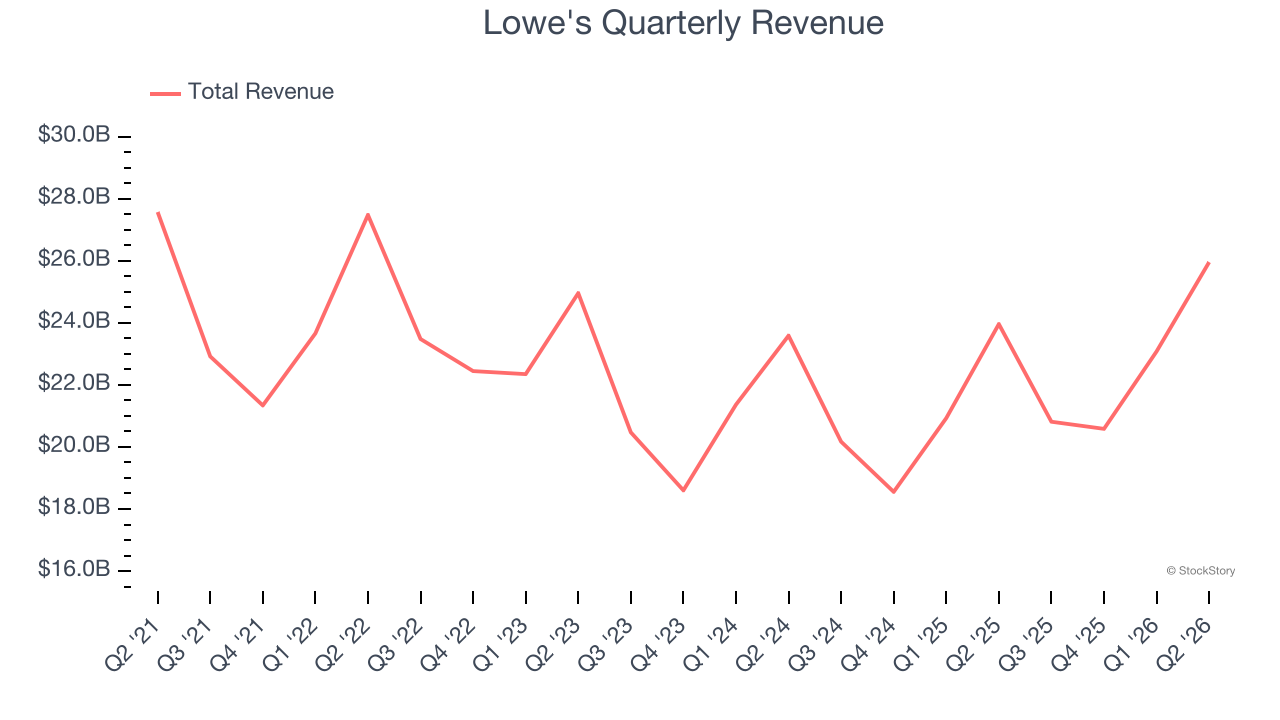
This quarter, Lowe's grew its revenue by 8.3% year on year, and its $25.96 billion of revenue was in line with Wall Street’s estimates.
Looking ahead, sell-side analysts expect revenue to grow 4.5% over the next 12 months, an acceleration versus the last three years. This projection is particularly noteworthy for a company of its scale and implies its newer products will spur better top-line performance.
ONE MORE THING: The $21 AI Application Stock Wall Street Forgot. While Wall Street obsesses over who’s building AI, one company is already using it to print money. And nobody’s paying attention.
AI chip stocks trade at ridiculous valuations. This company processes a trillion consumer signals monthly using AI and trades at a third of the price. The gap won’t last. The institutions will figure it out. You need to see this first. Read the FREE Report Before They Notice.
Store Performance
Number of Stores
A retailer’s store count often determines how much revenue it can generate.
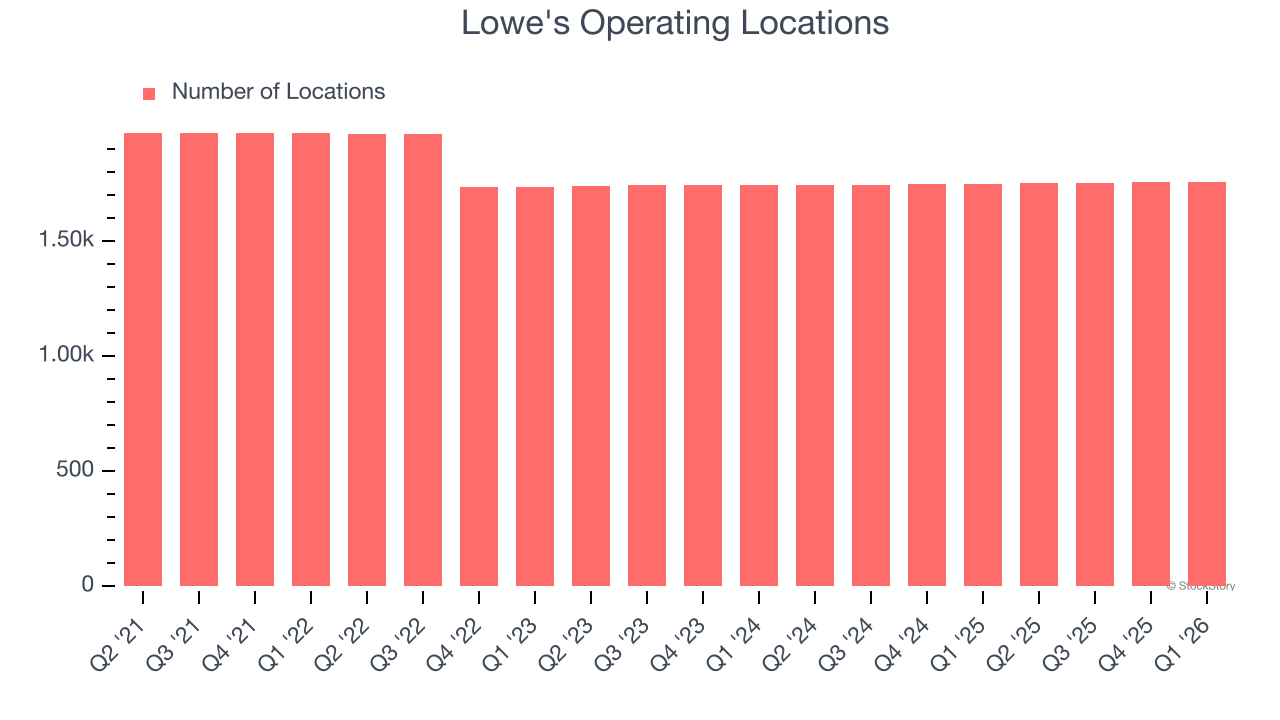
Lowe's has kept its store count flat over the last two years while other consumer retail businesses have opted for growth.
When a retailer keeps its store footprint steady, it usually means demand is stable and it’s focusing on operational efficiency to increase profitability.
Note that Lowe's reports its store count intermittently, so some data points are missing in the chart below.
Same-Store Sales
The change in a company’s store base only tells one side of the story. The other is the performance of its existing locations and e-commerce sales, which informs management teams whether they should expand or downsize their physical footprints. Same-store sales is an industry measure of whether revenue is growing at those existing stores and is driven by customer visits (often called traffic) and the average spending per customer (ticket).
Lowe’s demand within its existing locations has barely increased over the last two years as its same-store sales were flat. This performance isn’t ideal, and we’d be skeptical if Lowe's starts opening new stores to artificially boost revenue growth.
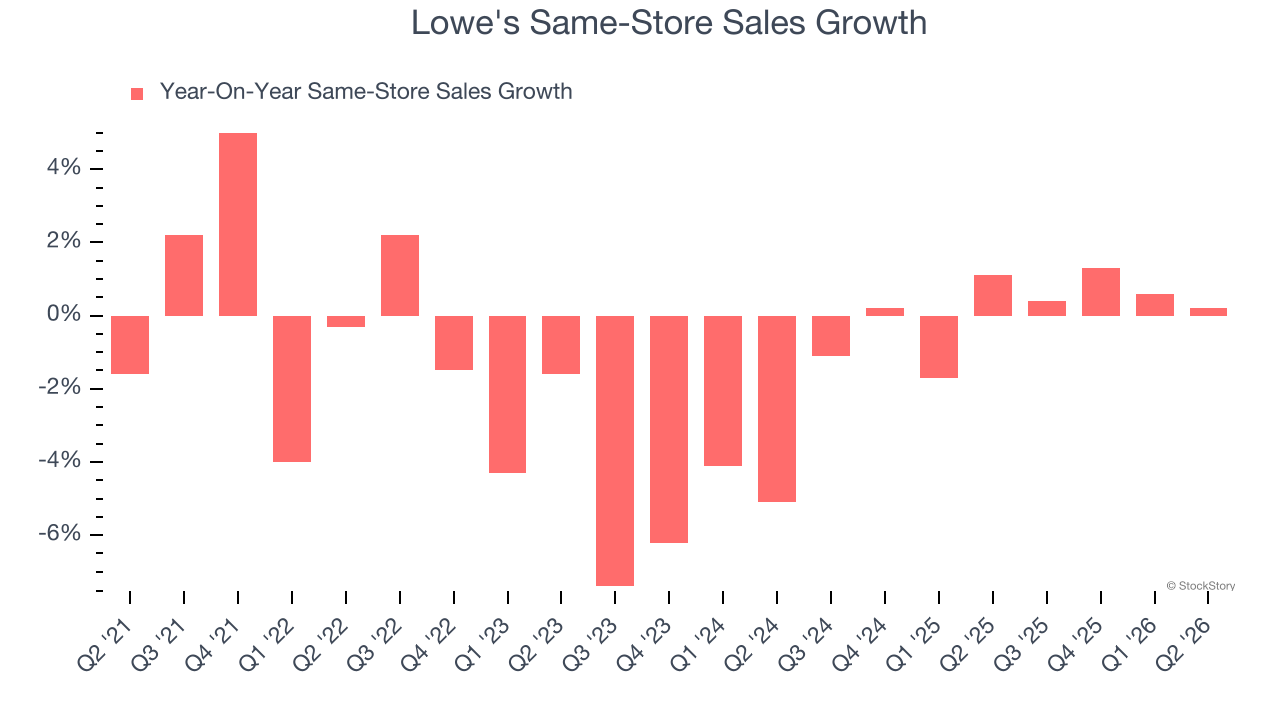
In the latest quarter, Lowe’s year on year same-store sales were flat. This performance was more or less in line with its historical levels.
Key Takeaways from Lowe’s Q2 Results
It was good to see Lowe's narrowly top analysts’ gross margin expectations this quarter. We were also glad its EPS outperformed Wall Street’s estimates. On the other hand, its full-year EPS guidance missed and its full-year revenue guidance fell slightly short of Wall Street’s estimates. Overall, this quarter could have been better. The stock traded down 2.9% to $209.45 immediately following the results.
Lowe’s latest earnings report disappointed. One quarter doesn’t define a company’s quality, so let’s explore whether the stock is a buy at the current price. What happened in the latest quarter matters, but not as much as longer-term business quality and valuation, when deciding whether to invest in this stock. We cover that in our actionable full research report which you can read here (it’s free).