As the Q1 earnings season wraps, let’s dig into this quarter’s best and worst performers in the healthcare providers & services industry, including Pediatrix Medical Group (NYSE: MD) and its peers.
The healthcare providers and services sector, from insurers to hospitals, benefits from consistent demand, generating stable revenue through premiums and patient services. However, it faces challenges from high operational and labor costs, reimbursement pressures that squeeze margins, and regulatory uncertainty. Looking ahead, an aging population with more chronic diseases and a shift toward value-based care create tailwinds. Digitization via telehealth, data analytics, and personalized medicine offers new revenue streams. Nonetheless, headwinds persist, including clinical labor shortages, ongoing reimbursement cuts, and regulatory scrutiny over pricing and quality.
The 40 healthcare providers & services stocks we track reported a strong Q1. As a group, revenues beat analysts’ consensus estimates by 1.4% while next quarter’s revenue guidance was in line.
Luckily, healthcare providers & services stocks have performed well with share prices up 10.5% on average since the latest earnings results.
Pediatrix Medical Group (NYSE: MD)
With a network of approximately 2,620 affiliated physicians caring for some of the most vulnerable patients, Pediatrix Medical Group (NYSE: MD) provides specialized physician services focused on neonatal, maternal-fetal, pediatric cardiology and other pediatric subspecialty care across 37 states.
Pediatrix Medical Group reported revenues of $476.2 million, up 3.9% year on year. This print exceeded analysts’ expectations by 2.6%. Overall, it was a very strong quarter for the company with a beat of analysts’ EPS and revenue estimates.
“Our first quarter operating results exceeded our expectations, driven by top-line growth,” said Mark S. Ordan, Chief Executive Officer of Pediatrix Medical Group.
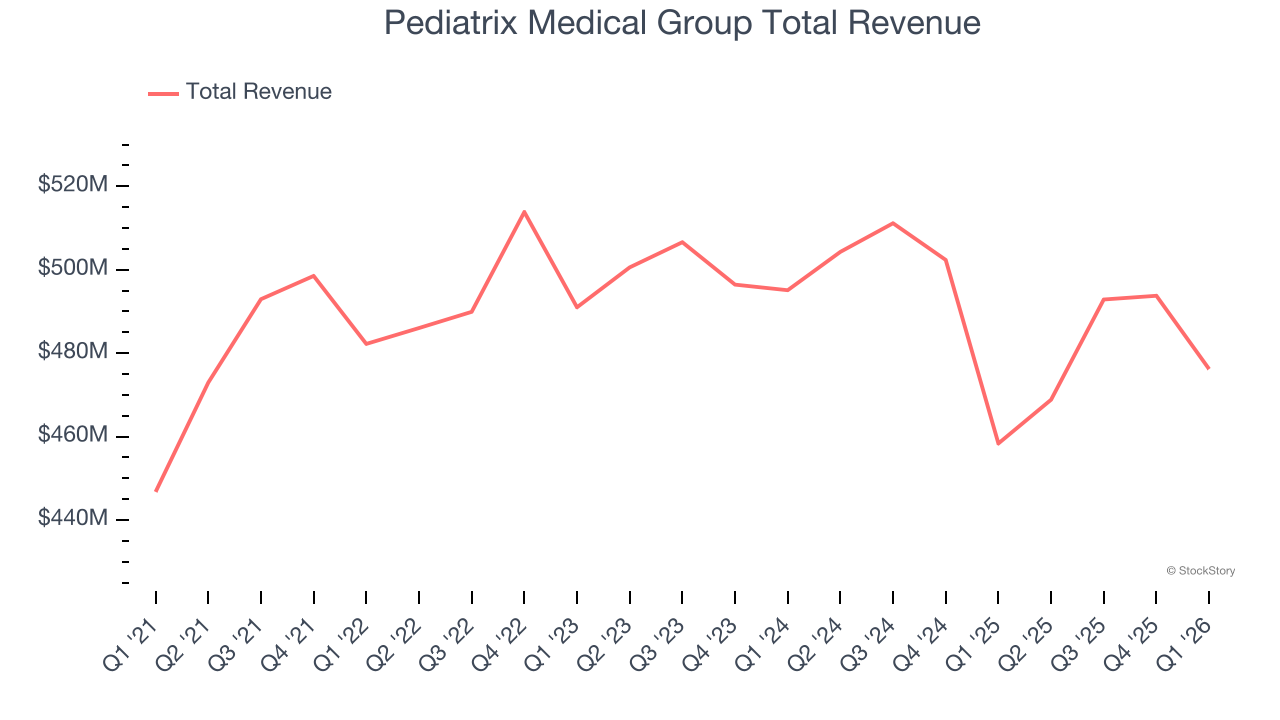
The stock is down 3.9% since reporting and currently trades at $21.54.
Is now the time to buy Pediatrix Medical Group? Access our full analysis of the earnings results here, it’s free.
Best Q1: agilon health (NYSE: AGL)
Transforming how doctors care for seniors by shifting financial incentives from volume to outcomes, agilon health (NYSE: AGL) provides a platform that helps primary care physicians transition to value-based care models for Medicare patients through long-term partnerships and global capitation arrangements.
agilon health reported revenues of $1.42 billion, down 7.3% year on year, outperforming analysts’ expectations by 3.2%. The business had a stunning quarter with EBITDA guidance for next quarter exceeding analysts’ expectations and a beat of analysts’ EPS estimates.
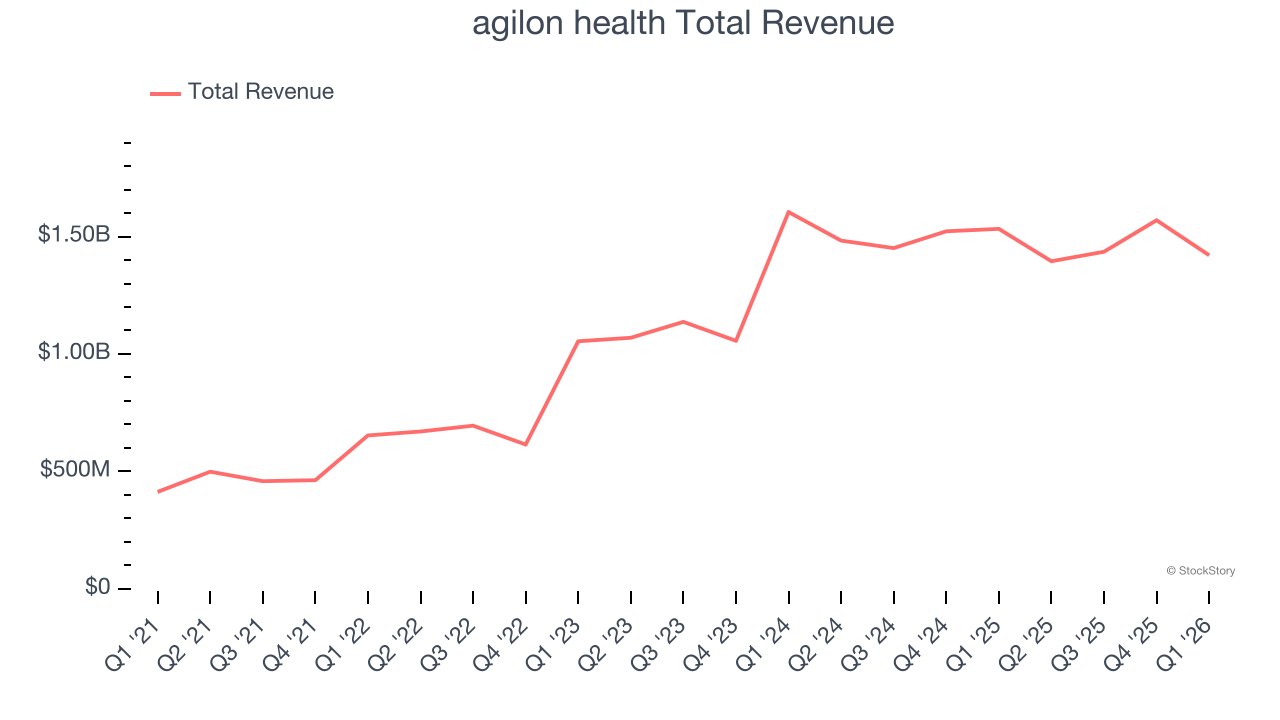
agilon health pulled off the highest full-year guidance raise among its peers. On a dimmer note, the company lost 85,000 customers and ended up with a total of 426,000. The market seems happy with the results as the stock is up 229% since reporting. It currently trades at $91.70.
Is now the time to buy agilon health? Access our full analysis of the earnings results here, it’s free.
Weakest Q1: Option Care Health (NASDAQ: OPCH)
With a nationwide network of 177 locations serving 43 states and a team of over 4,500 clinicians, Option Care Health (NASDAQ: OPCH) is the largest independent provider of home and alternate site infusion services, delivering medications and clinical support to patients across the United States.
Option Care Health reported revenues of $1.35 billion, up 1.3% year on year, falling short of analysts’ expectations by 3.3%. It was a slower quarter as it posted full-year revenue guidance missing analysts’ expectations and a significant miss of analysts’ revenue estimates.
As expected, the stock is down 22.4% since the results and currently trades at $20.85.
Read our full analysis of Option Care Health’s results here.
McKesson (NYSE: MCK)
With roots dating back to 1833, making it one of America's oldest continuously operating businesses, McKesson (NYSE: MCK) is a healthcare services company that distributes pharmaceuticals, medical supplies, and provides technology solutions to pharmacies, hospitals, and healthcare providers.
McKesson reported revenues of $96.3 billion, up 6% year on year. This print missed analysts’ expectations by 5.3%. Overall, it was a slower quarter as it also recorded a significant miss of analysts’ revenue estimates.
The stock is down 2.1% since reporting and currently trades at $739.01.
Read our full, actionable report on McKesson here, it’s free.
LifeStance Health Group (NASDAQ: LFST)
With over 6,600 licensed mental health professionals treating more than 880,000 patients annually, LifeStance Health (NASDAQ: LFST) provides outpatient mental health services through a network of clinicians offering psychiatric evaluations, psychological testing, and therapy across 33 states.
LifeStance Health Group reported revenues of $403.5 million, up 21.2% year on year. This result topped analysts’ expectations by 4.2%. It was an exceptional quarter as it also recorded EBITDA guidance for next quarter exceeding analysts’ expectations and revenue guidance for next quarter exceeding analysts’ expectations.
The stock is up 4.8% since reporting and currently trades at $7.71.
Read our full, actionable report on LifeStance Health Group here, it’s free.
Market Update
Late in 2025 into early 2026, there was hand-wringing around artificial intelligence. For software companies, the fear was that AI would erode pricing power and compress margins as new tools made it easier to replicate what once required expensive enterprise platforms. Crypto investors had their own version of the same anxiety: if AI agents could trade, allocate capital, and manage wallets autonomously, what exactly was the long-term value of today’s crypto infrastructure?
These concerns triggered a noticeable rotation away from these sectors and into safer havens. But markets rarely dwell on one narrative for long. Spring 2026 came, and the focus shifted abruptly from technological disruption to geopolitical risk. The US’ conflict with Iran became the dominant driver of market psychology, and when geopolitics takes center stage, the script changes quickly. Investors stop debating growth rates and start worrying about oil supply, inflation, and global stability.
Want to invest in winners with rock-solid fundamentals? Check out our Top 5 Growth Stocks and add them to your watchlist. These companies are poised for growth regardless of the political or macroeconomic climate.
StockStory’s analyst team — all seasoned professional investors — uses quantitative analysis and automation to deliver market-beating insights faster and with higher quality.