Tax preparation company H&R Block (NYSE: HRB) reported calendar Q3 2026 (fiscal Q1 2027) results topping the market’s revenue expectations, with revenue up 10.2% year on year to $224.3 million. The company expects the full year’s revenue to be around $4.14 billion, close to analysts’ consensus estimates. Its non-GAAP loss of $1.40 per share was 3.1% above analysts’ consensus estimates.
For more on H&R Block, read our free full research report.
H&R Block (HRB) Q3 CY2026 highlights:
- Revenue $224.3 million vs S&P analyst consensus of $212.6 million (10.2% year-on-year growth, 5.5% beat)
- Adjusted EPS -$1.40 vs S&P analyst consensus of -$1.45 (3.1% beat)
- Adjusted EBITDA -$185.2 million (-82.5% margin, 8.9% year-on-year decline)
- Revenue guidance The company reconfirmed its revenue guidance for the full year of $4.14 billion at the midpoint
- Adjusted EPS guidance Management reiterated its full-year adjusted EPS guidance of $6.14 at the midpoint
- EBITDA guidance $1.13 billion at the midpoint for the full year, in line with analysts’ consensus estimates
- Adjusted EBITDA margin -82.5%, in line with the same quarter last year
- Free cash flow -$379.2 million compared to -$370 million in the same quarter last year
- Market capitalization $6.49 billion
"We are pleased with our start to fiscal 2027, including revenue growth of more than 10%," said Curtis Campbell, president and chief executive officer. "At the same time, we continue advancing strategic initiatives designed to enhance the client experience and support future growth. Our focus remains on executing our strategy and positioning H&R Block for long-term success."
Revenue growth
Examining a company’s long-term performance can provide clues about its quality. Any business can put up a good quarter or two, but many enduring ones grow for years. H&R Block’s revenue grew at a weak 3.3% annualized rate over the last five years, falling short of the consumer discretionary sector standard. H&R Block is a seasonal business because it generates most of its revenue during tax season, so the charts in our report show uneven results across quarters.
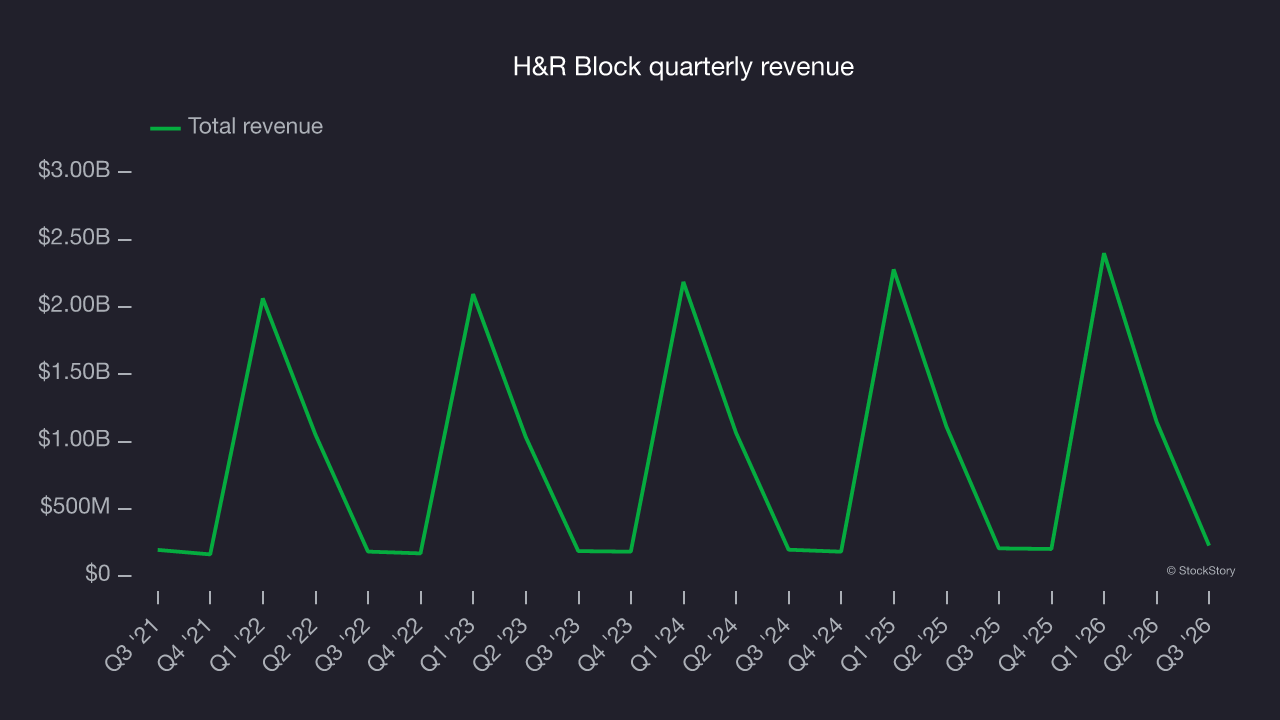
Long-term growth is the most important, but within consumer discretionary, product cycles are short and revenue can be hit-driven due to rapidly changing trends and consumer preferences. H&R Block’s annualized revenue growth of 4.7% over the last two years is above its five-year trend, a positive sign. 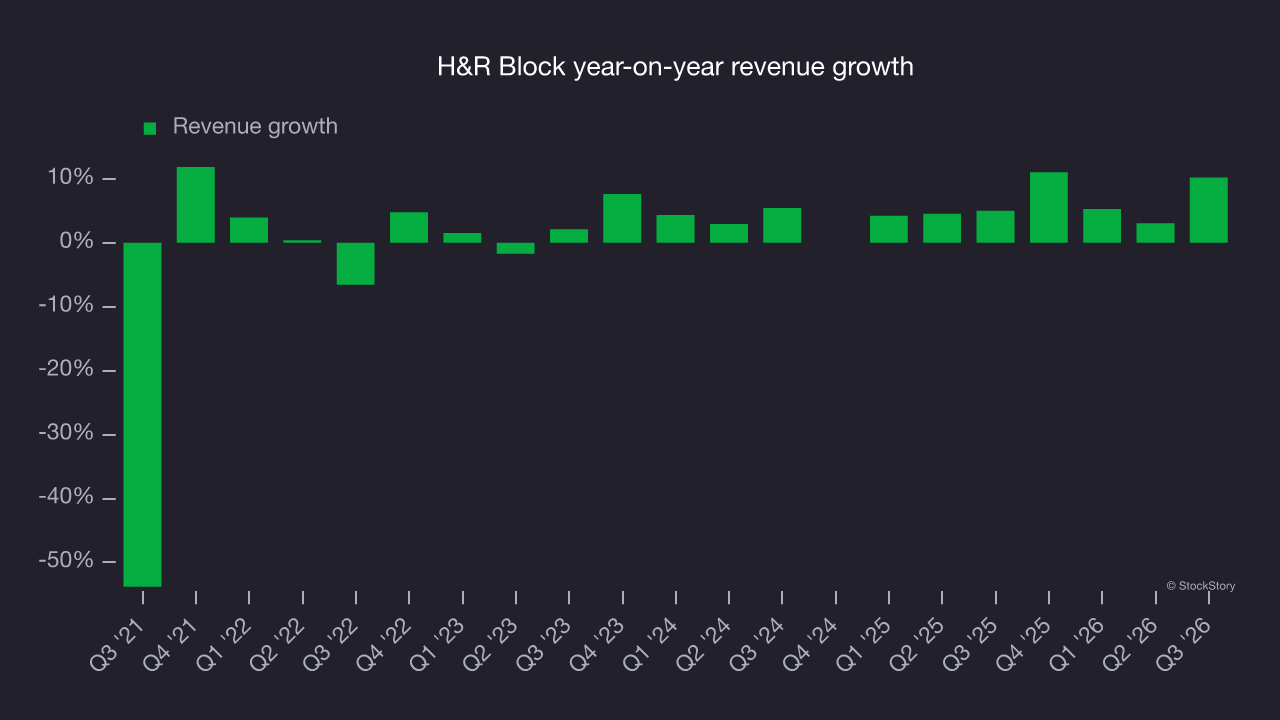
H&R Block also breaks out the revenue for its most important segments, Tax Preparation and Financial Services, which are 61.8% and 33.3% of revenue. Over the last two years, H&R Block’s Tax Preparation revenue (do-it-yourself, assisted, add-on services) averaged 11% year-on-year growth while its Financial Services revenue (Emerald Card, Spruce, interest income) averaged 172% growth. 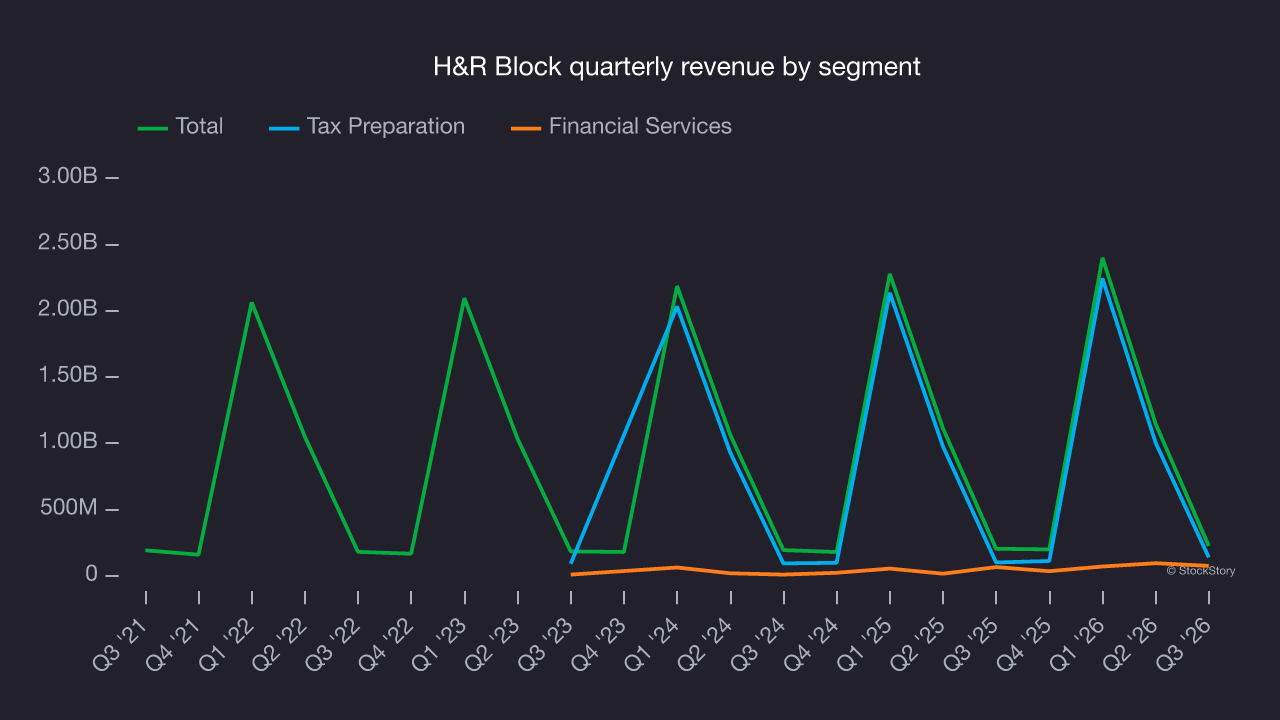
This quarter, H&R Block reported year-on-year revenue growth of 10.2%, and its $224.3 million of revenue exceeded Wall Street’s consensus estimates by 5.5%.
Looking ahead, sell-side analysts expect revenue to grow 4.4% over the next 12 months, according to S&P, similar to its two-year rate. This projection is underwhelming and indicates its newer products and services will not accelerate its top-line performance yet.
Operating margin
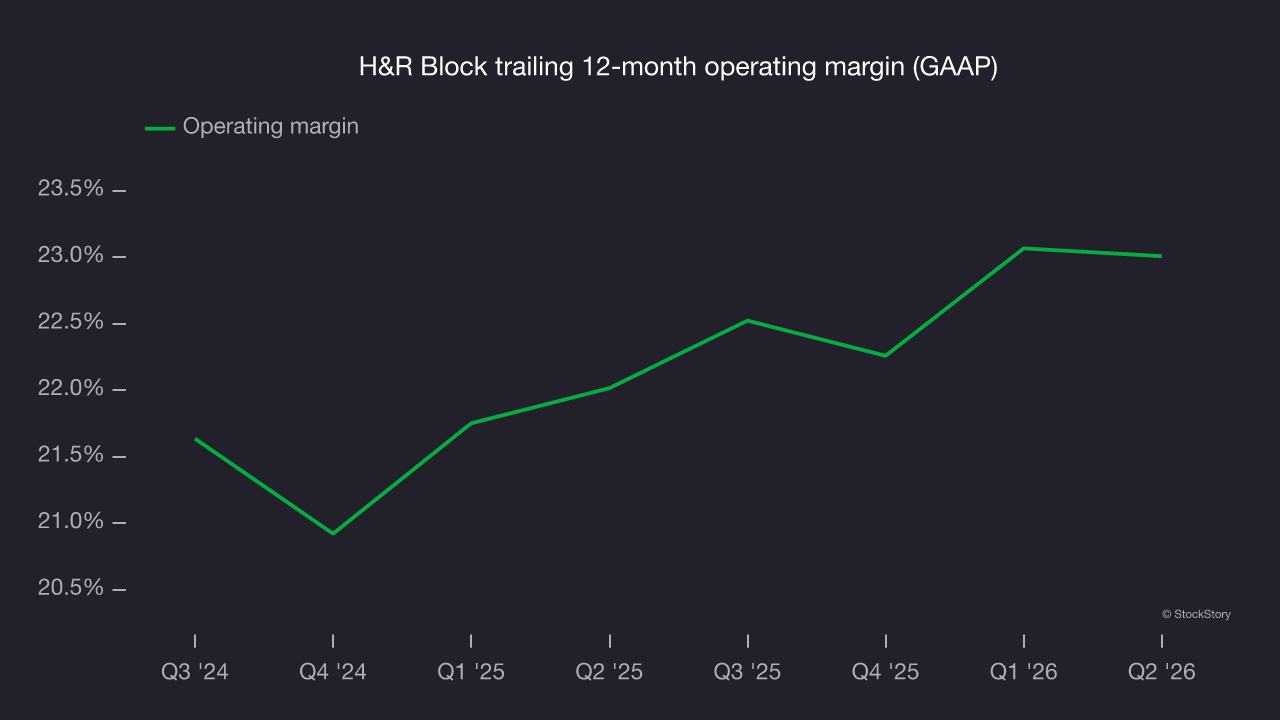
in line with the same quarter last year. Because H&R Block is a seasonal business, longer-term performance is more informative than a single quarter.
Earnings per share
Long-term changes in earnings per share, or EPS, matter for the same reason as long-term revenue growth. Compared to revenue, however, EPS highlights whether a company’s growth is profitable.
H&R Block’s weak 2.3% annual EPS growth over the last five years aligns with its revenue performance. This tells us it maintained its per-share profitability as it expanded.
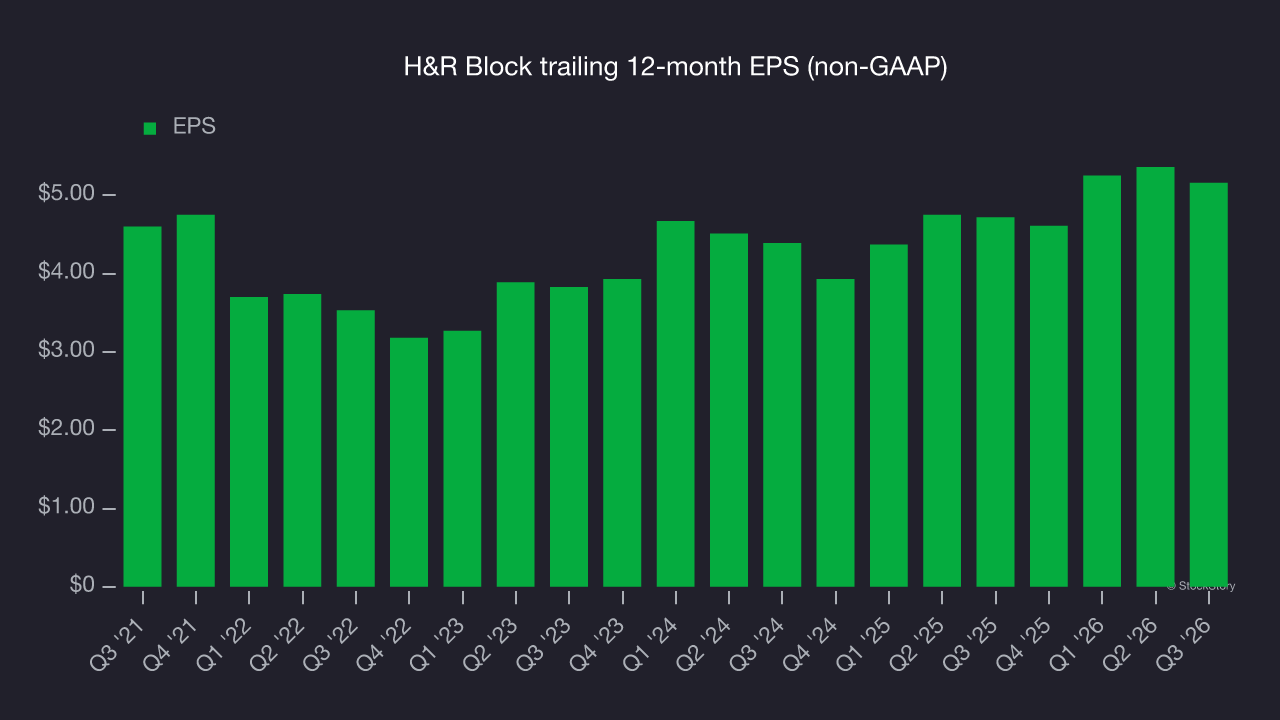
In Q3, H&R Block reported adjusted EPS of negative $1.40, down from negative $1.20 in the same quarter last year. Despite falling year on year, this result beat analysts’ consensus estimates by 3.1%. Over the next 12 months, Wall Street expects H&R Block’s full-year EPS to grow 17.7% from $5.16 to $6.07, according to S&P.
Key takeaways from H&R Block’s Q3 results
Revenue and EBITDA both topped consensus estimates, giving H&R Block’s quarter some clear positives. Investors were likely hoping for more, however, as shares fell 2.8% to $49.65 immediately after the results.
When considering an investment in H&R Block, look at its valuation and business quality as well as what happened in the latest quarter. Read our full research report here for more on those factors (it’s free).