Waste management company Casella (NASDAQ: CWST) fell short of the market’s revenue expectations in Q3 2026, but revenue rose 15.2% year on year to $559.2 million. On the other hand, the company’s outlook for the full year was close to analysts’ consensus estimates with revenue guided to $2.11 billion at the midpoint. Its non-GAAP profit of $0.35 per share was 7.9% below analysts’ consensus estimates.
For more on Casella Waste Systems, read our free full research report.
Casella Waste Systems (CWST) Q3 2026 highlights:
- Revenue $559.2 million vs S&P consensus estimates of $563.4 million (15.2% year-on-year growth, 0.7% miss)
- Adjusted EPS $0.35 vs S&P consensus estimates of $0.38 (7.9% miss)
- Adjusted EBITDA $133.5 million vs analysts' consensus estimates of $135.4 million (23.9% margin, 1.4% miss)
- Revenue guidance The company slightly lifted its revenue guidance for the full year to $2.11 billion at the midpoint from $2.1 billion
- EBITDA guidance $478 million at the midpoint for the full year, in line with analysts' consensus estimates
- Operating margin 2.8%, down from 6.1% in the same quarter last year
- Market capitalization $6.25 billion
“We again delivered solid top-line revenue and Adjusted EBITDA growth in the third quarter with strong performance across most of our business,” said Ned Coletta, President and CEO of Casella Waste Systems, Inc. “Solid waste pricing was robust, up 5.9% in collection and up 4.6% at our landfills, along with 12.8% landfill volume growth. Where fully implemented, floating fuel fees continued to insulate our business from the impact of elevated and volatile fuel prices. We remain highly confident in our operating plans for this year, supported by strong fourth quarter performance visibility, and as such have narrowed our 2026 guidance on Adjusted EBITDA and maintained our Adjusted Free Cash Flow guidance, while raising our revenue guidance to reflect higher floating fuel fees.”
Revenue growth
A company’s long-term performance is an indicator of its overall quality. Any business can experience short-term success, but top-performing ones sustain growth for years. Over the last five years, Casella Waste Systems grew its revenue at a strong 19.1% compounded annual growth rate. Its growth beat the average industrials company and shows its offerings resonate with customers.
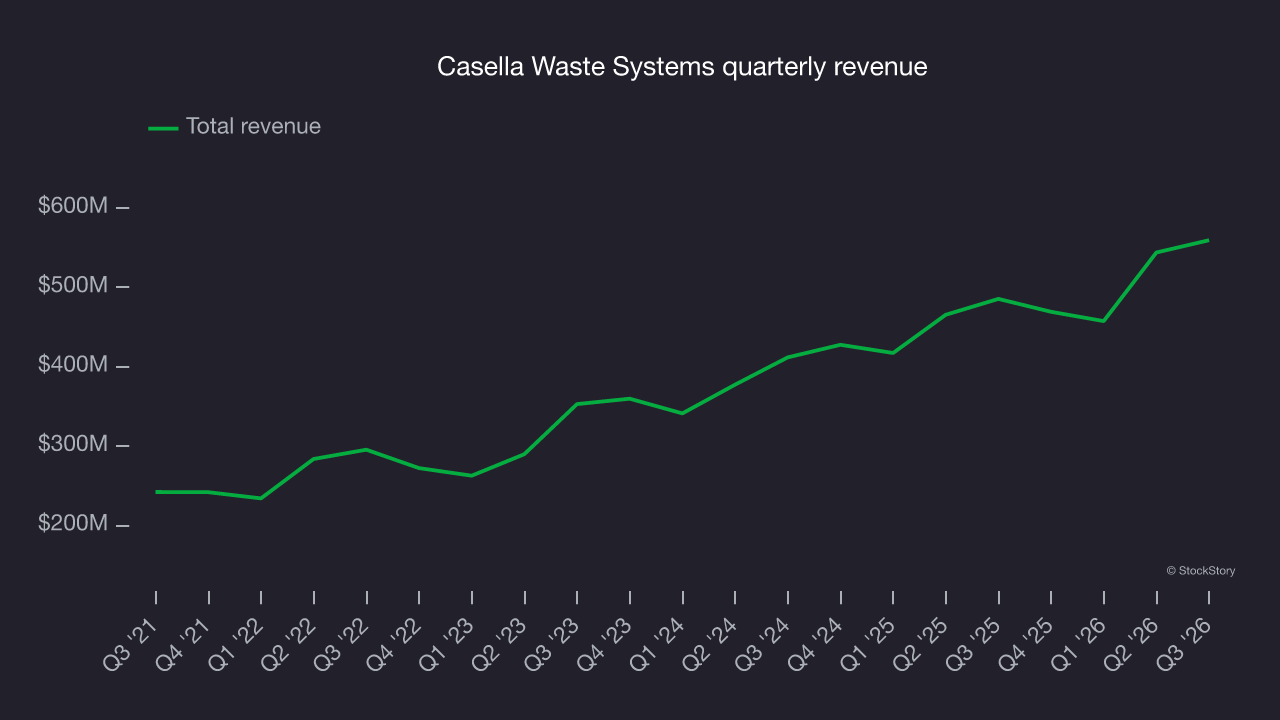
Long-term growth is the most important, but within industrials, a half-decade historical view may miss new industry trends or demand cycles. Casella Waste Systems’s annualized revenue growth of 16.7% over the last two years is below its five-year trend, but the results still suggest healthy demand.
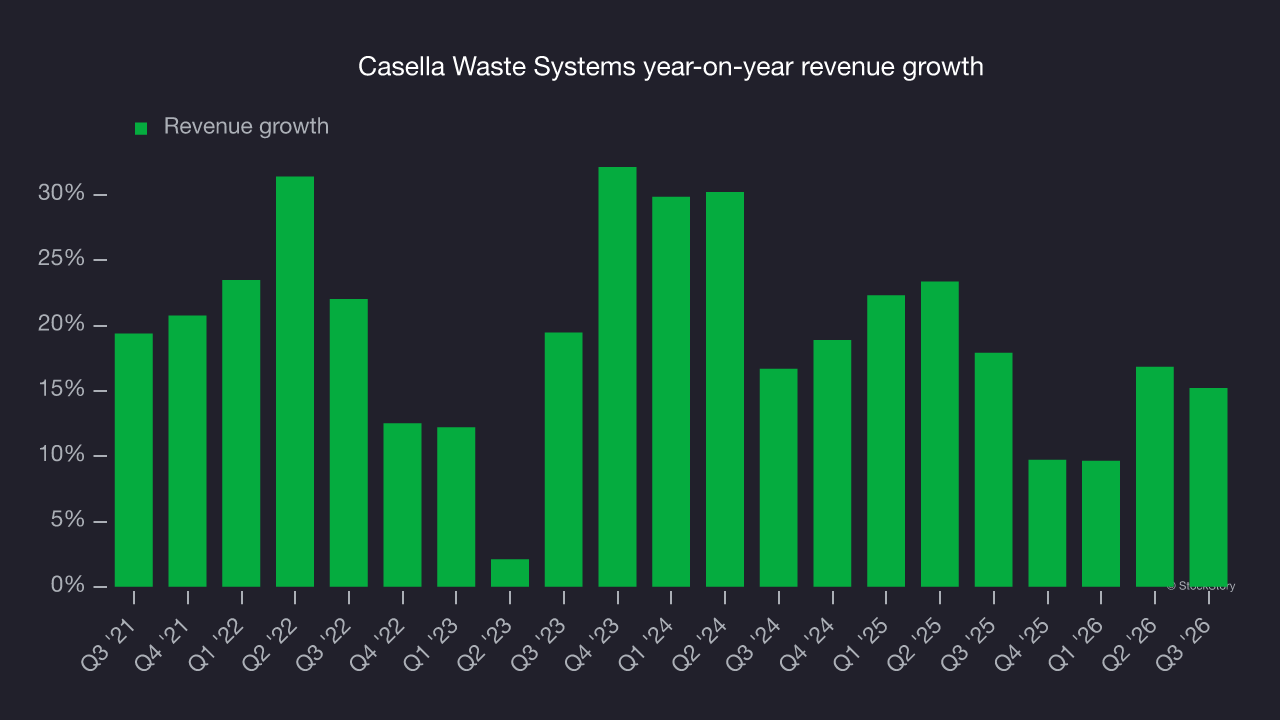
This quarter, Casella Waste Systems’s revenue grew by 15.2% year on year to $559.2 million but fell short of Wall Street’s consensus estimates.
Looking ahead, sell-side analysts expect revenue to grow 9.6% over the next 12 months, according to S&P, a deceleration versus the last two years. Still, this projection is noteworthy and suggests the market is forecasting success for its products and services.
Operating margin
Over the last five years, Casella Waste Systems’s operating margin fell by 6.4 percentage points. This deterioration shows its costs grew relative to revenue, putting pressure on profitability. Its trailing 12-month operating margin was 2.6%.
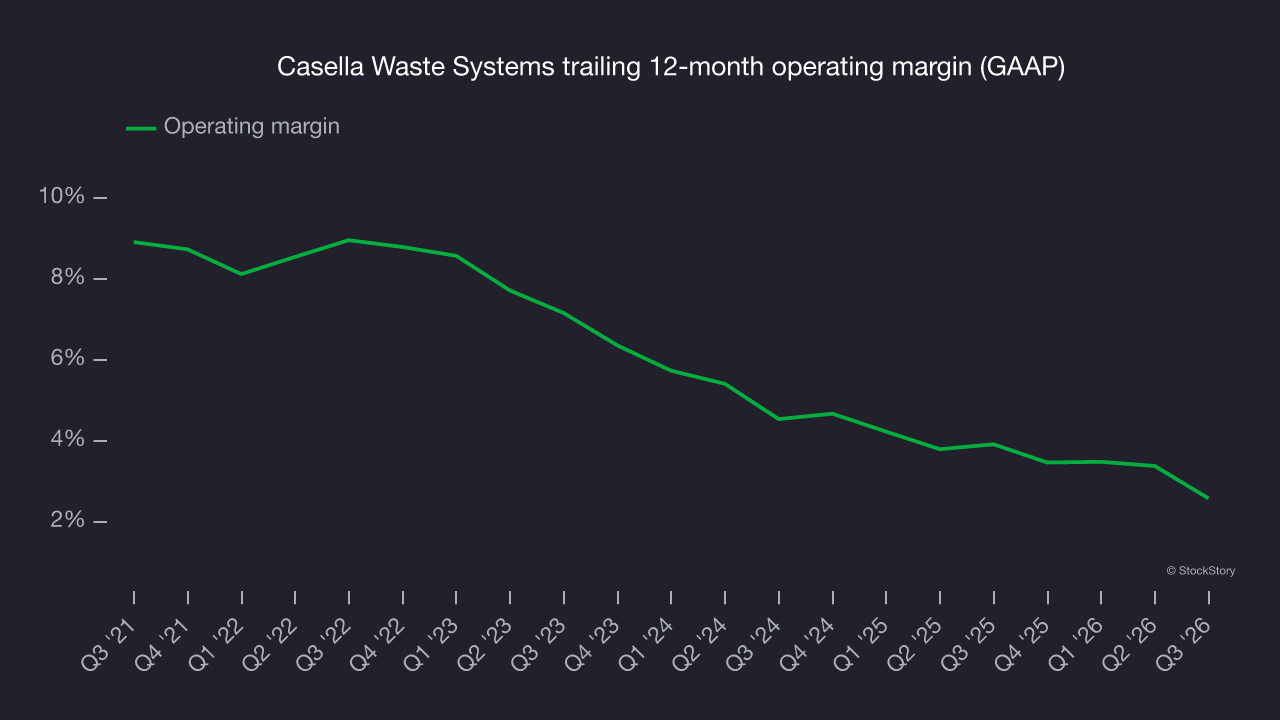
In Q3, Casella Waste Systems generated an operating profit margin of 2.8%, down 3.3 percentage points year on year. Since Casella Waste Systems’s operating margin decreased more than its gross margin, it appears to have been less efficient because expenses such as marketing, R&D and administrative overhead increased.
Earnings per share
Long-term changes in earnings per share, or EPS, matter for the same reason as long-term revenue growth. Compared to revenue, however, EPS highlights whether a company’s growth is profitable.
Casella Waste Systems’s EPS grew at an uninspiring 8% compounded annual growth rate over the last five years, lower than its 19.1% annualized revenue growth. This indicates the company became less profitable on a per-share basis as it expanded.
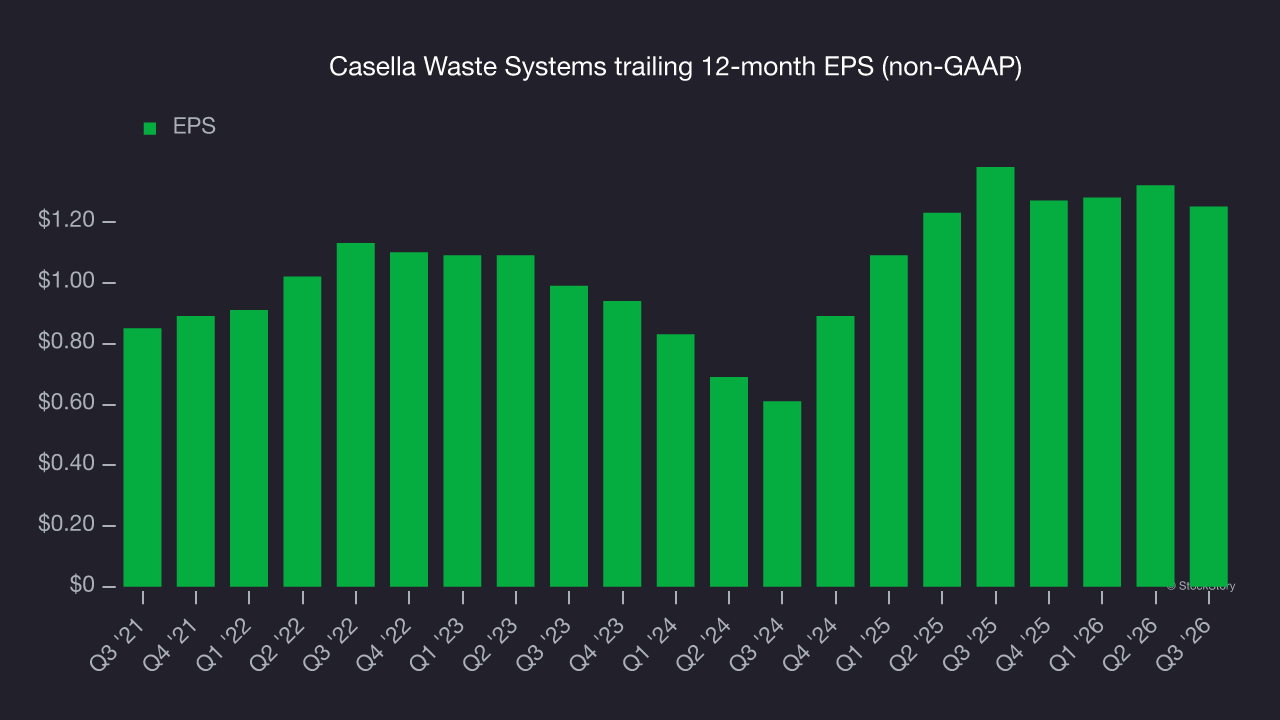
A closer look at Casella Waste Systems’s earnings helps explain its performance. As noted earlier, Casella Waste Systems’s operating margin declined by 6.4 percentage points over the last five years. Its share count also grew by 23.4%, meaning the company not only became less efficient with its operating expenses but also diluted its shareholders.
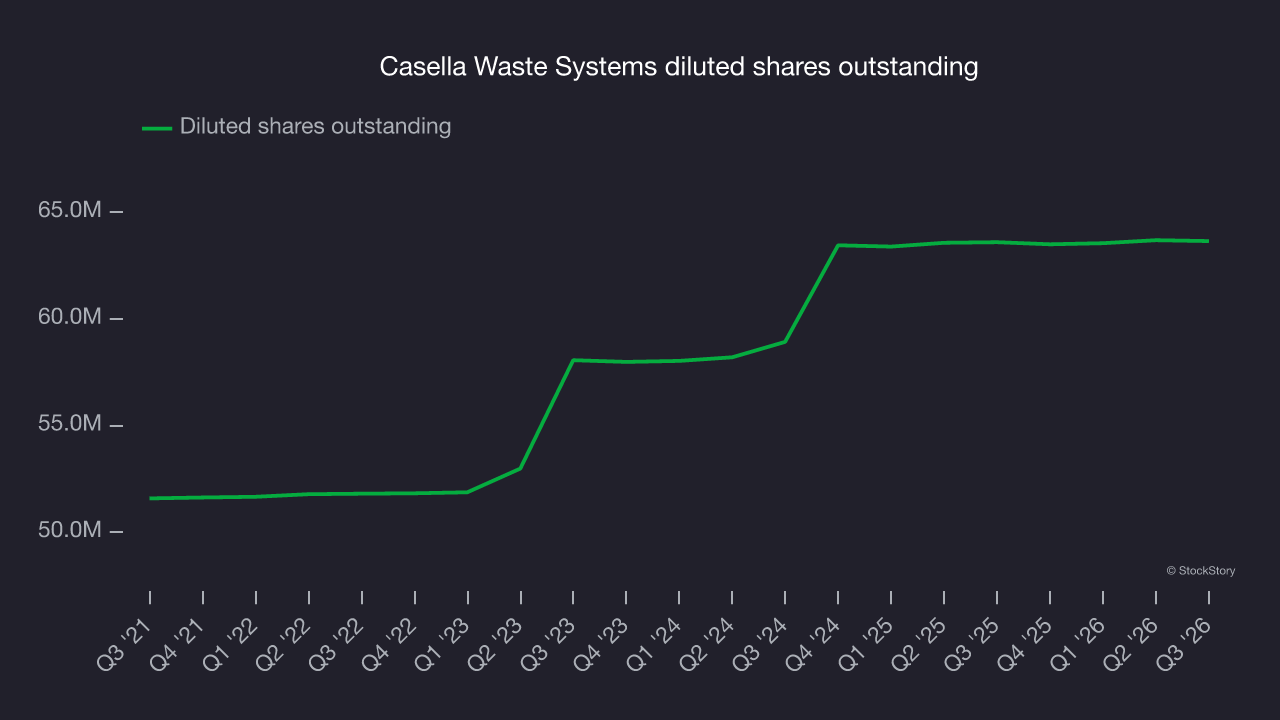
As with revenue, examining EPS over a shorter period can reveal changes in the business.
For Casella Waste Systems, its two-year annual EPS growth of 43.1% was higher than its five-year trend. This acceleration made it one of the faster-growing industrials companies in recent history.
In Q3, Casella Waste Systems reported adjusted EPS of $0.35, down from $0.42 in the same quarter last year. This result missed analysts’ consensus estimates. Over the next 12 months, Wall Street expects Casella Waste Systems’s full-year EPS to grow 2.8% from $1.25 to $1.28, according to S&P.
Key takeaways from Casella Waste Systems’s Q3 results
Casella Waste Systems delivered a softer quarter with few positives: EPS missed consensus estimates, and revenue came in slightly below Wall Street’s consensus. Shares tumbled 6.1% to $92.56 immediately after the release.
Casella Waste Systems’s latest earnings report disappointed. One quarter doesn’t define a company’s quality or determine whether the stock is a buy at the current price. The latest quarter is only one piece of the longer-term business quality puzzle. Quality, when combined with valuation, can help determine if the stock is a buy. For more on Casella Waste Systems, read our full research report here (it’s free).