Global satellite communications provider Viasat (NASDAQ: VSAT) fell short of the market’s revenue expectations in calendar Q3 2026 (fiscal Q2 2027) as revenue rose 3.4% year on year to $1.18 billion. Its non-GAAP loss of $0.32 per share was significantly below analysts’ consensus estimates.
For more on Viasat, read our full research report for free.
Viasat (VSAT) Q3 CY2026 highlights:
- Revenue $1.18 billion vs S&P analysts’ consensus estimates of $1.21 billion (3.4% year-on-year growth, 2.4% miss)
- Adjusted EPS -$0.32 vs S&P analysts’ consensus estimates of -$0.01 (significant miss)
- Adjusted EBITDA $369.9 million vs analysts’ consensus estimates of $387.3 million (31.3% margin, 4.5% miss)
- Operating margin 0.6%, down from 3.1% in the same quarter last year
- Free cash flow margin 6.6%, similar to the same quarter last year
- Market capitalization $8.16 billion
Revenue growth
Reviewing a company’s long-term revenue performance reveals insights into its quality. Even a bad business can perform well for one or two quarters, but a high-quality one grows for years.
With $4.66 billion in revenue over the past 12 months, Viasat is one of the larger companies in the business services industry and benefits from a well-known brand that influences purchasing decisions.
Viasat’s 12.9% annualized revenue growth over the last five years was strong, indicating high demand.
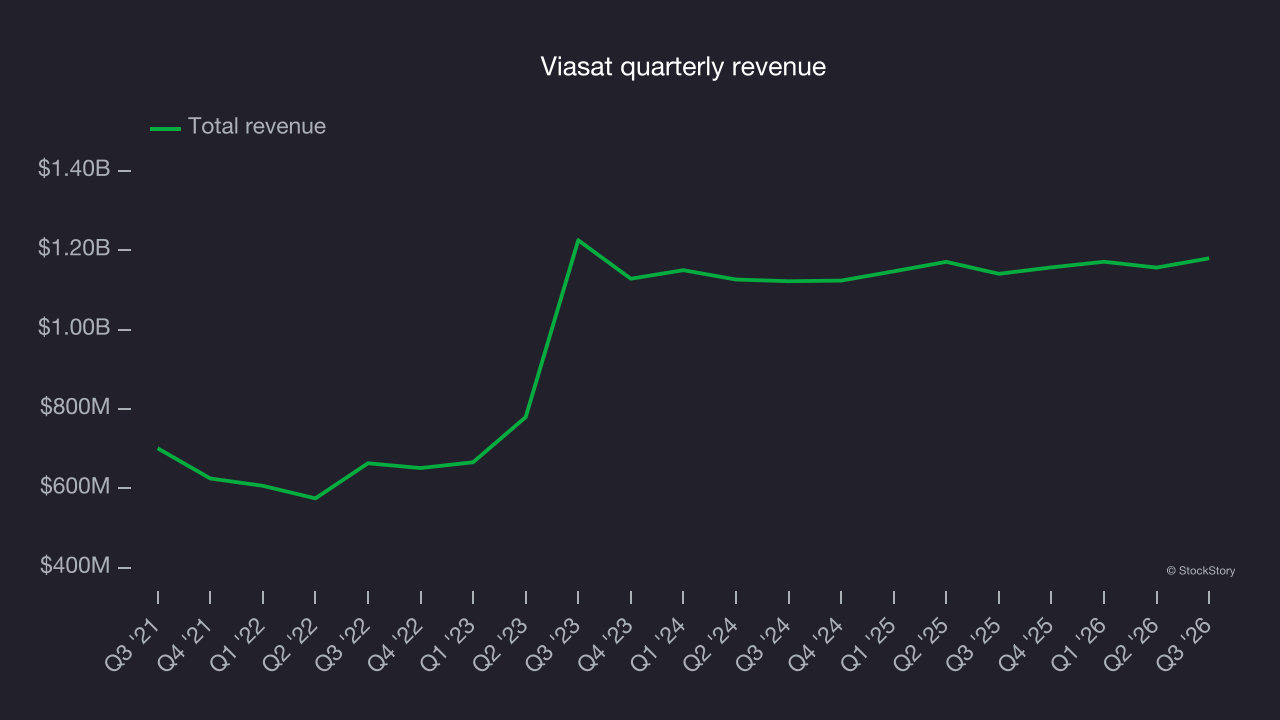
Long-term growth is the most important, but within business services, a half-decade historical view may miss new innovations or demand cycles. Viasat’s recent performance shows its demand has slowed significantly as its annualized revenue growth of 1.5% over the last two years was well below its five-year trend. 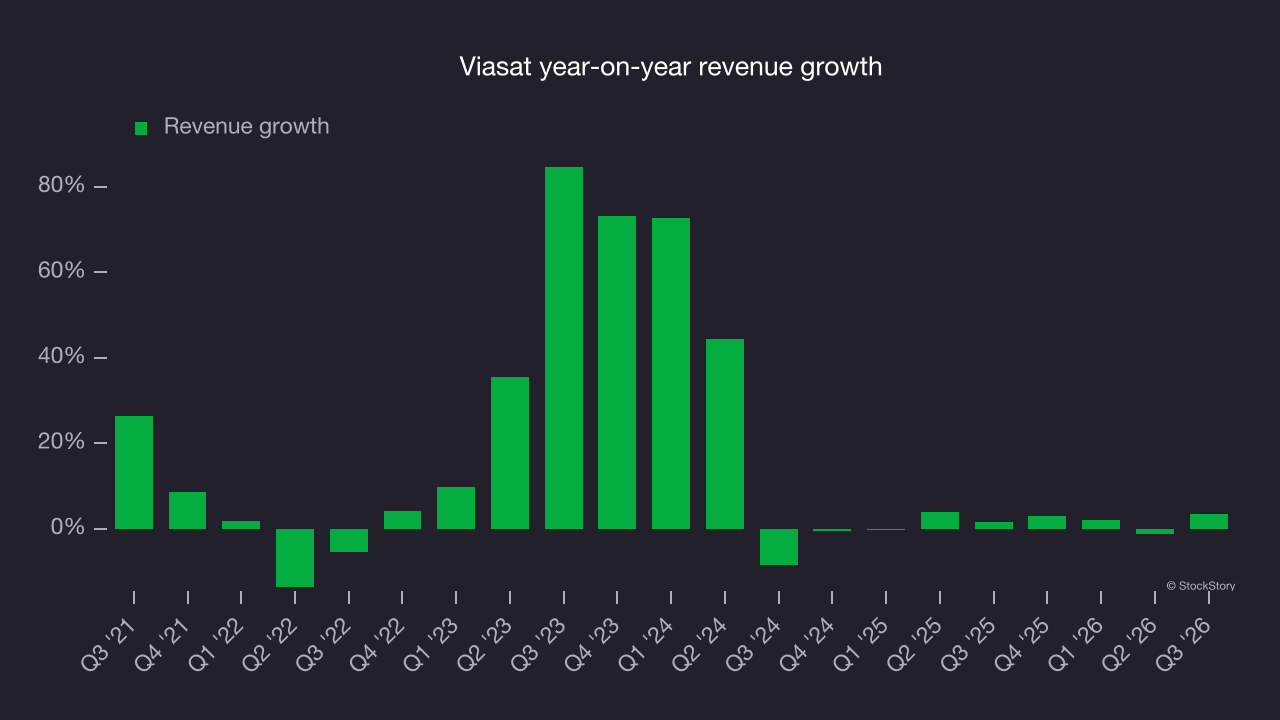
This quarter, Viasat’s revenue grew by 3.4% year on year to $1.18 billion, falling short of Wall Street’s consensus estimates.
Looking ahead, sell-side analysts expect revenue to grow 7.2% over the next 12 months, according to S&P, an improvement versus the last two years. This projection indicates its newer products and services will drive stronger revenue growth.
Adjusted operating margin
Although Viasat broke even this quarter from an operational perspective, it’s generally struggled over a longer time period. Its expensive cost structure has contributed to an average adjusted operating margin of negative 5.4% over the last five years. Unprofitable business services companies warrant closer scrutiny because they can be vulnerable when conditions deteriorate. It’s uncertain whether the business can endure a full cycle.
On the positive side, Viasat’s adjusted operating margin rose by 7 percentage points over the last five years, as its revenue growth provided operating leverage. Still, it will take much more for the company to reach long-term profitability.
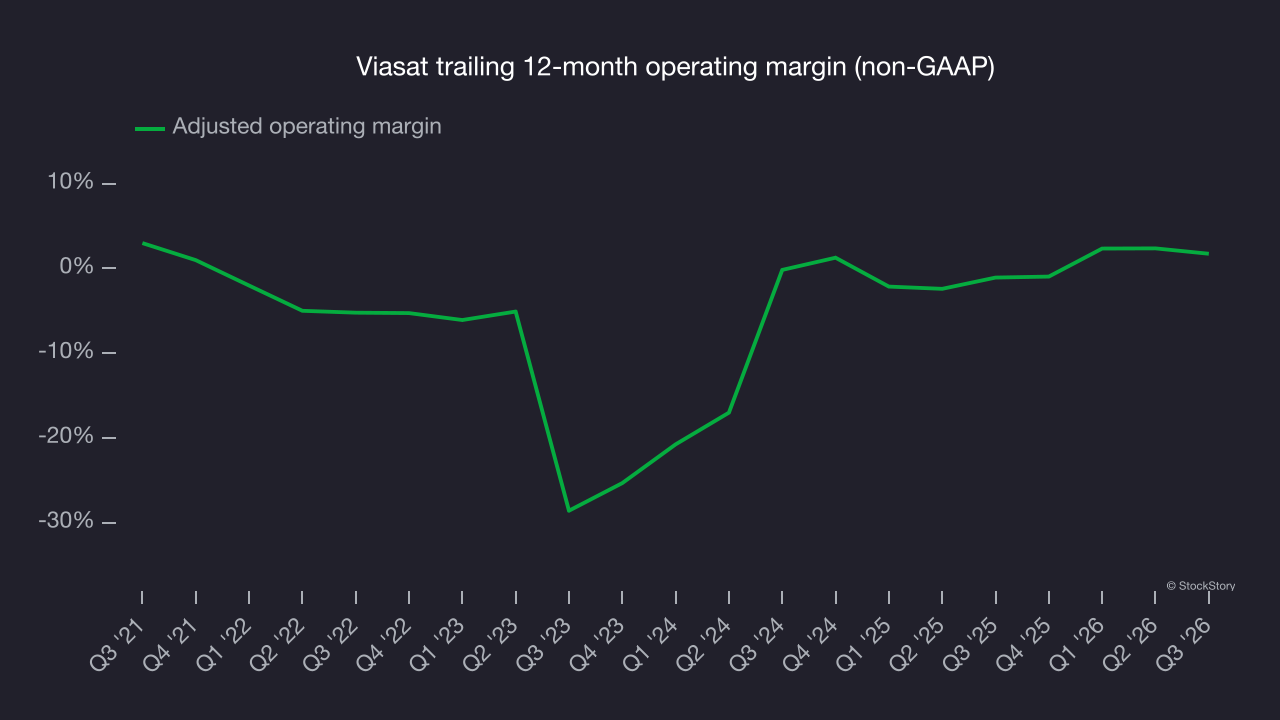
In Q3, Viasat’s breakeven margin was 0.6%, down 2.5 percentage points year on year. This contraction shows it was less efficient because its expenses grew faster than its revenue.
Earnings per share
Revenue trends explain a company’s historical growth, but the long-term change in earnings per share, or EPS, points to the profitability of that growth. For example, a company could inflate its revenue through excessive spending on advertising and promotions.
Viasat’s EPS declined by 16.7% annually over the last five years while its revenue grew by 12.9%. However, its adjusted operating margin improved during this time, indicating that non-fundamental factors such as interest expenses and taxes affected its ultimate earnings.
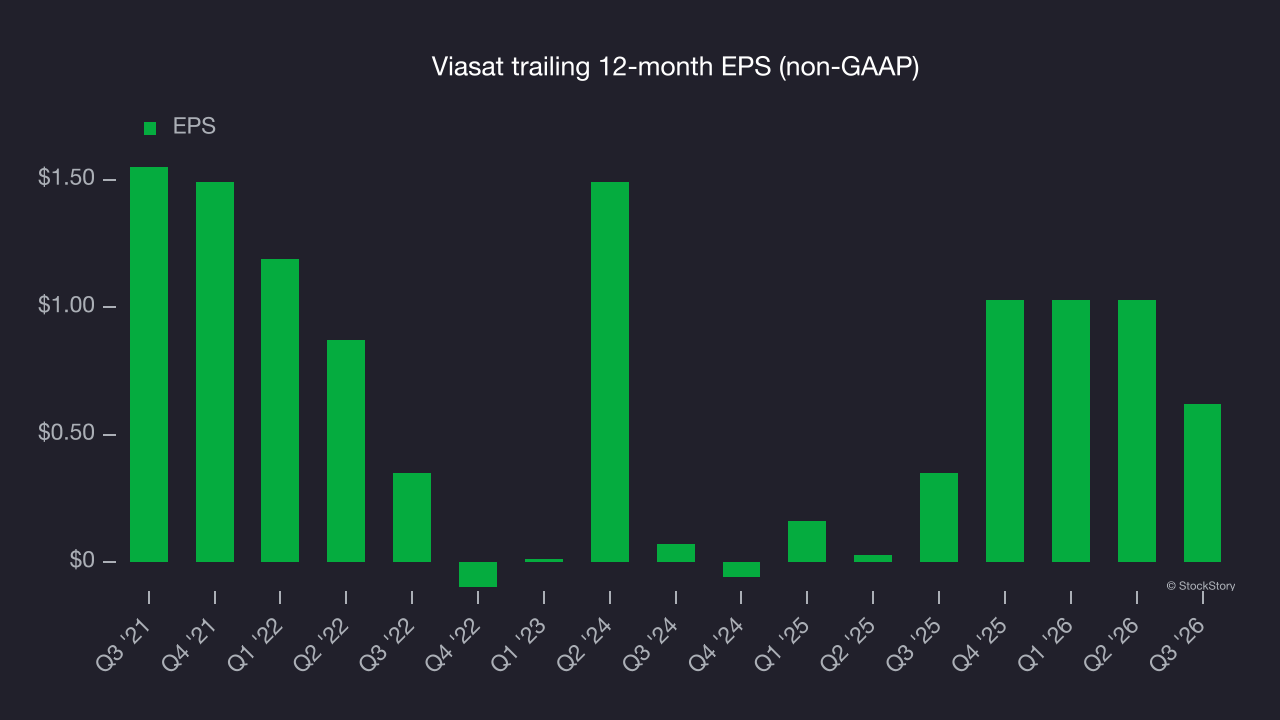
A closer look at Viasat’s earnings helps explain its performance. A five-year view shows Viasat has diluted its shareholders, growing its share count by 85.2%. This dilution overshadowed its increased operational efficiency and has led to lower per share earnings. Taxes and interest expenses can also affect EPS but don’t tell us as much about a company’s fundamentals. 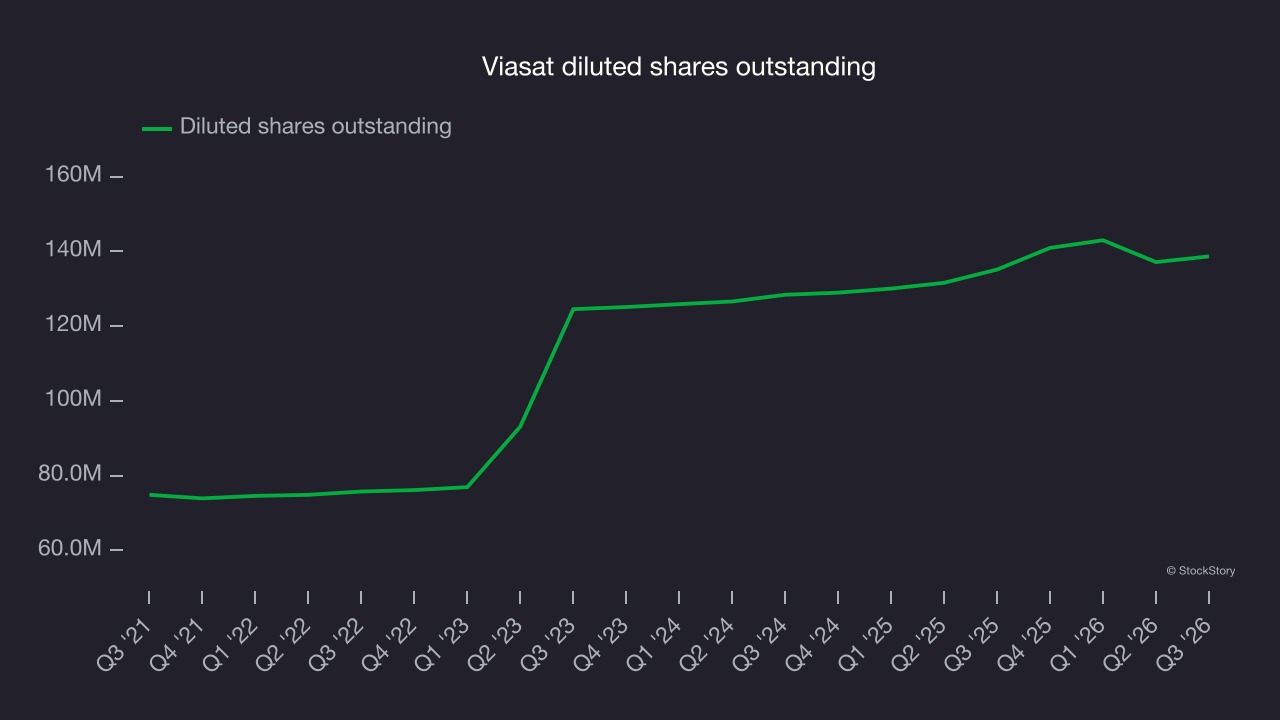
As with revenue, analyzing EPS over a more recent period can provide insight into an emerging theme or development for the business.
For Viasat, its two-year annual EPS growth of 198% was higher than its five-year trend. This acceleration made it one of the faster-growing business services companies in recent history.
In Q3, Viasat reported adjusted EPS of negative $0.32, down from $0.09 in the same quarter last year. This result missed analysts’ consensus estimates. There is insufficient data to analyze expected EPS growth based on Wall Street analysts’ consensus projections.
Key takeaways from Viasat’s Q3 results
Viasat fell short of Wall Street’s consensus estimates for both revenue and EPS, leaving few positives in a quarter that could have been better. Shares edged lower 1.4% to $58.40 immediately after the results.
Viasat’s latest quarter was underwhelming. One earnings report doesn’t define a company’s quality, though, so let’s examine whether the stock is a buy at the current price. The latest quarter matters, but not nearly as much as longer-term fundamentals and valuation when deciding if the stock is a buy. Read the full research report here (it’s free).