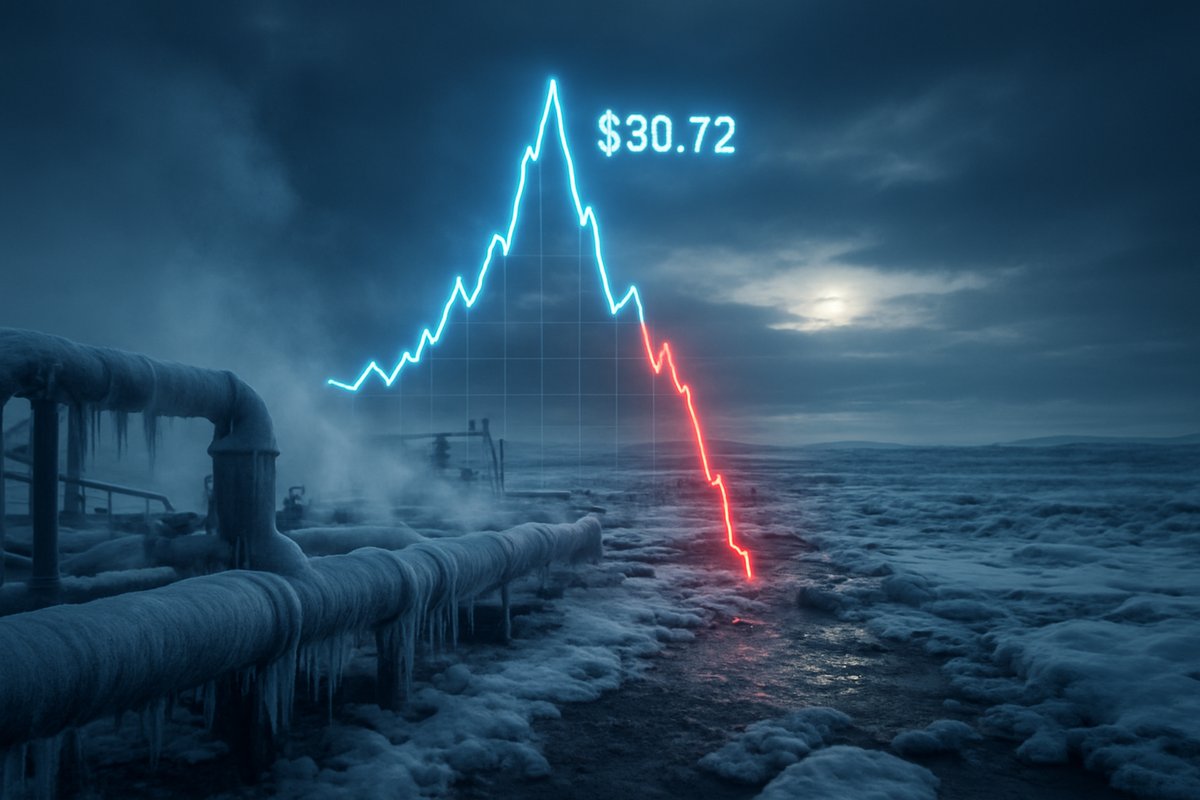
The U.S. natural gas market has undergone a historic and violent "normalization" over the last sixty days, shifting from record-shattering price peaks in January to a staggering 52% collapse throughout February. This volatility has sent shockwaves through the energy sector, leaving leveraged investors reeling and major producers scrambling to recalibrate their hedging strategies for the remainder of 2026.
After Henry Hub spot prices reached an unprecedented nominal high of $30.72 per million British thermal units (MMBtu) during the height of "Winter Storm Fern" in late January, the market has since been flooded by a rapid recovery in domestic production. As of early April 2026, the industry is grappling with the aftermath of a "localized crisis of abundance," where record output of 111.6 billion cubic feet per day (Bcf/d) has collided with unseasonably mild temperatures, effectively erasing the "weather premium" that had defined the start of the year.
From Deep Freeze to Flash Crash: The February Freefall
The volatility of early 2026 will likely be remembered as one of the most dramatic periods in the history of American energy trading. The timeline began in mid-January when Winter Storm Fern, an Arctic blast of historic proportions, swept across the Lower 48. The storm triggered widespread "wellhead freeze-offs," which at one point knocked approximately 18.3 Bcf/d of production offline. On January 23, 2026, the supply-demand imbalance pushed spot prices at the Henry Hub to $30.72/MMBtu, a figure that caught many industrial consumers and utilities off guard.
However, the "Fern spike" proved to be short-lived. By early February, the freeze-offs were resolved with surprising speed. U.S. producers restored operations with extreme efficiency, pushing national dry gas production to a record 111.6 Bcf/d by February 2. This surge in supply coincided with a "heatwave-free" February that saw temperatures across the Eastern United States trend far above seasonal norms. The result was a "flash crash" in the futures market; on February 2 alone, the Nymex front-month contract plummeted 25.6%, the steepest single-day decline since 1995. By the end of February, natural gas prices had shed 52.3% of their value, hovering just above the $3.00 support level—a far cry from the double-digit highs seen only weeks prior.
Corporate Winners and Losers in the Volatility Vortex
The rapid price swing has created a stark divide among public companies and exchange-traded products. Expand Energy Corporation (NASDAQ: EXE), the entity formed from the late 2024 merger of Chesapeake Energy and Southwestern Energy, has found itself under immense pressure. As the largest independent natural gas producer in the country, Expand Energy’s massive footprint in the Appalachian and Haynesville shales means its bottom line is hypersensitive to Henry Hub fluctuations. While the company benefited from the January spike, its stock has faced headwinds as investors worry about oversupply heading into the injection season.
In contrast, EQT Corporation (NYSE: EQT) emerged from the chaos with a unique advantage. Having entered 2026 largely unhedged, EQT reportedly reaped a $1 billion windfall during the January price surge. However, recognizing the volatility, CEO Toby Rice moved quickly in March to increase the company’s 2026 price hedges from 7% to 25%, a defensive pivot aimed at protecting against further downside. Meanwhile, Comstock Resources (NYSE: CRK) has struggled significantly. With a high debt-to-equity ratio and heavy exposure to the Haynesville Shale, Comstock’s stock fell 9.5% on the day of the February crash, prompting analysts to raise concerns about the company's liquidity in a lower-for-longer price environment.
The most extreme impacts, however, were felt in the world of leveraged ETFs. The ProShares Ultra Bloomberg Natural Gas (NYSEARCA: BOIL), which seeks 2x daily returns, nearly doubled in value during the mid-January spike before losing roughly 66% of its value in February. Conversely, the ProShares UltraShort Bloomberg Natural Gas (NYSEARCA: KOLD), which provides -2x daily exposure, suffered catastrophic losses during the storm but rallied spectacularly as it tracked the 52% collapse of the underlying index through the remainder of the month.
Industry Trends and the Regulatory Horizon
This roller-coaster start to 2026 fits into a broader trend of "production resilience" that has come to define the modern U.S. shale era. Technological advancements have enabled companies to bring supply back online faster than ever after weather-related disruptions, a reality that has structurally limited the duration of price spikes. This event has also reignited the debate over LNG export capacity. Companies like Cheniere Energy (NYSE: LNG) remain relatively insulated from domestic price crashes, as their business model thrives on the spread between low domestic prices and higher international benchmarks.
Regulators are also taking notice. The Federal Energy Regulatory Commission (FERC) and state utility boards are likely to scrutinize the January spot price spike of $30.72, with some consumer advocacy groups calling for tighter oversight of "wellhead preparedness" to prevent future freeze-offs from causing such extreme price movements. Historically, the February 2026 crash draws parallels to the 2014-2015 "Shale Gale" era, though the current speed of production recovery is unprecedented.
What Comes Next: Strategic Pivots and Market Surveillance
In the short term, the market is looking for signs of a "production curtailment" movement. With prices sitting near multi-year lows for the spring season, some producers may choose to shut in wells or delay new completions to avoid selling into a glutted market. The long-term challenge will be balancing this newfound production capacity with the growing demand from data centers and the burgeoning AI industry, which are expected to drive a significant increase in natural gas-fired power generation through 2027.
Investors should watch for the next round of quarterly earnings calls in May, where companies like Antero Resources (NYSE: AR) and Coterra Energy (NYSE: CTRA) are expected to detail their hedging levels for the winter of 2026-2027. If production continues to hover near the 111.6 Bcf/d record, the market may require a significant "heat wave" this summer to clear the surplus and prevent another round of price collapses in the autumn.
Navigating the Aftermath
The first quarter of 2026 has provided a masterclass in the inherent volatility of the natural gas market. The 52% February plunge served as a sobering reminder that in a world of high-efficiency production and unpredictable climate patterns, today’s record high can easily become tomorrow’s oversupplied low. For the major producers, the lesson of the "Great Thaw" is clear: capital discipline and robust hedging are the only defenses against a market that can turn on a dime.
Moving forward, the focus will shift from the drama of Winter Storm Fern to the fundamental reality of storage levels and export capacity. While the immediate crisis of high prices has passed, the risk of a prolonged period of suppressed prices looms large. Investors and industry stakeholders should remain vigilant, watching for any signs of a "strategic retreat" in production that could finally bring the market back into balance.
This content is intended for informational purposes only and is not financial advice.