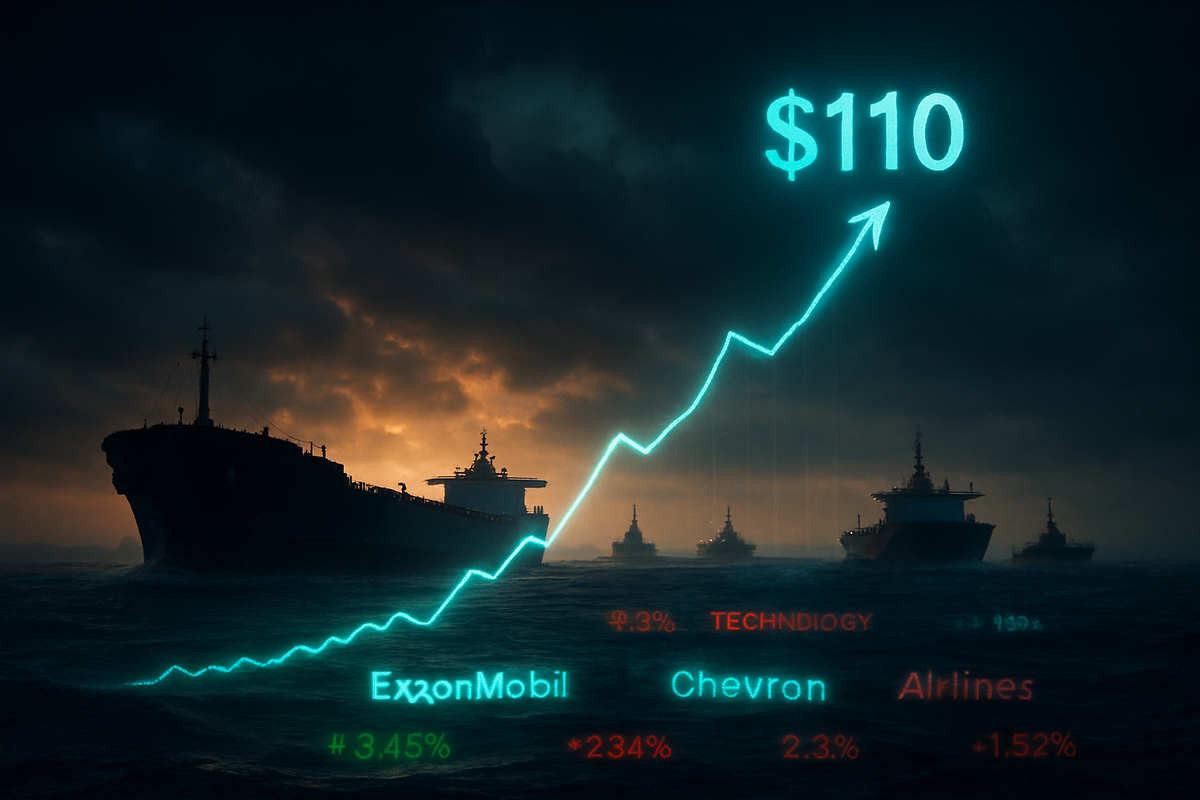
NEW YORK — Global energy markets were sent into a tailspin on April 2, 2026, as West Texas Intermediate (WTI) and Brent crude both surged past the $110 per barrel mark following an aggressive national address by President Trump. The sudden spike, which saw prices jump nearly 10% in a single trading session, comes amid an escalating maritime crisis in the Middle East that threatens to paralyze the world’s most vital oil transit routes.
The surge was triggered by the President's vow to take "decisive and overwhelming action" against Iranian-backed interests following a series of renewed Houthi rebel attacks on commercial shipping in the Red Sea and an intelligence report suggesting a potential full-scale blockade of the Strait of Hormuz. For a global economy already grappling with "sticky" inflation and high interest rates, the return of triple-digit oil prices marks a volatile new chapter in the 2026 fiscal year.
A Two-Strait Chokehold: The Path to $110 Oil
The geopolitical tinderbox ignited late last night when President Trump delivered a prime-time address from the Oval Office, shifting his administration’s "Drill, Baby, Drill" rhetoric toward a "Maximum Pressure 2.0" military stance. The President warned that the United States would no longer tolerate the "harassment of the seas" by Houthi rebels, who on March 28, 2026, officially re-entered the conflict by launching a barrage of missiles at U.S. and Israeli naval assets near the Bab al-Mandab Strait.
The situation worsened this morning when reports surfaced that Iran had moved anti-ship cruise missiles to the islands of Abu Musa and the Greater and Lesser Tunbs, positioning them to effectively close the Strait of Hormuz. This 21-mile-wide artery carries approximately 20% of the world’s daily oil supply and 20% of its liquefied natural gas (LNG). Traders immediately priced in a "war premium," fearing that the removal of 13 to 14 million barrels of oil per day from the market would be unavoidable if the blockade persists.
Market analysts noted that while oil had been trading in the $70 range earlier this year, the "two-strait chokehold"—simultaneously threatening the Red Sea and the Persian Gulf—has created a supply-side shock not seen since the 1970s. The immediate market reaction saw WTI crude leap from $101 to $110.45 within hours of the President's speech, while Brent crude followed suit, hovering around $109.80 by the mid-day bell.
Corporate Divergence: Winners and Losers in the "Great Rotation"
The sudden spike in energy costs has triggered a massive "sector rotation" on Wall Street, as institutional investors flee growth-oriented technology stocks in favor of "Old Economy" energy majors. ExxonMobil (NYSE: XOM) emerged as the day's biggest winner, with its shares climbing 5.2% to hit a new all-time high of $176. Investors are betting that Exxon’s record production in the Permian Basin and its recent integration of Pioneer Natural Resources will yield unprecedented cash flows in a $110+ oil environment. Similarly, Chevron (NYSE: CVX) saw its stock jump 4.8%, as its high-margin upstream operations in the Gulf of Mexico are now viewed as a critical "safe-haven" for capital.
Conversely, the transportation and consumer discretionary sectors are reeling. United Airlines (NASDAQ: UAL) shares plummeted 6.6% today after the carrier announced it would cut 5% of its flight capacity to offset a 60% surge in jet fuel prices since February. Delta Air Lines (NYSE: DAL) also felt the heat, dropping 4.1% as analysts warned that the "robust travel demand" of 2025 may finally buckle under the weight of $5.00-a-gallon gasoline.
The tech sector, which dominated the 2024-2025 bull market, faced a brutal sell-off. Microsoft (NASDAQ: MSFT) and Nvidia (NASDAQ: NVDA) fell 3.2% and 4.5% respectively, as the rising cost of powering massive AI data centers coupled with broader inflationary fears cooled investor enthusiasm for high-multiple growth stocks.
The Return of "Slowflation": Wider Economic Significance
This surge in oil prices fits into a broader, more concerning trend of "slowflation"—a period of stagnant growth coupled with persistent inflation. Just as the Federal Reserve was signaling a potential pivot toward interest rate cuts in late 2026, this energy shock threatens to anchor inflation expectations well above the 2% target. Federal Reserve Chair Jerome Powell recently warned that the central bank is prepared to raise rates further if energy prices continue to bleed into core inflation data.
Historically, every sustained 10% increase in the price of oil adds approximately 0.3 percentage points to the headline Consumer Price Index (CPI). With oil up 40% from its January lows, economists at Goldman Sachs estimate that U.S. inflation could push toward 3.5% by early summer, effectively ending any hopes for a "soft landing."
Furthermore, the Trump administration's "fossil-fuel first" policies—including the recent $1 billion payment to French giant TotalEnergies to abandon offshore wind projects in favor of U.S. drilling—have underscored a national shift toward energy independence at the expense of the green transition. This policy pivot has drawn sharp criticism from environmental groups but has found support among energy-sector investors who see a multi-year bull run for carbon-based fuels.
Strategic Pivots and the Road Ahead
In the short term, the market is bracing for a potential release from the Strategic Petroleum Reserve (SPR). However, with the SPR already at historically low levels following the 2022-2023 drawdowns, the administration has limited levers to pull. The coming weeks will likely see a push for increased domestic production, but "drilling your way out" of a geopolitical blockade in the Middle East is a strategy that takes months, not days, to manifest in actual supply.
The primary opportunity for investors may lie in midstream infrastructure and energy service providers, which are expected to see increased demand as the U.S. tries to fill the global supply gap. However, the risk of "demand destruction" remains high; if oil remains above $120 for an extended period, the resulting spike in shipping and heating costs could trigger a global recession, eventually collapsing the very demand that drove prices higher.
Conclusion: A Market in Transition
The events of April 2, 2026, have fundamentally altered the market landscape for the remainder of the year. The transition from "bits to atoms"—from software-led growth to energy-led stability—is no longer a theoretical projection but a lived reality on the New York Stock Exchange. The key takeaways for investors are clear: geopolitical risk is no longer a peripheral concern but the primary driver of equity valuations.
Moving forward, the market will be hyper-sensitive to any diplomatic developments in Tehran or tactical movements in the Persian Gulf. Investors should closely watch the upcoming PPI and CPI data releases for signs of how quickly energy costs are migrating into the broader economy. For now, the "war economy" mindset has taken hold of the energy sector, and with the Strait of Hormuz hanging in the balance, the era of cheap energy appears to be firmly in the rearview mirror.
This content is intended for informational purposes only and is not financial advice.