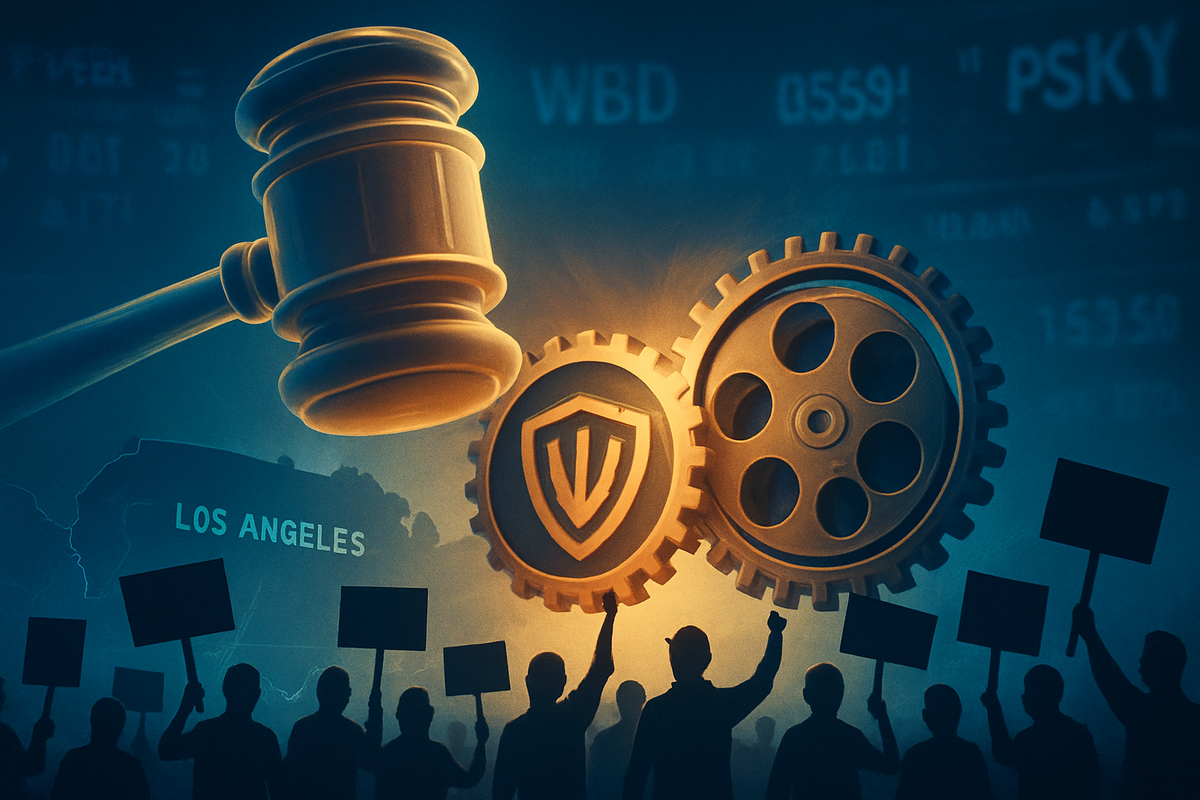
The media and entertainment landscape reached a fever pitch this week as a coalition of Hollywood’s most influential creative voices formally launched a campaign to block the proposed merger between Paramount Skydance Corporation (Nasdaq: PSKY) and Warner Bros. Discovery (Nasdaq: WBD). Following the February 27, 2026, announcement of a $111 billion "super-major" consolidation, a "talent revolt" has emerged, casting a shadow of uncertainty over a deal that was previously viewed by Wall Street as an inevitability. With a critical shareholder vote looming on April 23, the industry is bracing for a regulatory and reputational showdown that could redefine the economics of content creation for decades.
As of April 14, 2026, the merger represents the most significant attempt to consolidate power in the history of American media, promising to unify the libraries of Paramount+ and Max into a single "Super Aggregator." However, the opposition—led by over 1,400 actors, directors, and writers—argues that the transaction would effectively eliminate the competitive market for high-end content, leaving creators with fewer places to pitch and sell their work. For investors, the immediate implication is a widening "regulatory discount" in the stock price of WBD, which currently trades at approximately $27.50—nearly 11% below the $31.00 cash offer price—reflecting growing fears that the Department of Justice (DOJ) or state attorneys general might intervene.
The current crisis began in earnest on February 27, 2026, when Warner Bros. Discovery’s board accepted a "superior proposal" from the newly formed Paramount Skydance entity. This $111 billion deal followed a chaotic bidding war that saw traditional media giants outmaneuver tech-heavy rivals like Netflix (Nasdaq: NFLX) for control of the storied Warner Bros. and Paramount lots. Under the leadership of David Ellison at PSKY and David Zaslav at WBD, the merger aims to achieve $6 billion in annual cost savings, primarily through the elimination of overlapping corporate functions and a reduction in redundant content production.
However, the timeline took a sharp turn in early April 2026. An open letter signed by a "Creative Coalition" including industry heavyweights like J.J. Abrams, Denis Villeneuve, and Emma Thompson, characterized the merger as an "existential threat" to the diversity of American storytelling. This grassroots opposition has been bolstered by formal complaints from the Writers Guild of America (WGA), which cited the risk of widespread layoffs and a narrowed "monopsony" power in the labor market. The initial market reaction was one of cautious optimism regarding the $31 cash-out for WBD shareholders, but as of mid-April, the narrative has shifted to the "Byzantine labyrinth" of legal challenges that lie ahead.
On April 13, 2026—just yesterday—the UK’s Competition and Markets Authority (CMA) announced its own preliminary probe into the deal, signaling that the resistance is not confined to California. Meanwhile, the U.S. DOJ has issued broad subpoenas focused on the horizontal overlap in the companies' sports and news divisions, specifically the potential dominance of a combined CBS Sports and TNT Sports network. This multi-front regulatory assault has introduced a "ticking fee" risk, where PSKY must pay WBD shareholders an additional $0.25 per share per quarter if the deal is delayed beyond September 30, 2026.
The potential winners and losers of this merger are as polarized as the Hollywood unions and the corporate boards themselves. Warner Bros. Discovery shareholders stand to win the most in the short term, provided the deal closes; the $31.00 per share offer represents a massive premium for a company that has faced significant debt headwinds over the last three years. Similarly, institutional investors are eyeing the "synergy potential" of a combined $79 billion debt load being managed by a single, leaner entity with 200 million streaming subscribers.
Conversely, the creative community and mid-tier production companies are positioned as the primary losers. If the merger reduces the "Big Five" studios to a "Big Four," the bargaining power of talent will likely plummet. Smaller streaming competitors like AMC Networks (Nasdaq: AMCX) or Lionsgate (NYSE: LGF.A) could also find themselves marginalized as the PSKY-WBD entity leverages its massive library to demand better placement on smart TV platforms like those operated by Roku (Nasdaq: ROKU). Furthermore, the 2026 workforce faces a grim outlook; the promised $6 billion in cost savings is almost synonymous with thousands of layoffs across both the New York and Los Angeles offices.
Disney (NYSE: DIS) occupies a unique middle ground in this scenario. While the emergence of a "Super Aggregator" rivaling Disney+ is a competitive threat, the regulatory scrutiny applied to Paramount and Warner could provide Disney with cover to pursue its own smaller, strategic acquisitions or joint ventures without attracting the same level of antitrust heat. If the merger is blocked, however, WBD and PSKY could both see their valuations crater as they would be forced to return to a "standalone" strategy in an era where scale is the only defense against the dominance of Big Tech.
The significance of the Paramount-Warner opposition goes beyond a simple labor dispute; it marks a turning point in the "Great Re-bundling" trend of 2026. For the past two years, the media sector has been reversing the fragmentation of the early 2020s, moving back toward large, consolidated packages to combat "subscription fatigue." This merger was intended to be the pinnacle of that trend. The current pushback suggests that the industry may have reached the limits of consolidation that the public and the regulators are willing to tolerate.
Historically, this event mirrors the 2019 acquisition of 21st Century Fox by Disney, but the regulatory climate in 2026 is far more hostile toward "vertical and horizontal integration." California Attorney General Rob Bonta’s recent public statements that the deal is "not a done deal" highlights a new era where state-level regulators are willing to sue to protect local labor markets, even if federal regulators remain on the fence. This shift in policy means that future M&A activity in the tech and media space will likely face a much higher "burden of proof" regarding consumer and worker benefits.
Furthermore, the "talent revolt" underscores a growing tension between AI-driven corporate efficiency and human-led creativity. As PSKY and WBD tout "AI-optimized content libraries" to justify their merger to Wall Street, the creative guilds are fighting to ensure that consolidation does not lead to an "algorithmic monoculture." The outcome of this merger will likely set the precedent for how intellectual property is managed in the age of generative AI and massive corporate consolidation.
Looking ahead, the next 90 days are critical. The shareholder vote on April 23 will be the first major hurdle. While proxy advisors like Glass Lewis are recommending approval based on "immediate cash value," a significant "no" vote from activist investors or a vocal minority of shareholders could derail the momentum. If the vote passes, the focus shifts entirely to the DOJ and the UK’s CMA. Analysts expect that the companies may have to offer significant divestitures—potentially selling off CNN or certain sports rights—to satisfy antitrust concerns.
In the long term, if the deal is blocked, both Paramount Skydance and Warner Bros. Discovery will need to execute rapid "strategic pivots." For WBD, this might mean a more aggressive push into licensing its content to third parties (like Netflix) to service its debt, rather than hoarding it for Max. For PSKY, a failed merger could lead to a renewed search for a partner, possibly looking toward a tech giant like Apple (Nasdaq: AAPL) or Amazon (Nasdaq: AMZN) that has a cleaner balance sheet but less legacy media baggage.
The Hollywood opposition to the Paramount-Warner merger is a watershed moment for the entertainment industry. It represents a clash between the financial necessity of scale and the creative necessity of competition. For investors, the takeaway is clear: the path to "Super Aggregation" is fraught with regulatory and reputational landmines. While the financial logic of the merger remains compelling on paper, the human element—the talent that creates the value in these libraries—is currently the deal's greatest "tail risk."
As the market moves forward, watch for the results of the April 23 shareholder meeting and any formal filings from the DOJ. The "regulatory discount" currently seen in WBD stock is a direct reflection of the market's uncertainty. If the merger fails, we could see a massive reshuffling of the media sector's valuation as the dream of a "one-stop-shop" streaming giant gives way to a more fragmented, yet perhaps more competitive, landscape. For now, the "Great Re-bundling" is on hold, waiting for a verdict from both the regulators and the creators of Hollywood.
This content is intended for informational purposes only and is not financial advice.