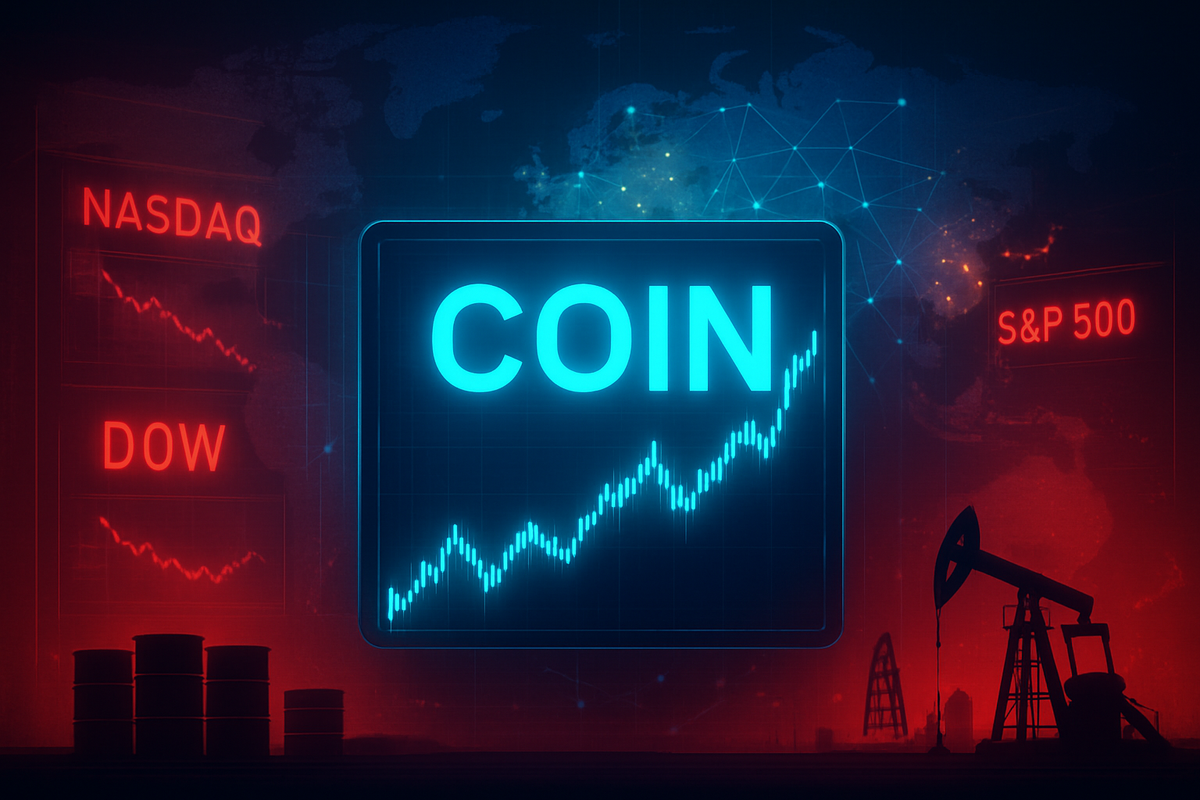
On March 2, 2026, the global financial landscape was rocked by a profound geopolitical shift that sent traditional markets into a tailspin. However, amidst the chaos of a rapidly escalating conflict in the Middle East, Coinbase Global, Inc. (NASDAQ: COIN) emerged as a beacon of stability and growth, with its shares jumping 12.5% by the close of Monday’s trading session. This remarkable rally signaled a decoupling of the crypto sector leader from broader market volatility, reinforcing its newfound role as a critical piece of global financial infrastructure.
The surge in COIN shares comes at a time of extreme uncertainty, as the sudden closure of the Strait of Hormuz and a dramatic spike in energy prices triggered a massive sell-off in the Nasdaq and S&P 500. While traditional tech giants faltered under the weight of looming inflation and supply chain fears, Coinbase benefitted from its strategic pivot toward a diversified "Everything Exchange" model, attracting investors seeking both liquid digital assets and immediate access to defensive equities within a single, compliant ecosystem.
The Strike and the Surge: A Timeline of Resilience
The immediate catalyst for the market upheaval was a coordinated military operation involving U.S. and Israeli forces against Iranian infrastructure over the weekend of February 28 to March 1, 2026. By the time markets opened on Monday, March 2, reports confirmed the death of high-level Iranian leadership, leading to the swift closure of the Strait of Hormuz—a chokepoint responsible for a fifth of the world’s oil supply. Brent Crude prices immediately leaped by over 12%, creating a "war premium" that historically would have dragged high-beta assets like Coinbase down with the rest of the tech sector.
Instead, Coinbase (NASDAQ: COIN) experienced a groundswell of buy-side pressure. The timing was particularly fortuitous for the company, which had officially launched its nationwide "Everything Exchange" feature just five days prior on February 25. This integration allowed U.S. users to trade traditional stocks and ETFs alongside digital assets on a unified platform. As the geopolitical shock hit, investors utilized Coinbase not just to buy Bitcoin (BTC), but to rotate capital into defense and energy sectors without the friction of moving funds between different brokerage accounts.
The initial market reaction saw Coinbase shares open significantly higher, climbing steadily throughout the day. Key stakeholders, including institutional desks that utilize Coinbase Prime for custody, reportedly increased their positions as the USDC stablecoin—largely managed by the Circle-Coinbase consortium—saw its peg strengthen as a "digital dollar" safe-haven. This flight to quality within the crypto ecosystem marked a stark departure from previous cycles where geopolitical tension often led to a localized liquidity crunch for crypto-related equities.
Winners and Losers in the Wake of Volatility
In the immediate aftermath of the shock, the divergence between winners and losers was sharp. Alongside Coinbase, MicroStrategy Inc. (NASDAQ: MSTR) saw its shares climb 7.6%, continuing its trajectory as a leveraged play on Bitcoin’s recovery from its weekend lows. BlackRock Inc. (NYSE: BLK), as a major partner with Coinbase for its spot Bitcoin ETF, also saw defensive interest as investors bet on the continued institutionalization of digital assets as a macro hedge.
On the traditional front, the energy and defense sectors were the clear beneficiaries of the crisis. Exxon Mobil Corp. (NYSE: XOM) and Lockheed Martin Corp. (NYSE: LMT) both saw significant gains as the prospect of a prolonged regional conflict drove up oil prices and defense spending expectations. These companies, now tradeable directly on the Coinbase platform for many retail investors, saw record-high retail volume through the app's new stock-trading interface, further validating Coinbase’s move to challenge legacy brokerages.
Conversely, the losers were concentrated in sectors sensitive to fuel costs and regional instability. Major airlines and travel platforms plummeted as airspace across the Middle East was shuttered. The broader tech sector, represented by the Invesco QQQ Trust (NASDAQ: QQQ), struggled as investors feared that the oil shock would force the Federal Reserve into a more hawkish stance to combat renewed inflationary pressures. The resilience of COIN in this environment highlights a significant shift in how the market perceives the risks associated with the digital asset industry compared to traditional growth stocks.
Decoupling and the New Macro Hedge Narrative
The 12.5% jump for Coinbase (NASDAQ: COIN) is being viewed by analysts as a pivotal moment in the "decoupling" narrative. For years, crypto-related stocks moved in lockstep with the Nasdaq 100, viewed as high-risk, speculative bets. However, the events of March 2026 suggest that Bitcoin and its primary exchange are transitioning into a "high-beta macro asset" status—recovering faster than traditional equities and serving as a liquidity lifeboat during periods of extreme geopolitical stress.
This shift is partially attributed to the increasing regulatory clarity in the United States. The resilience shown during this crisis is expected to accelerate the passage of the CLARITY Act in the U.S. Senate, which aims to provide a permanent federal framework for stablecoins. By positioning USDC as a strategic national asset during a time of war, Coinbase has effectively aligned its corporate interests with U.S. financial hegemony, a move that provides a "political shield" that offshore competitors like Binance simply do not possess.
Historically, this event draws comparisons to the early days of the 2022 conflict in Ukraine, where crypto initially dipped before seeing a surge in use for cross-border transfers and value preservation. The difference in 2026 is the scale of institutional involvement. With major banks now deeply integrated into the crypto plumbing, the panic-selling of the past has been replaced by structured, algorithmic rebalancing that favors Coinbase’s liquid and compliant environment.
The Road Ahead: Strategic Pivots and Market Evolution
Looking forward, the short-term outlook remains volatile as the situation in the Middle East develops. Coinbase will likely need to manage unprecedented trading volumes while ensuring platform stability—a task that has challenged the exchange during previous periods of hyper-activity. The success of the "Everything Exchange" during its first major test suggests that the company may double down on its expansion into traditional finance, potentially seeking licenses to offer more complex derivative products to retail users.
In the long term, this event may redefine the "safe-haven" trade. If Bitcoin continues to hold its value or gain during regional conflicts while traditional indices suffer, the pressure on institutional pension funds to include a 1-3% allocation to digital assets will become nearly irresistible. Coinbase’s role as the primary custodian for these assets puts it in a unique position to capture the management fees and spread from this massive capital migration.
The primary challenge for Coinbase in the coming months will be navigating the macro-economic fallout of higher oil prices. If the conflict leads to a global recession, the overall volume of trading across all asset classes could contract, potentially capping the gains seen in the early days of the crisis. However, the strategic pivot to a multi-asset platform provides a buffer that the company previously lacked, allowing it to remain profitable even if crypto-specific interest wanes temporarily.
Final Assessment: A Landmark Day for Digital Assets
The events of March 2, 2026, will likely be remembered as the moment Coinbase (NASDAQ: COIN) solidified its place as a cornerstone of the modern financial system. The 12.5% surge in its share price against a backdrop of global military escalation and commodity shocks is a testament to the company’s evolving business model and the growing maturity of the digital asset class.
Investors should watch for the upcoming quarterly earnings reports to see exactly how much of the "Everything Exchange" volume was driven by the current crisis. Furthermore, the progress of the CLARITY Act in the Senate will be a major milestone for the valuation of the USDC ecosystem. As the world navigates a more fragmented and volatile geopolitical landscape, the role of transparent, liquid, and 24/7 markets will only grow in importance.
For now, the market has sent a clear message: in a world of increasing instability, the infrastructure of the digital economy is proving to be more resilient than many had predicted. While traditional safe-havens like gold and oil performed as expected, the standout performance of Coinbase suggests that the future of finance is not just digital, but increasingly indispensable during times of global strife.
This content is intended for informational purposes only and is not financial advice.