The era of "GPU-only" obsession that defined 2023 and 2024 has matured into a sophisticated hunt for the physical backbone of the digital age. Investors who once focused exclusively on the "brains" of AI—the processing units—are now aggressively rotating capital into the "nervous system" and "circulatory system" of the data center: high-bandwidth memory, ultra-fast storage, and the massive power infrastructure required to keep these systems from overheating.
This shift marks a critical realization for the market: the bottleneck for AI performance has moved. While processing power remains vital, the ability to feed data to those processors and manage the resulting thermal load has become the primary differentiator between successful AI deployments and expensive, idling hardware. As of January 26, 2026, the "physical layer" of the AI stack is no longer seen as a collection of commodity components, but as a suite of strategic assets that dictate the pace of global technological progress.
The Rise of the Strategic Bottleneck
The current market landscape is dominated by the race for HBM4, the latest generation of High Bandwidth Memory. Leading the charge is SK Hynix (KRX: 000660), which secured a dominant market share in late 2025 by perfecting a mass production system for the memory units required by the next generation of AI chips. Not to be outdone, Samsung (KRX: 005930) has recently passed key qualification hurdles for its own HBM4 modules, with mass production slated for early February 2026. This surge in demand has created a "memory supercycle" unlike anything seen since the dot-com era, with DRAM revenues projected to climb over 50% this year alone.
The timeline leading to this moment began in earnest during the second half of 2025, when hyperscale cloud providers realized that their massive GPU clusters were being throttled by "memory walls"—the inability of data to move into the processor as fast as the processor could handle it. Simultaneously, the storage market experienced a shock. Enterprise SSD prices, which were relatively stable just eighteen months ago, have skyrocketed. A high-capacity 30TB SSD that cost roughly $3,000 in early 2025 is now commanding prices north of $11,000. This is driven by the necessity of "checkpointing" in AI training, where the state of a massive model must be saved instantly to prevent data loss during system failures.
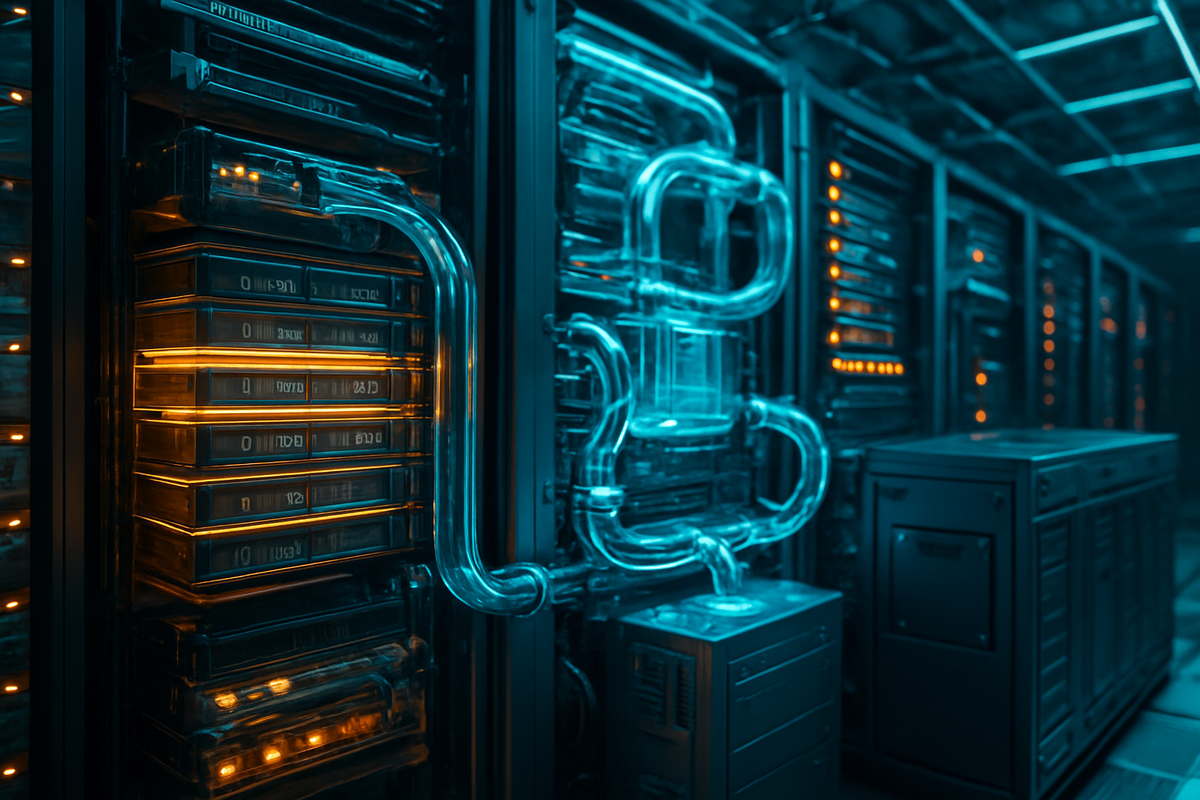
Key players like Micron Technology (NASDAQ: MU) have reported being "completely sold out" of their HBM capacity through the end of 2026, illustrating the sheer scale of the supply-demand imbalance. Meanwhile, the data center infrastructure sector has moved from the periphery of the AI conversation to its very center. Companies like Vertiv Holdings (NYSE: VRT) have become household names for institutional investors as they provide the liquid cooling solutions required to manage the 100kW+ rack densities found in the latest AI "factories."
Winners and Losers in the Physical Layer Shift
In this new hardware-centric reality, Micron Technology (NASDAQ: MU) stands out as a primary beneficiary. By positioning memory as a strategic asset rather than a commodity, Micron has seen its margins expand to record levels. Its fiscal Q1 reports from December 2025 confirmed that the company is no longer just riding a cycle; it is essential to the architecture of modern computing. Similarly, Western Digital (NASDAQ: WDC) has seen its fortunes rise as its enterprise SSD division capitalizes on the massive bit-demand growth. Analysts expect its upcoming January 29 earnings report to reflect a significant windfall from the AI-native storage boom.
The winners also include the "grid-to-chip" infrastructure providers. Eaton Corporation (NYSE: ETN) has seen its data center-related revenue grow by nearly 65% annually as it builds the electrical transformers and power management systems necessary to fuel the AI revolution. Vertiv Holdings (NYSE: VRT) remains the leader in the "cooling war," with its recently launched liquid cooling platforms becoming the industry standard for the NVIDIA (NASDAQ: NVDA) Vera Rubin architecture. These firms are winning not because they make the smartest software, but because they own the physical constraints of the industry.
Conversely, the "losers" in this shift are the software-centric AI firms that have failed to demonstrate a clear path to monetization. As capital expenditures (CapEx) from hyperscalers like Microsoft and Google increasingly lean toward the physical infrastructure, the pressure on software developers to prove the ROI of their AI applications has reached a breaking point. Investors are increasingly skeptical of "wrapper" startups—companies that simply provide a thin software layer over existing large language models—preferring instead the "embodied AI" companies that integrate hardware and software or the firms that build the physical infrastructure itself.
The Significance of the "Energy Wall"
This shift fits into a broader historical trend where the maturity of a technology is marked by the focus on its infrastructure. Just as the early days of the automobile gave way to a boom in road construction and oil refining, the AI era is now defined by its physical needs. We are currently witnessing a global struggle against the "energy wall," where the availability of power and the efficiency of cooling are the primary limiters of AI growth. This has led to a surge in interest for "Sovereign AI," where nations are investing in their own domestic data center infrastructure to ensure they aren't left behind in the global compute race.
The regulatory environment is also reacting to this shift. Governments are increasingly looking at data center power consumption as a matter of national security and environmental policy. We are seeing the first instances of "compute-based" diplomacy, where access to high-end memory and cooling technology is used as leverage in international trade negotiations. This echoes the chip wars of 2023 but extends the battlefield to the entire data center stack, including the electrical grid and water usage for cooling.
Historically, this era resembles the build-out of the electrical grid in the early 20th century. While the inventions themselves were revolutionary, the true economic boom occurred when the infrastructure became standardized and reliable. In 2026, the standardization of liquid cooling and HBM4 is creating a similar platform for sustained economic growth, moving AI from a speculative laboratory phenomenon to a permanent fixture of the industrial landscape.
The Path Forward: From Labs to Factories
In the short term, the market will remain fixated on the supply chain's ability to meet the voracious appetite for hardware. We can expect strategic pivots from traditional chipmakers as they attempt to integrate more vertically, acquiring cooling or power management firms to offer "full-stack" hardware solutions. The long-term challenge will be the move toward "Edge AI"—bringing these powerful capabilities out of the massive data centers and into localized devices. This will require a new generation of low-power memory and efficient storage that can operate without the massive cooling systems of a centralized hub.
Market opportunities will emerge in the recycling and refurbishing of AI hardware as the first generations of AI servers reach the end of their lifecycle. Furthermore, we may see the emergence of "compute as a utility," where the physical availability of a data center's resources is traded on spot markets much like electricity or natural gas. The strategic requirement for 2026 and beyond is no longer just about having the best algorithm, but about having the most efficient "AI Factory" to run it.
Conclusion and Investor Outlook
The transition of power from AI software and processors to memory, storage, and infrastructure marks a maturation of the industry. The key takeaways for the start of 2026 are clear: memory is a strategic asset, storage is an AI-native necessity, and power management is the ultimate physical constraint. The "physical layer" is currently the most profitable and defensible portion of the AI trade, as the barriers to entry—massive capital requirements and technical expertise in thermodynamics and materials science—are incredibly high.
Moving forward, the market will be characterized by a "flight to quality" in hardware. Investors should keep a close eye on upcoming earnings from the infrastructure giants and monitor the ramp-up of HBM4 production. Any delays in the rollout of the Vera Rubin platform or similar next-gen architectures could cause temporary volatility, but the underlying trend remains robust. The AI boom is no longer a ghost in the machine; it is a physical reality made of silicon, copper, and cooling fluid, and the companies that supply those materials are now the masters of the domain.
This content is intended for informational purposes only and is not financial advice