In a landmark shift for global semiconductor trade, the U.S. government has officially transitioned from a policy of outright denial to a "managed access" framework for high-end artificial intelligence hardware. Nvidia (NASDAQ: NVDA) has received conditional approval to export its H200 AI chips to the Chinese market, marking a significant pivot in the ongoing technological standoff between Washington and Beijing. However, this approval is far from a return to business as usual, as it comes tethered to the most stringent security and financial requirements ever imposed on a private technology enterprise.
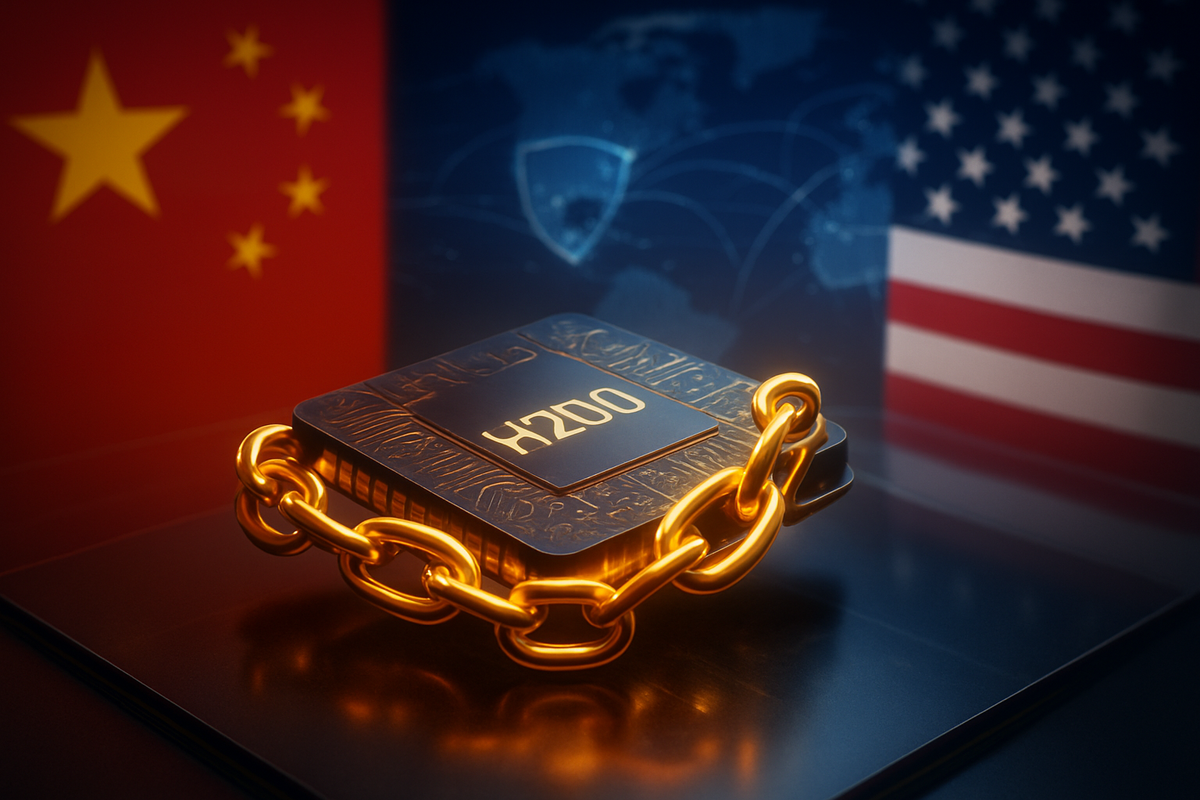
The move represents a complex compromise intended to maintain U.S. technological leadership while capturing economic value from the world’s second-largest economy. While the green light theoretically reopens a multi-billion dollar revenue stream for Nvidia, the new "Golden Handcuffs" policy—characterized by mandatory U.S. routing, volume caps, and a massive 25% surcharge—has introduced layers of friction that may ultimately dampen the commercial enthusiasm for the very chips it seeks to regulate.
A New Era of Managed Access
The policy shift, orchestrated by the Department of Commerce’s Bureau of Industry and Security (BIS), officially took effect on January 16, 2026. This transition followed months of intense negotiations between the executive branch and industry leaders, most notably Nvidia CEO Jensen Huang. The centerpiece of the new framework is the reclassification of the H200—and competing hardware like the MI325X from Advanced Micro Devices (NASDAQ: AMD)—from a "presumption of denial" status to a "case-by-case review" process. This allows U.S. firms to bid for contracts with Chinese entities, provided they navigate a gauntlet of four primary hurdles.
Chief among these is the "50% Volume Rule," which prohibits Nvidia from shipping more than half of its total U.S. domestic sales volume to the China and Macau markets. This ensures that American cloud providers and federal agencies remain at the front of the queue for the world’s most advanced compute resources. Furthermore, the chips must undergo a physical detour; units manufactured in Taiwan must now be routed through the United States for verification at third-party laboratories. These labs are tasked with ensuring the chip’s memory bandwidth and processing performance have not been "unlocked" or tampered with beyond established compliance thresholds before they reach Chinese soil.
Winners and Losers in the New Trade Landscape
Nvidia stands as both the primary beneficiary and the most burdened participant in this new regime. On one hand, the company can finally address the massive pent-up demand for high-end AI training hardware among Chinese tech giants. However, the 25% "surcharge" mandated by the U.S. government—effectively a tariff designed to fund domestic semiconductor manufacturing—makes Nvidia's products significantly more expensive than local alternatives. This price hike, combined with Chinese state-sanctioned discouragement of foreign hardware, creates a challenging sales environment for the Silicon Valley giant.
Conversely, domestic Chinese semiconductor players like Huawei and its supply chain partners may see an unexpected boost. While their hardware currently lags behind Nvidia in raw performance, the "security friction" and 25% price premium on U.S. chips make the Huawei Ascend 950 and 960 series increasingly attractive to state-owned enterprises and local researchers. Major Chinese internet firms like Alibaba Group Holding (NYSE: BABA) and ByteDance are reportedly caught in the middle, weighing the necessity of Nvidia’s superior software ecosystem against the political and financial risks of the new "managed access" system.
The Shift Toward "Taxable Dependency"
This regulatory pivot signals a broader trend in U.S. foreign policy: a move from "total decoupling" to "taxable dependency." By allowing China to purchase Nvidia’s second-tier flagship chips, the U.S. is essentially forcing the Chinese AI industry to subsidize the American semiconductor sector via the 25% surcharge. This revenue is earmarked for the CHIPS Act initiatives, creating a feedback loop where Chinese tech spending directly fuels the expansion of U.S. manufacturing capabilities. It is a strategic move that acknowledges the impossibility of a complete trade break while weaponizing the U.S. lead in chip architecture.
The ripple effects are being felt across the global supply chain. Logistics firms and testing laboratories are seeing a surge in demand due to the mandatory U.S. routing requirement. However, this policy also introduces new vulnerabilities. Chinese customs officials have already begun "slowing" H200 shipments at the border, citing concerns that the mandatory U.S. testing process could be used to install "backdoors" or other surveillance measures. This tit-for-tat security theater threatens to create a "policy whiplash" that could disrupt the predictable flow of components for months to come.
Navigating the Road Ahead
Looking forward, Nvidia is already pivoting its strategy to mitigate these hurdles. The company is reportedly accelerating the development of the B30A, a specialized version of its newer Blackwell architecture designed specifically to sit just below the most stringent "case-by-case" performance thresholds. By tailoring its hardware to slip through the gaps of the current regulations, Nvidia hopes to maintain its market share in China without triggering the most aggressive oversight measures.
In the short term, investors should prepare for volatility as the first wave of "managed access" chips makes its way through the new verification labs. The success of this policy will depend on whether Chinese firms are willing to pay the "premium for performance" or if they will double down on domestic self-reliance. If the friction proves too great, we may see the emergence of a "shadow market" for AI compute, where older or diverted hardware becomes the primary currency for Chinese developers, further complicating the global regulatory landscape.
Market Implications and Closing Thoughts
The approval of H200 sales to China under these strict conditions is a double-edged sword for the tech industry. While it removes the absolute ceiling on Nvidia’s China revenue, it replaces it with a complex, high-friction environment that prioritizes national security over free-market efficiency. The "50% Volume Rule" and the 25% surcharge are unprecedented interventions that redefine the relationship between a public company and the state.
For the market, the coming months will be a test of Nvidia’s ability to manage a split-tier product line across two increasingly incompatible geopolitical spheres. Investors should keep a close eye on export license approval rates and the quarterly commentary from Chinese hyperscalers regarding their capital expenditure. As of January 2026, the message from Washington is clear: American technology is available for a price, but that price now includes both a heavy financial tax and a permanent degree of government oversight.
This content is intended for informational purposes only and is not financial advice