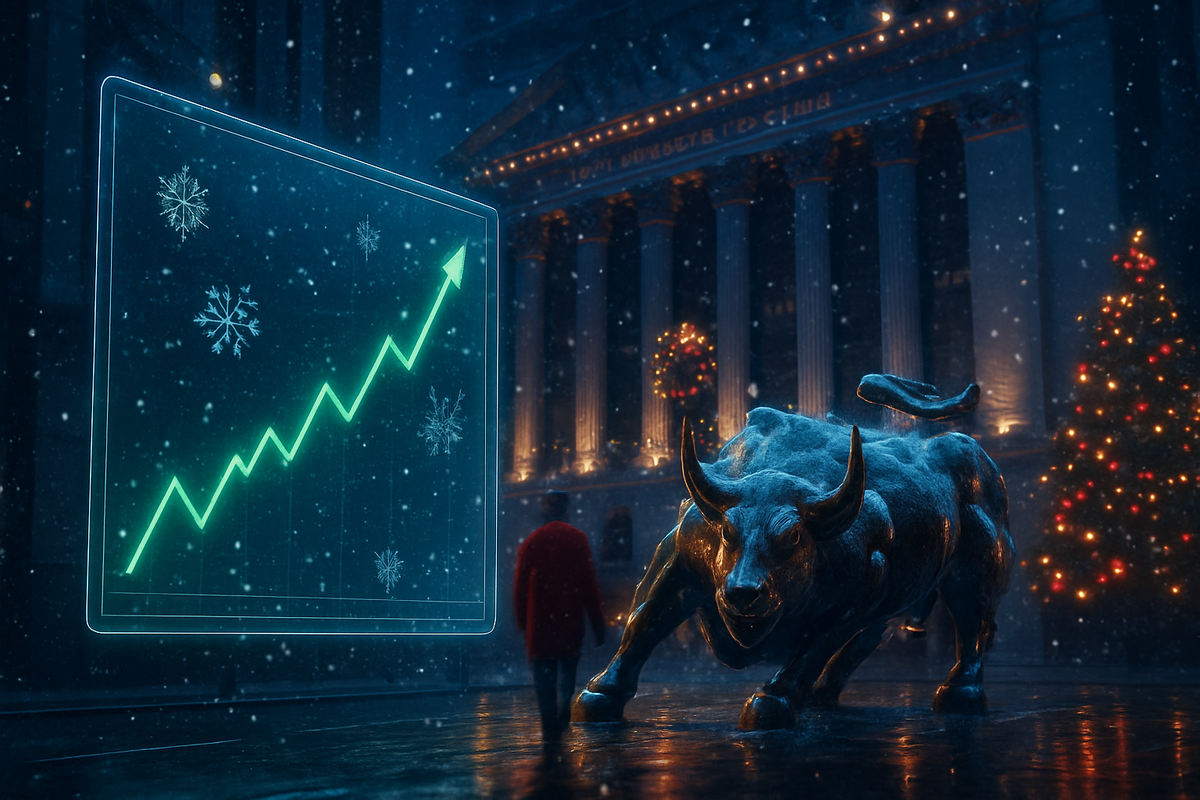
The ghost of Christmas past appears to have finally been exorcised from the New York Stock Exchange. On December 18, 2025, a critical inflation update delivered a much-needed gift to investors, sparking a broad-based market surge and setting the stage for what analysts believe will be a robust "Santa Claus Rally" to close out the year. After a dismal 2024 holiday season that saw the markets retreat in the face of "sticky" prices, today’s data suggests that the macroeconomic environment has finally turned a corner, potentially fueling a "melt-up" as the calendar flips to 2026.
The immediate implications are profound: the cooling Consumer Price Index (CPI) has effectively greenlit a more accommodative stance from the Federal Reserve. For a market that has been wrestling with high valuations and fears of a late-cycle slowdown, the 2.7% annual inflation print—coming in significantly lower than the 3.1% forecast—acts as a high-octane propellant. Major indices responded with vigor, with the Nasdaq Composite jumping nearly 2% in a single session, signaling that the year-end "Santa window" is open for business.
A Tale of Two Decembers: From the 2024 Grinch to the 2025 Gift
The path to this moment has been paved with volatility. To understand the significance of today’s rally, one must look back at the "failed" Santa Claus Rally of 2024/2025. Exactly one year ago, the market was blindsided by a "hawkish cut" from the Federal Reserve. Despite a 25-basis-point reduction in rates, policymakers signaled a "higher-for-longer" path that sent the S&P 500 (NYSEARCA: SPY) tumbling 3.26% during the traditional seven-day holiday window. That period was defined by rising insurance costs and a stalling descent in core inflation, leaving investors with coal in their portfolios.
The timeline leading into December 2025 was equally fraught with tension. A 43-day government shutdown in the fall of 2025 disrupted data collection, leading many to fear that year-end inflation prints would be "fudged" or artificially low. However, today’s release of the November CPI data confirmed a sustainable downward trend in shelter and energy costs. Key stakeholders, including Fed Chair Jerome Powell and Treasury officials, have hinted that the era of Quantitative Tightening (QT) is nearing its end, a move that would inject massive liquidity into the financial system just as the holiday shopping season peaks.
Tech Titans and Retail Giants: The Winners of the "Inflation Thaw"
The primary beneficiaries of this shift are the high-growth technology companies that dominate the market cap of major indices. Nvidia (NASDAQ: NVDA) saw its shares rebound 3.8% following the report, as investors regained confidence in the long-term capital expenditure cycles for its Blackwell and Rubin AI chips. Similarly, Microsoft (NASDAQ: MSFT) climbed 2.5%, bolstered by today's news of an expanded "agentic AI" partnership with Cognizant and a staggering $400 billion backlog in commercial commitments. Apple (NASDAQ: AAPL), while initially lagging, joined the recovery as it navigated regulatory shifts in Japan and expanded its services monetization through the App Store.
In the semiconductor space, Micron Technology (NASDAQ: MU) emerged as the day's superstar, soaring over 12% after an earnings beat that highlighted insatiable demand for AI hardware. On the consumer side, Amazon (NASDAQ: AMZN) and Walmart (NYSE: WMT) are positioned to win big from the dual tailwinds of cooling inflation and resilient consumer spending. Walmart, in particular, has seen its digital sales grow by 27% this year, making it a formidable player in the holiday retail wars. Meanwhile, Disney (NYSE: DIS) gained over 2% as it leveraged a new $1 billion investment in OpenAI to revitalize its digital platforms for the peak travel season.
Global Liquidity and the 7,000 Milestone
The wider significance of this rally extends beyond domestic borders. The 2025/2026 Santa Claus Rally is being supported by a massive $191 billion fiscal stimulus package from Japan, which has revitalized the global carry trade and provided a secondary layer of liquidity for U.S. equities. This stands in stark contrast to the historical precedent of 2024, where global central banks were largely out of sync, and the U.S. was forced to carry the weight of restrictive monetary policy alone.
Furthermore, this event fits into a broader industry trend of "AI Realism." After the speculative fervor of 2023 and 2024, the market is now rewarding companies that can demonstrate actual revenue growth from AI integration. The cooling inflation data allows the Fed to lower the "risk-free rate," which mathematically justifies the higher price-to-earnings multiples currently seen in the tech sector. Analysts like Tom Lee of Fundstrat have suggested that if this momentum continues, the S&P 500 could be on a collision course with the 7,000 milestone by mid-2026—a scenario that seemed impossible during the "sticky inflation" scares of last year.
The Road Ahead: 2026 and Beyond
In the short term, the market will focus on the final five trading days of December and the first two of January—the official Santa Claus Rally window. If the indices can maintain their post-CPI gains, it will mark a significant psychological victory for bulls, potentially leading to a "melt-up" in the first quarter of 2026. However, strategic pivots may be required for investors who have been overly defensive. The transition from a "inflation-fighting" regime to a "growth-supporting" regime suggests a rotation back into small-cap stocks and cyclical sectors that have been suppressed by high borrowing costs.
Long-term challenges remain, primarily in the form of overstretched valuations. With the S&P 500 trading at roughly 21.6 times forward earnings, there is little margin for error. Any resurgence in energy prices or a geopolitical flare-up could quickly derail the "soft landing" narrative. Investors should also watch for the official end of Quantitative Tightening, which, while positive for liquidity, could create volatility in the bond markets as the Fed stops being a guaranteed buyer of Treasuries.
Final Assessment: A Season for Optimism
The 2025 holiday season is shaping up to be the mirror image of the 2024 disappointment. The combination of a "downward surprise" in inflation, a dovish pivot from the Federal Reserve, and strong corporate earnings from the likes of Micron and Nvidia has created a "Goldilocks" environment for equities. The key takeaway for investors is that the macro-drag that defined the last 24 months is finally fading, allowing individual company fundamentals to once again drive price action.
As we move into 2026, the market appears well-positioned for continued growth, though the "low-hanging fruit" of the recovery may have already been picked. Investors should keep a close eye on the January "Effect"—a historical tendency for stocks to continue their December momentum—and watch for any signs of a "hangover" in consumer spending after the holiday rush. For now, the "Santa Claus Rally" isn't just a myth; it's a very real catalyst driving Wall Street toward new heights.
This content is intended for informational purposes only and is not financial advice.