Best AI Crypto Trading Platforms in 2026: A Practical Guide to Choosing Your AI Trading Tool
Search for "AI crypto trading" and you'll find dozens of tools making almost the same promises: smarter entries, less emotion, trading while you sleep. This guide helps you tell them apart. Features were checked against each platform's own pages in October 2026.
What Is an AI Crypto Trading Platform?
An AI crypto trading platform, or AI-powered trading platform, is software that uses AI to help with some part of trading: finding ideas, reading the market, running a strategy or placing orders. Most tools fall into four groups.
Research and signal tools surface setups and alerts. The decision stays with you.
Execution bots run a strategy you configured, such as a grid or dollar-cost averaging, on an exchange through an API key.
Market intelligence platforms, from on-chain dashboards to AI market research tools, explain why a market is moving. They don't trade.
Agentic, on-chain platforms combine research with execution from your own wallet and can run an AI trading agent within limits you set. This is agentic finance, where platforms such as TRUE Finance AI sit.
How to Choose an AI Trading Tool
What Do You Want the Tool to Do?
If you're still learning to read charts, start with research. If you already trust a rule, such as buying BTC every Monday, you need execution.
How Much Complexity Can You Handle?
A leveraged grid with the wrong range can be liquidated before a beginner has worked out what went wrong. Start with defaults you understand.
Who Holds Your Funds?
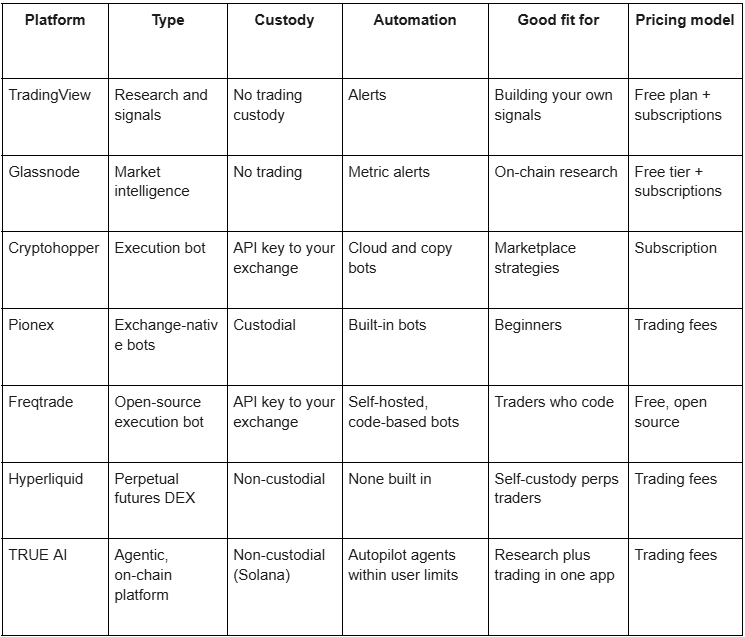
Bot services such as Cryptohopper, and self-hosted bots such as Freqtrade, trade your exchange account through an API key. Exchange-native bots, such as Pionex, keep your funds on the exchange. Non-custodial venues, such as Hyperliquid or TRUE AI on Solana, keep assets in a wallet you control. Each model places the risk somewhere different.
How Much Should Run Without You?
Ask how easily you can stop the tool. Sensible automation comes with clear limits: a budget, approved assets, a stop-loss, an end date and a record of what it did.
How Deep Does Market Analysis Go?
Some tools only see price. Others bring in order flow, funding rates, liquidation levels, news and on-chain flows to help you research assets, track narratives, analyze markets and understand risk.
Which Markets Can You Trade?
Spot, perpetual futures, DEX swaps and tokenized stocks aren't available everywhere. Perpetuals also add leverage and funding payments.
Can You See How It Works?
Look for a public fee page, documentation and clear risk warnings. Treat leaderboard returns with caution, since they usually show a chosen time window.
Best AI Crypto Trading Platforms in 2026
TradingView for Charts and Custom Signals
TradingView is where many traders start their analysis. It covers crypto, stocks and FX, and its Pine Script language lets you write your own indicators.
Key features:
Hundreds of built-in indicators, plus community scripts for almost any idea you can name
Alerts on price, an indicator or several conditions at once
Backtesting and paper trading, so a strategy can fail on pretend money first
Screeners that reach DEX pairs, not just big exchanges
Good fit for: traders who want to build and test their own signals.
Watch out for: it doesn't run strategies by itself, and the free plan limits indicators and alerts.
Glassnode for On-Chain Intelligence
Glassnode is a crypto market intelligence platform that shows what is happening beneath the price. It never places trades.
Key features:
Exchange flows, holder behavior, ETF and derivatives data in one place
Entity-adjusted metrics, which ignore coins one owner shuffles between their own wallets
An alert when a metric crosses your threshold
Good fit for: research-minded traders who want on-chain evidence behind a decision.
Watch out for: the free tier is display-only with daily data; the detailed metrics sit on the top plan.
Cryptohopper for Cloud Bots and Ready-Made Strategies
Cryptohopper runs trading bots in the cloud, so your strategy keeps running when your laptop is closed. It also works as a copy trading platform: the Copy Bot mirrors a trader you choose.
Key features:
A strategy designer you can test on past data or in paper mode
A marketplace where other users sell strategies and signals
Trailing orders and DCA tools
Good fit for: intermediate traders who want to try ready-made strategies without running a server.
Watch out for: the AI strategy tools are only included in the highest plan.
Pionex for Built-In Bots
Pionex is an exchange with trading bots built in. Its popular grid bot places a ladder of buy and sell orders inside a price range, with AI-suggested settings to help you start.
Key features:
Grid, DCA and arbitrage bots, ready as soon as you deposit
No bot subscription on top of the usual trading fees
Good fit for: beginners who want simple automation without API keys or coding.
Watch out for: Pionex is custodial. Your funds stay on the exchange, and the bots trade only Pionex markets.
Freqtrade for Open-Source, Self-Hosted Bots
Freqtrade is a free, open-source trading bot written in Python. You run it yourself, on your own computer or a cloud server, and write strategies as code. In return you get full control over the logic, with nothing hidden behind a subscription.
Key features:
Backtesting on historical data before a strategy touches real funds
A dry-run mode that simulates trades live
Control through Telegram or a web dashboard
Support for major exchanges, including Hyperliquid for perpetuals
Good fit for: technical traders who can write Python and want a bot they fully own.
Watch out for: setup and maintenance are on you, and without coding skills it's hard to get far.
Hyperliquid for Self-Custody Perpetuals
Hyperliquid is a decentralized exchange and on-chain trading platform running on its own blockchain, built for perpetual futures and spot trading.
Key features:
A full order book on-chain, for perps and spot
Trading straight from your own wallet
Lower fees as your 14-day volume grows
Good fit for: experienced traders comfortable with leverage and self-custody.
Watch out for: there are no built-in research or AI tools, so every call on leverage is yours.
TRUE AI for Research and Trading in One Non-Custodial App
TRUE AI (TRUE Finance AI) is a Solana trading platform built around agentic finance, using technology from True Labs. It brings market research, trading and optional automation into one conversational app.
Ask why a token moved and you get a plain-language read of the chart, funding and news. You then place the trade yourself on TRUE's perpetual futures DEX or as a Jupiter-routed swap. Your own wallet signs every fill. TRUE Finance AI also offers deep research for longer questions, and its AI stock and crypto analysis covers on-chain stocks as well as tokens. Autopilot agents run a strategy you define within the assets, budget, stop-loss rules and end date you approve, and each decision is logged. For a closer look, see our deep dive on TRUE AI.
Key features:
Real-time market analysis you can question in plain language
Perps, swaps and copy trading, each signed from your wallet
Autopilot agents that log every decision they make
An MCP connector for ChatGPT, Claude and other assistants
Good fit for: traders who want analysis and execution in the same place while keeping their own keys.
Watch out for: it isn't available to US residents, and as a newer platform it has a shorter public track record than long-running tools.
The Seven Platforms Compared
How the difference plays out. Imagine a Solana token becomes the weekend's narrative and rises 40% in a few hours. A grid bot set between $1.00 and $1.20 sells step by step, then sits idle above the range. If the story fades, it buys all the way back down.
A setup that tracks narratives might show funding turning sharply positive, a sign the move is mostly leverage. You decide whether to stay out. On an agentic platform, an agent could watch the token only within the budget and stop-loss you approved. Neither guarantees a better result: one follows a price range, the other follows your reasons.
Decision Checklist
Do I want ideas, or do I want orders placed?
Am I comfortable holding my own keys?
If the tool makes a bad move overnight, can I see what it did and stop it quickly?
What will it cost each month at my real trading volume?
Can I start with paper trading, a demo or a small budget?
Red Flags to Avoid
Guaranteed or "consistent" returns. Markets don't hand out guarantees, so a tool that offers one is either exaggerating or hiding something.
No explanation of how trades are made. You should know what triggers an order. If the answer is just "our proprietary AI," keep looking.
Unclear custody. Ask one plain question: where are my coins sitting right now? If the help pages can't say, that's your answer.
Pressure to deposit. A bonus that expires in 47 minutes is designed to rush you.
FAQ
Which AI crypto trading platform is best for beginners?
To learn price action, TradingView's free charts are a gentle start. Pionex is simpler if you'd like a bot running without touching API keys. And Cryptohopper's marketplace lets you borrow a tested strategy instead of building one.
Which AI trading platforms let me keep my own keys?
The non-custodial ones. Your funds stay in your wallet, and every trade needs your signature. Hyperliquid works this way for perpetuals, as do apps built on Jupiter and TRUE AI on Solana. The catch: nobody can freeze your account, and nobody can recover a lost seed phrase.
What is the difference between a trading bot and an AI trading agent?
A bot repeats one plan. A Pionex grid keeps buying and selling inside its range whatever the news says. An AI trading agent, sometimes called an autonomous trading agent, looks at context first, such as funding, liquidations or a headline, then acts inside your limits. Platforms like TRUE Finance AI log the reasoning behind each move.
Are AI crypto trading bots profitable?
Sometimes, for some people. A bot won't panic-sell or skip a stop-loss, which helps. But it can't see the future, and fees, bad timing or a strategy built for last year's market can wipe out any edge. Anyone promising otherwise is selling something.
Final Verdict
The best AI crypto trading platform is the one that matches the job you need done. For understanding the market, TradingView and Glassnode give the clearest view. If it's running a strategy you already trust, Cryptohopper, Pionex and Freqtrade will handle it, each with its own custody trade-off. Hyperliquid suits traders who want self-custody perpetuals.
TRUE Finance AI sits where those jobs meet. It keeps research, trading and an optional Autopilot agent in one non-custodial Solana app, so the steps stop scattering across tabs.
Whichever you choose, those search-page promises still don't hold. AI can gather context faster than you and hold you to your own limits. It can't tell you where the price goes next. Crypto trading, especially with leverage, can lose you money. Start small, keep your judgment in the loop and let a tool earn your trust before your funds follow.